

A job shop evaluating equipment profitability usually focuses on upfront machinery capital expenditure. However, the recurring operating expense of laser cutting consumables — optical protective windows, precision copper nozzles, ceramic sensor rings, and internal filtration elements — dictates the baseline cost per cut part. Failing to quantify this variable ledger causes fabricators to quote subcontracting jobs below their true operational threshold.
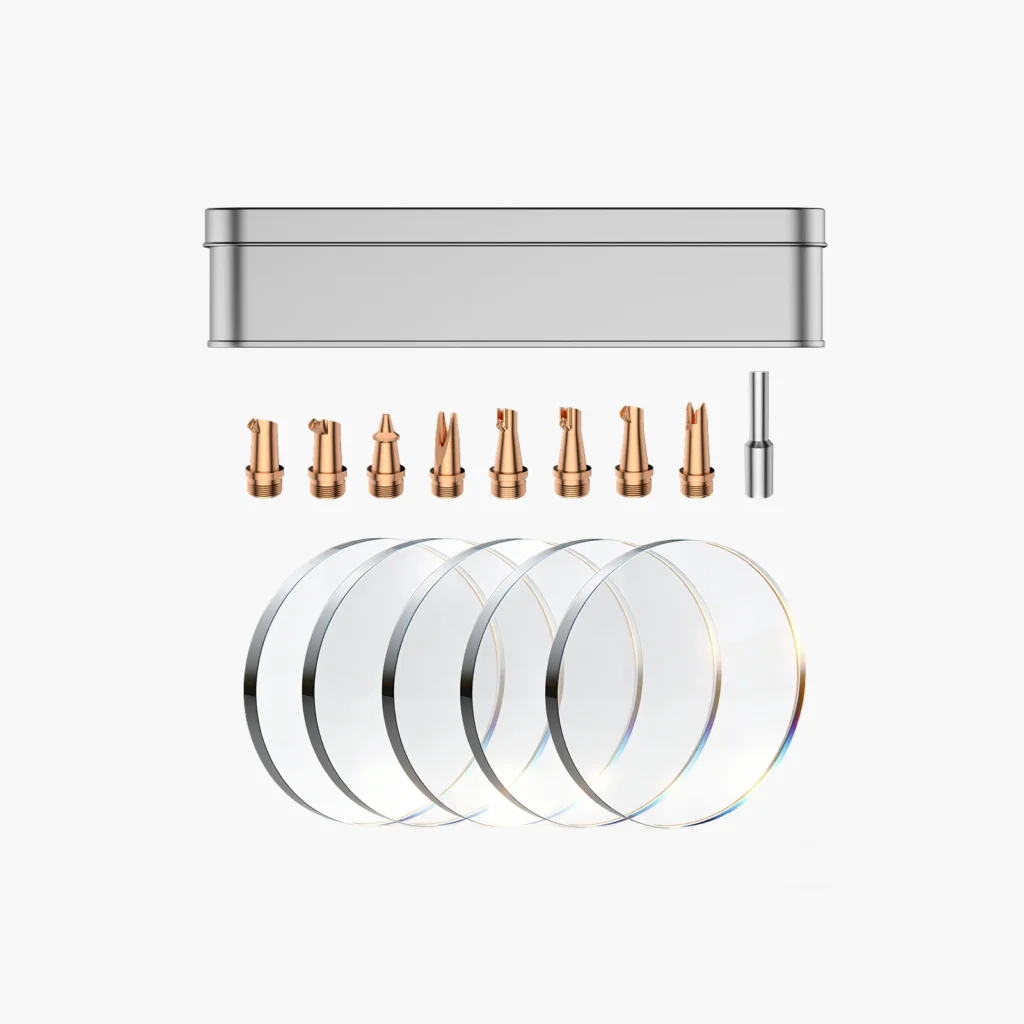
This operational guide details consumable component lifespans, preventative service intervals, and an annualized budget model for 3kW to 12kW fiber laser systems. Benchmarked against factory maintenance records from single-shift (2,000 hr/yr) to continuous double-shift (4,000 hr/yr) operations, this framework enables plant directors to eliminate unplanned optical downtime and preserve machine tool margins.
Ⅰ. Core Optical & Mechanical Consumable Lifespan Matrix
1. Primary Cutting Head Consumables
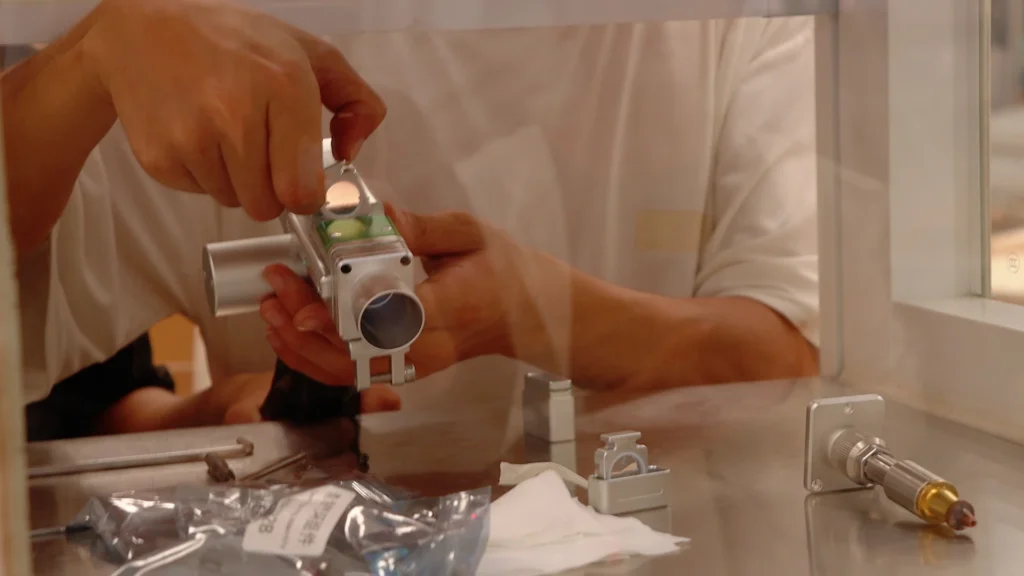
The industrial cutting head relies on three sacrificial front-end components. The precision copper nozzle directs assist gas flow into the kerf. The fused-silica protective window isolates sensitive focusing lenses from spatter. The ceramic ring provides electrical insulation and transmits capacitive height-sensing signals to the CNC.
Each component follows a deterministic wear curve. Copper nozzles average 300 to 500 pierce cycles before thermal erosion degrades orifice roundness. Protective windows endure 200 to 400 beam-on hours given clean assist air. Ceramic rings deliver 500 to 1,000 cutting hours provided mechanical collisions are avoided.
Table 1: Core Consumables Wear Profiles and Replacement Costs
| Consumable Component | Expected Service Life | Unit Cost Benchmark | Primary Failure Mechanism | Immediate Replacement Trigger |
| Single/Double Copper Nozzle | 300–500 pierces (60–120 hrs) | $8–$18 | Orifice thermal deformation, spatter adhesion | Asymmetric kerf, one-sided dross formation |
| Lower Protective Window | 200–400 beam hours | $18–$45 | Fume coating, thermal micro-cracking | Laser power attenuation >5%, focal drift |
| Capacitive Ceramic Ring | 500–1,000 beam hours | $25–$65 | Thermal fatigue, tip collision fracture | Erratic capacitance readings, Z-axis hunting |
| Cabinet/Assist Air Filters | 500–1,000 operating hours | $60–$120 | Particulate saturation, oil buildup | Pressure drop exceeding 0.35 bar across filter |
| Dual-Circuit Chiller Coolant | 6–12 operating months | $40–$90 | Microbial growth, deionization breakdown | Coolant discoloration, conductivity >10 μS/cm |
Cost data reflects industrial OEM replacement components deployed across North American and European standard machine installations.
2. Operational Wear Accelerators
Consumable degradation is governed by operational discipline. Compressed air contamination remains the leading cause of premature failure. Sub-micron oil vapor and residual water droplets coat optical surfaces under assist pressures above 10 bar, triggering localized heat absorption and catastrophic thermal lensing.
Improper piercing parameters rapidly destroy copper nozzles. Inadequate standoff heights during high-pressure piercing allow molten slag to eject vertically into the gas passage, causing immediate internal bore scarring. Maintaining correct piercing heights protects gas flow concentricity and extends nozzle life.
Ⅱ. Single-Layer vs. Double-Layer Nozzle Hydrodynamics & Gas Strategy
Selecting nozzle geometry directly impacts assist gas consumption, kerf dynamics, and consumable longevity. A mismatched nozzle profile accelerates copper erosion and wastes assist gas.
1. The Single Layer Laser Cutting Consumables Solution
أ single layer laser cutting consumables solution utilizes an open internal conduit engineered for non-reactive assist gases (high-purity nitrogen and compressed shop air). Because nitrogen cutting relies on kinetic expulsion rather than chemical reactions, high gas velocity is critical to clear molten alloy before dross adheres.
Single-layer nozzles maintain linear gas acceleration through the kerf with minimal internal stagnation zones. They represent the primary consumable standard when processing thin-to-medium gauge stainless steel, aluminum, and galvanized sheet under pressures between 10 bar and 16 bar.
2. Double-Layer Aerodynamics for Oxygen Cutting
Processing carbon steel plate thicker than 6mm requires a double-layer nozzle design. An internal core nozzle is enveloped by an outer concentric casing to regulate flow turbulence.
This dual-layer structure decelerates center-line oxygen velocity, generating a uniform, laminar assist stream at low pressure (0.5 bar to 1.5 bar). By eliminating turbulent eddies at the surface, it prevents oxygen runaway combustion, keeping molten slag clear of the nozzle bore.
+---------------------------------------------------------------------------------+
|                         NOZZLE HYDRODYNAMIC STRUCTURE                           |
|                                                                                 |
|       SINGLE-LAYER (High-Pressure N2/Air)       DOUBLE-LAYER (Low-Pressure O2)  |
|                  |     |                                   |  |  |              |
|                  |     |                                   |  |  |              |
|                 /       \                                 /  / \  \             |
|                /         \                               /  /   \  \            |
|               (  [Kerf]   )                             (  ( [K] )  )           |
|                \         /                               \  \   /  /            |
|                 =========                                 =========             |
|          Parallel Supersonic Jet                   Concentric Shielded Jet      |
+---------------------------------------------------------------------------------+
Table 2: Single-Layer vs. Double-Layer Nozzle Selection Matrix
| المعلمة | Single-Layer Nozzle | Double-Layer Nozzle | Operational Impact |
| Assist Gas Compatibility | Nitrogen (N₂), Compressed Air | الأكسجين (O₂) | Chemical reaction control |
| Operating Pressure | 10.0–16.0 bar | 0.5–1.5 bar | High kinetic flow vs. gentle laminar feed |
| Target Materials | Stainless steel, aluminum, brass | Carbon steel plate (>6mm) | Burr suppression and oxidation control |
| Typical Orifice Diameter | 1.2mm, 1.5mm, 2.0mm, 2.5mm | 1.0mm, 1.2mm, 1.5mm | Orifice size governs gas flow rate |
| Thermal Erosion Risk | Moderate (back-reflection heat) | High (oxygen combustion spatter) | Dual casing shields inner core orifice |
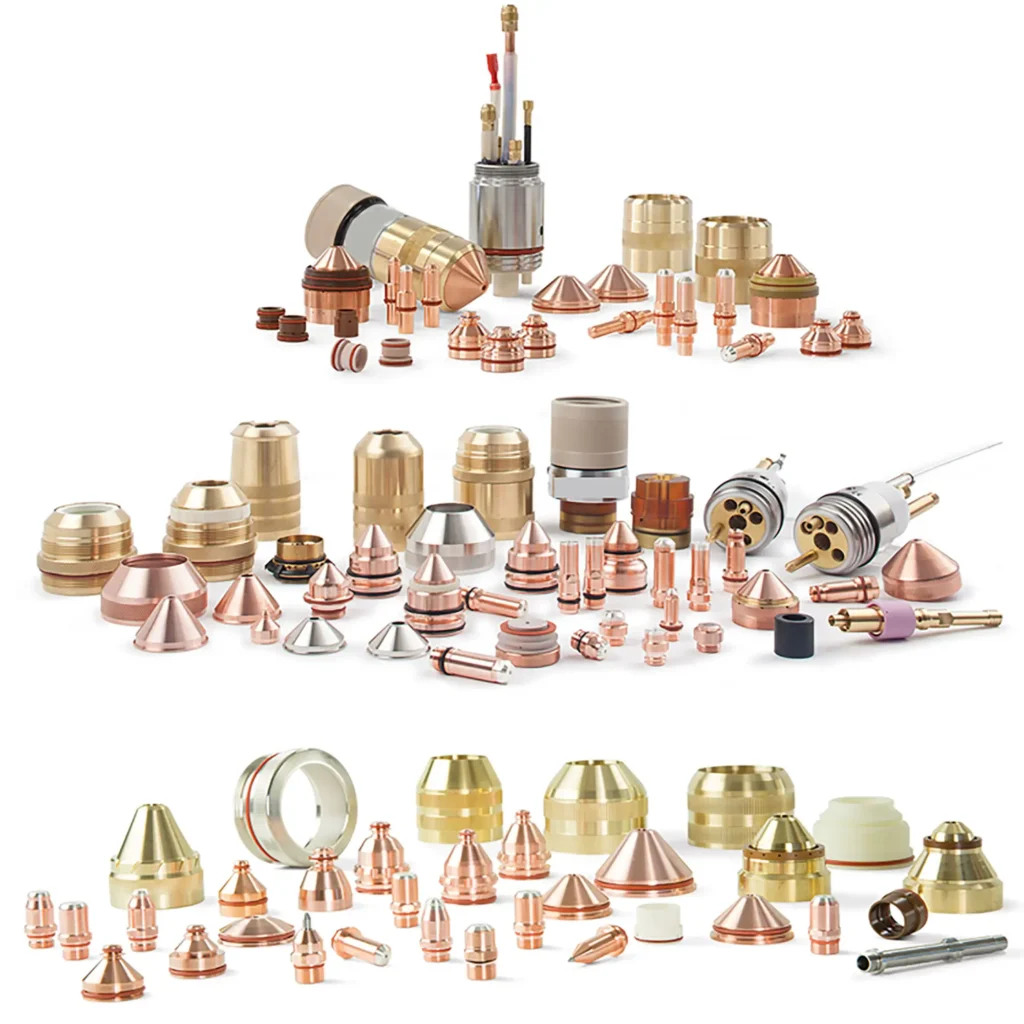
Ⅲ. Quick-Change Architecture: OEE Protection & Labor Reductions
Unscheduled downtime during manual lens inspection or nozzle replacement directly depresses machine Overall Equipment Effectiveness (OEE). High-volume job shops counter this bottleneck by implementing fast change laser cutting consumables mechanisms.
1. Quantifying Manual Changeover Bottlenecks
A conventional cutting head requires operators to stop production, wait for beam purge cycles, unscrew the threaded copper nozzle, and manually extract the protective window drawer using cleanroom finger cots. This routine maintenance takes 8 to 15 minutes per event.
In high-volume facilities performing frequent gauge changes or cutting spatter-heavy carbon plate, operators service consumables 3 to 5 times per shift. The resulting cumulative downtime drains 15 to 30 operating hours per month, stalling billable capacity.
2. Fast-Change Cartridge Mechanics & Pre-Set Tooling
Modern machine architectures eliminate threaded manual bottlenecks using modular, quick-indexing assemblies:
- Pneumatic Cartridge Drawers: Standard threaded retainers are replaced with spring-loaded, double-O-ring sealed sliding drawers. Window inspection and replacement take under 45 seconds while protecting internal optics from ambient airborne dust.
- Pre-Aligned Quick-Clamp Nozzle Adapters: Operators use calibrated quick-release bayonet fittings rather than fine threaded connections, cutting mechanical tip replacement time down to under 30 seconds without galling threads.
- Automated Height Touch-Off Routines: Pre-programmed macro routines execute automatic electrical capacitance homing immediately after a cartridge swap, eliminating manual nozzle centering and Z-axis jogging.
Table 3: Conventional Threaded Swaps vs. Fast-Change Cartridge Systems on OEE
| Operational Metric | Standard Threaded Assembly | Fast Change Cartridge Systems | Production Net Impact |
| Average Nozzle Swap Time | 4.0–6.0 minutes | 0.5–1.0 minute (quick-clamp) | 80% reduction in swap cycle |
| Protective Window Replacement | 8.0–15.0 minutes | 1.5–2.5 minutes (cartridge) | Minimizes cleanroom contamination risk |
| Capacitive Calibration Time | 2.0–4.0 minutes (manual jogging) | 0.3 minutes (automated touch-off) | Repeatable sub-millimeter standoff |
| Monthly Downtime (60–100 events) | 14.0–25.0 machine hours | 2.3–4.0 machine hours | 11.7–21.0 hours recovered |
| Recovered Monthly Capacity | Baseline ($0) | $1,400–$2,520 (at $120/hr shop rate) | Direct contribution to gross margin |
Assumes 60–100 consumable inspection, nozzle alignment, and material gauge changeover events per month in a high-mix production cell.
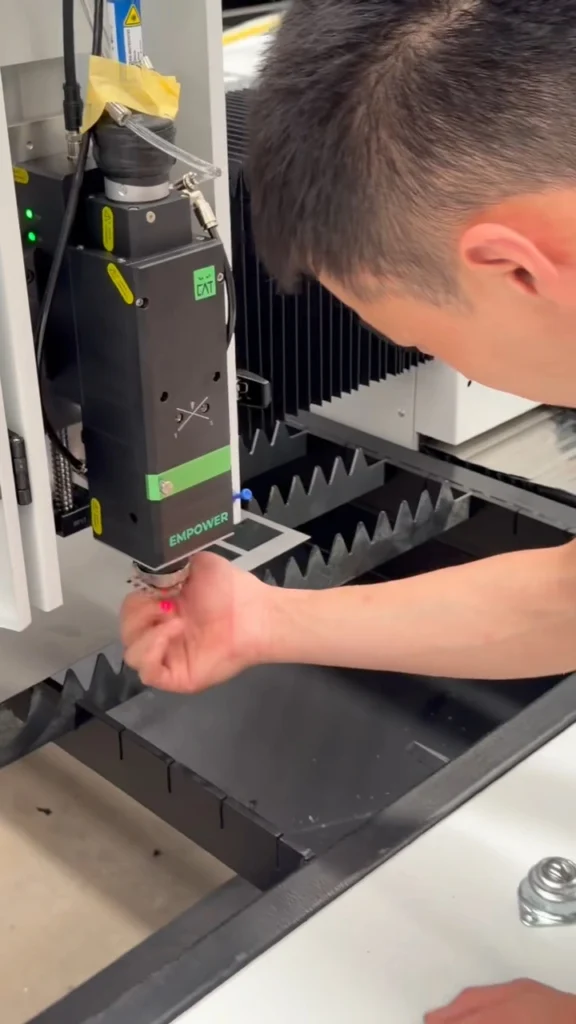
Ⅳ. Preventative Maintenance Intervals for Supporting Subsystems
Cutting head consumables are vulnerable to secondary subsystem failures. Sustaining optical life demands disciplined mechanical and environmental preventive checks.
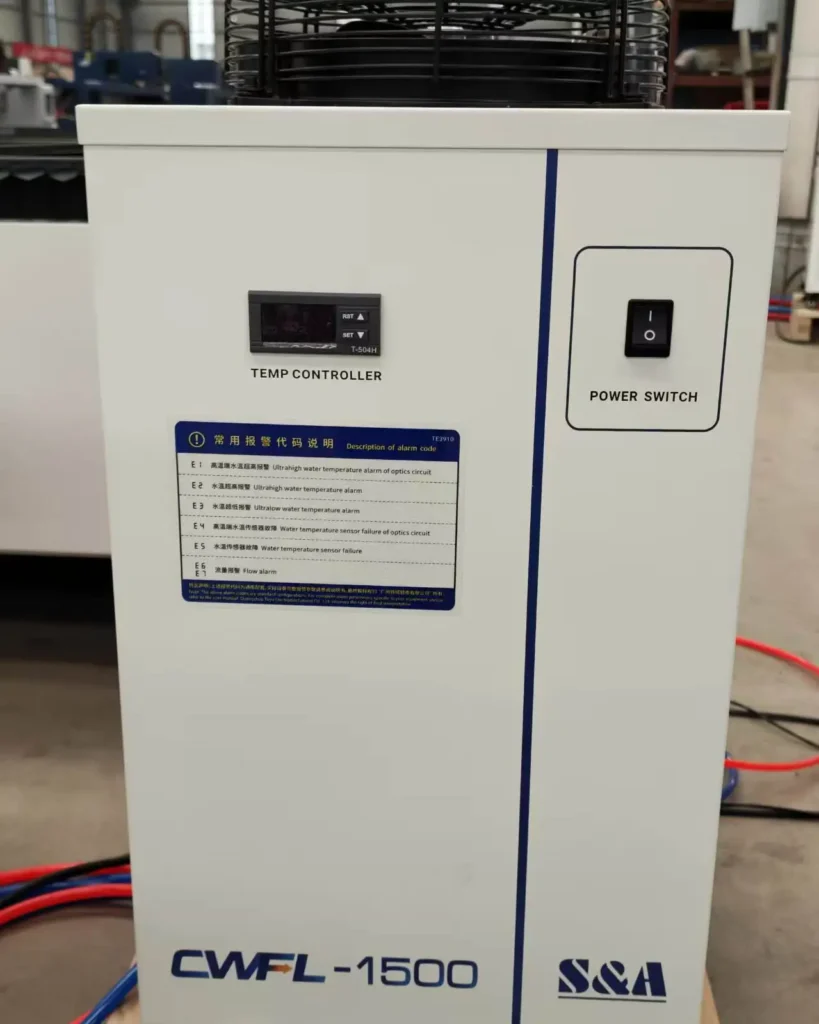
1. Dual-Circuit Industrial Chiller Care
The chiller regulates thermal equilibrium across the laser generator and cutting optics. A thermal divergence exceeding ±1.0°C causes focal length expansion. Operators must inspect reservoir levels and temperature deltas at the start of every shift.
Conductivity must remain below 10 μS/cm to prevent internal galvanic corrosion. Coolant should be flushed every 6 months using pure distilled water and OEM-certified biocides. Condenser fins must be vacuumed monthly to maintain ambient heat dissipation.
2. Gantry Motion Guides & Lubrication Delivery
Precision fiber laser kinematics depend on smooth linear rail and helical rack mechanics. Inadequate lubrication accelerates mechanical backlash, inducing jagged cut profiles and nozzle collisions.
Automatic pump reservoirs require weekly inspections. As detailed in our fiber laser financing guide, machines operating with documented lubrication logs retain up to 30% higher capital residual value in secondary equipment markets.
3. Assist Air Filtration Systems
For shops deploying high-pressure compressed air, multi-stage filtration trains require rigid maintenance. Water separators must purge automatically. The 0.01-micron coalescing oil filters require replacement every 1,000 hours, or immediately upon exhibiting a pressure differential above 0.35 bar. Operating with saturated air filters allows aerosolized oil to degrade lower protective windows within hours.
Table 4: Plant Preventative Maintenance Schedule Matrix
| التردد | Target System | Specific Operational Procedure | Required Service Time |
| Daily (Every Shift) | Cutting Optics & Chiller | Check lower window contamination; verify chiller temp & pressure | 5 minutes |
| Weekly (100 Hours) | Motion Axis & Pneumatics | Inspect guide rail oil films; drain air line water traps; verify oil reservoir | 20 minutes |
| Monthly (400 Hours) | Cooling Fins & Sensor Core | Clean chiller condenser; clean drawer seals; calibrate height sensor | 45 minutes |
| Quarterly (1,200 Hours) | Air Filtration Elements | Replace coalescing and particulate filters; check mechanical backlash | 2–3 hours |
| Bi-Annually (2,400 Hours) | Fluid Circuit | Drain, chemical flush, and refill dual-circuit deionized coolant | 3–4 hours |
Ⅴ. Annual Operating Cost Model: 3kW vs. 6kW vs. 12kW
Consumable costs correlate with laser output power. Higher wattages run thicker materials, generate heavier back-spatter, and demand elevated assist gas pressures.
Table 5: Estimated Annual Consumable Budget Benchmarks Across Power Classes (2,000 Operating Hours)
| Consumable Category | 3kW Baseline Budget | 6kW Production Budget | 12kW Heavy Plate Budget | Operational Cost Driver |
| Cutting Nozzles (Single/Double) | $480–$800 (50–65 units) | $800–$1,350 (75–100 units) | $1,500–$2,400 (120–160 units) | Pierce spatter erosion |
| Protective Windows (Upper/Lower) | $360–$600 (15–22 units) | $550–$900 (22–32 units) | $900–$1,600 (35–55 units) | High-power thermal load |
| Ceramic Rings & Cables | $120–$250 (3–5 units) | $200–$380 (5–7 units) | $320–$550 (7–10 units) | Thermal shock & collisions |
| Gas Filtration Filter Sets | $300–$500 (2 full sets) | $300–$500 (2 full sets) | $450–$750 (3 full sets) | High gas cubic throughput |
| Chiller Coolant & Biocides | $80–$120 (2 flushes) | $100–$150 (2 flushes) | $150–$220 (2 high-volume flushes) | Reservoir fluid capacity |
| Guide Rail Greases & Oils | $120–$180 (bulk grease) | $140–$200 (bulk grease) | $180–$260 (heavy-load oil) | Gantry acceleration load |
| Estimated Annual Subtotal | $1,460–$2,450 / year | $2,090–$3,480 / year | $3,500–$5,780 / year | Direct consumable OpEx |
| Hourly Consumable Allocation | $0.73–$1.23 / hour | $1.05–$1.74 / hour | $1.75–$2.89 / hour | Applied to hourly job quotes |
Estimated annual ranges based on standard single-shift production cycles (2,000 hours/year). Actual expenses scale with pierces per hour, assist gas purity compliance, and material surface scale.
Evaluating the baseline hourly run rate shows that consumables contribute $1.05 to $2.89 per machine hour. When compared to electricity, assist gas, and operator wages, consumables represent 3% to 6% of total operating expenses.
However, ignoring this variable expense causes secondary optical damage. A contaminated protective window can burn through and crack the internal collimating or focusing optics, generating emergency repair bills exceeding $4,500. Evaluating these internal operating dynamics against external subcontracting margins is detailed in our in-house vs outsourcing laser cutting cost evaluation.
Ⅵ. Maintenance FAQ
What is the primary difference between single-layer and double-layer laser nozzles?
Single-layer nozzles are engineered for high-pressure inert gases (nitrogen and compressed air), featuring an open conduit that maximizes kinetic melt ejection on stainless steel and aluminum. Double-layer nozzles feature an internal core that slows oxygen flow, delivering a gentle stream for burning carbon steel without turbulent spatter.
How do fast-change consumable mechanisms improve machine profitability?
Fast-change mechanisms replace threaded components with sealed pneumatic slide drawers and pre-aligned quick-clamp adapters. They reduce nozzle and lens swap downtime from 10 minutes to under 2 minutes, recovering 11 to 21 billable machine hours per month. This recovered capacity directly increases gross manufacturing margins.
Why do lower protective windows experience rapid micro-cracking and burn-through?
Optical windows fail prematurely when assist gas contains trace compressor oil or moisture droplets. These contaminants coat the silica surface, absorbing incoming beam energy. The localized thermal stress produces focal drift, micro-cracking, and burn-through, which can destroy internal focusing optics if ignored.
How much should a job shop budget annually for laser machine consumables?
A standard 3kW to 6kW laser machine running a 2,000-hour annual shift requires an operating consumable budget between $1,500 and $3,500 per year. For higher-power 12kW thick-plate production cells, budgets should scale to between $3,500 and $5,800 annually to account for higher piercing erosion and thermal wear.
Technical Summary
Managing laser cutting consumables is an operational workflow that directly governs machine uptime and margin per part. Implementing a single layer laser cutting consumables solution for high-pressure nitrogen processes optimizes kinetic expulsion, while fast change laser cutting consumables mechanisms protect valuable machine capacity by eliminating manual swap bottlenecks. By standardizing daily lens inspections, monitoring chiller fluid conductance, and budgeting hourly consumable allocations of $1.05 to $2.89 per hour, job shops can protect their optics, eliminate secondary downtime, and maintain competitive quote margins.
المراجع
- ISO 9013:2017 — القطع الحراري — تصنيف القطع الحراري, International Organization for Standardization
- ISO 8573-1:2010 — Compressed air — Contaminants and purity classes, International Organization for Standardization
- Fabricators and Manufacturers Association (FMA) — Laser Operating Cost Benchmarks, FMA Technical Publications
مزيد من القراءة
- Laser Cutting Gas Cost: Nitrogen vs Compressed Air — Comprehensive gas flow and assist pressure economics.
- القطع بالليزر داخليًّا مقابل الاستعانة بمصادر خارجية: التكلفة وعائد الاستثمار — Evaluating operational equipment costs against external subcontractor invoices.
- Fiber Laser Financing: 2026 Equipment Lease vs Buy — Capital leasing structures, depreciation tables, and Section 179 tax treatments.
- تكلفة آلة القطع بالليزر في الساعة: دفتر الأستاذ التشغيلي الكامل — Calculating hourly amortizations, auxiliary equipment power draws, and operational rates.





