

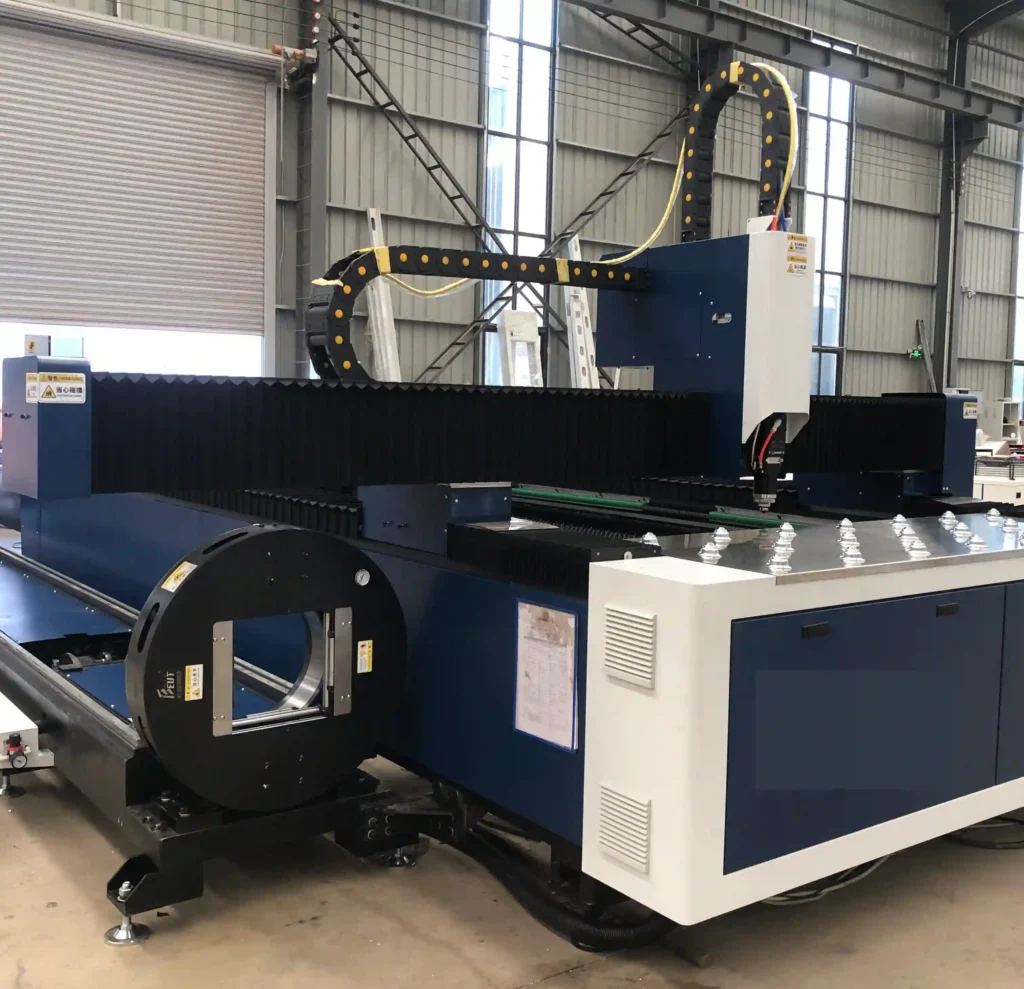
A job shop that cuts 80% flat sheet and 20% tube faces a capital decision that most equipment guides ignore. Buy two machines and double the Capex, the floor space, and the utility draw. Buy one sheet and tube laser cutting machine and accept that the two capabilities share a single beam.
This guide prices both paths. It uses real listing prices from the WSL product catalog, calculates the Capex gap, and models the payback on a single-shift job shop.
Ⅰ. The Job Shop Capital Dilemma: Two Machines vs. One Hybrid Footprint
1. The 80/20 order mix problem
Most job shops do not specialize. They take flat sheet work because it pays the rent, and they take tube work because the customer asked. The tube share is usually 15%–30% of cutting hours. That share is too small to justify a dedicated tube machine, and too large to keep outsourcing.
2. What the two-machine path actually costs
A dedicated 3015 flat sheet machine and a dedicated tube laser are two separate capital purchases. Each carries its own laser source, chiller, CNC controller, and foundation. The combined Capex is $30,000–$44,700, and the combined floor space is 90–120 square meters.
3. What the hybrid path solves
A hybrid laser cutter shares one laser source, one chiller, and one control cabinet across both sheet and tube work. Deploying a dual-capability tube and plate laser cutting machine drops total Capex by 35%–45% and reduces required floor space by roughly 45%. The trade-off is that only one cutting mode runs at a time.
Ⅱ. Three Commercial Price Tiers: What $12,900, $18,800, and $26,800 Actually Buy
1. The $12,900 entry tier
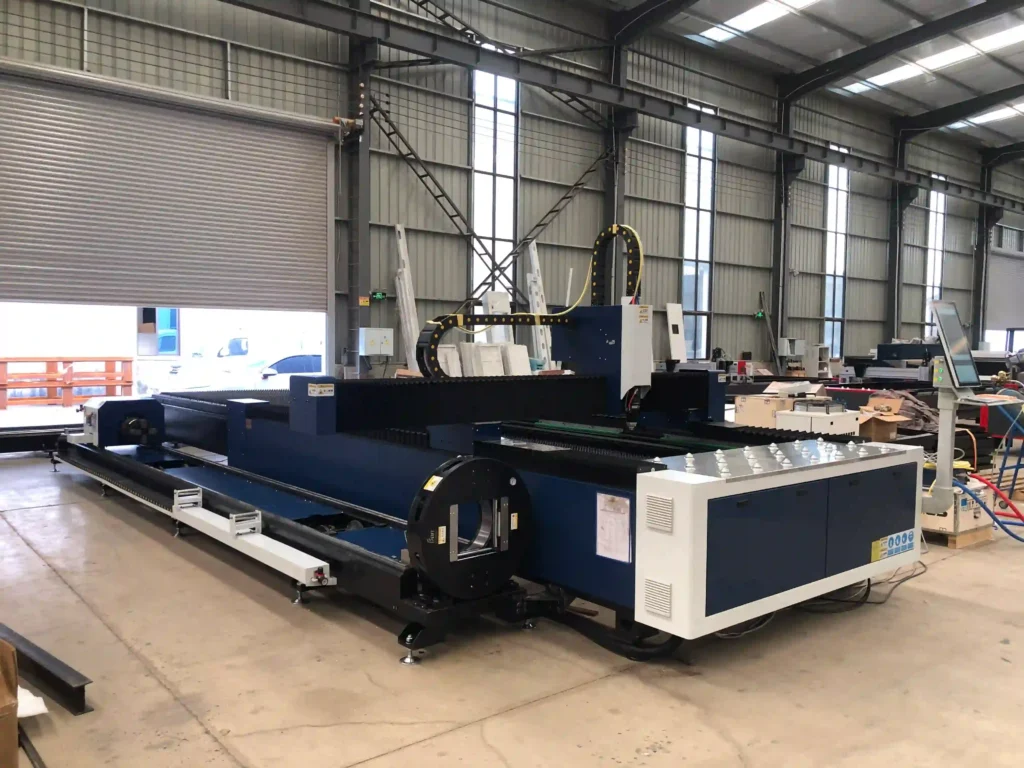
Open-frame single table with a side-mount tube rotary axis. This is the entry point for startups, prototype shops, and low-volume mixed work. It cuts thin to medium sheet and small to medium tube, and it is designed for one-shift operation.
2. The $18,800 enclosed tier
Full enclosure with strong zone-controlled fume extraction. The extra $5,900 buys CE and OSHA compliance, dust isolation from the workshop, and rail protection from spatter. For any shop running more than one shift, or processing galvanized material, this enclosed plate and tube fiber laser cutting machine configuration represents the practical operational baseline.
3. The $26,800 heavy-duty tier
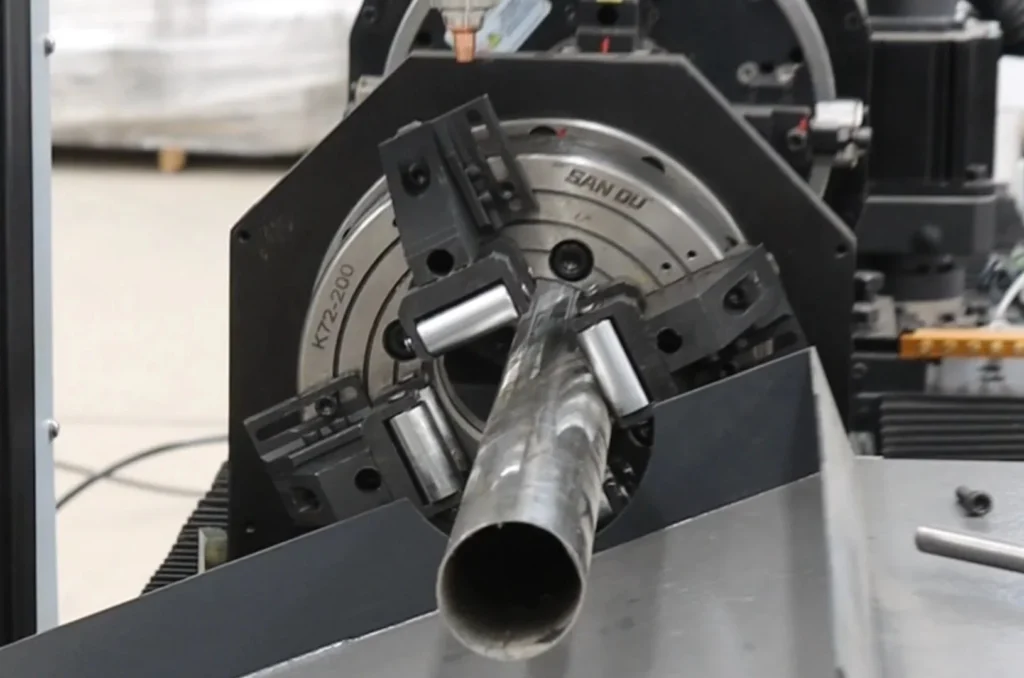
Heavy-duty dual-function frame with a pneumatic self-centering chuck and a reinforced machine base. Similar to the structural engineering required for a 20kW fiber laser cutting machine cost and ROI layout, this tier is built for thick-wall tube and heavy plate cut in continuous production. The pneumatic chuck holds tube rigidity under higher cutting torque, while the base maintains geometric accuracy under sustained thermal load.
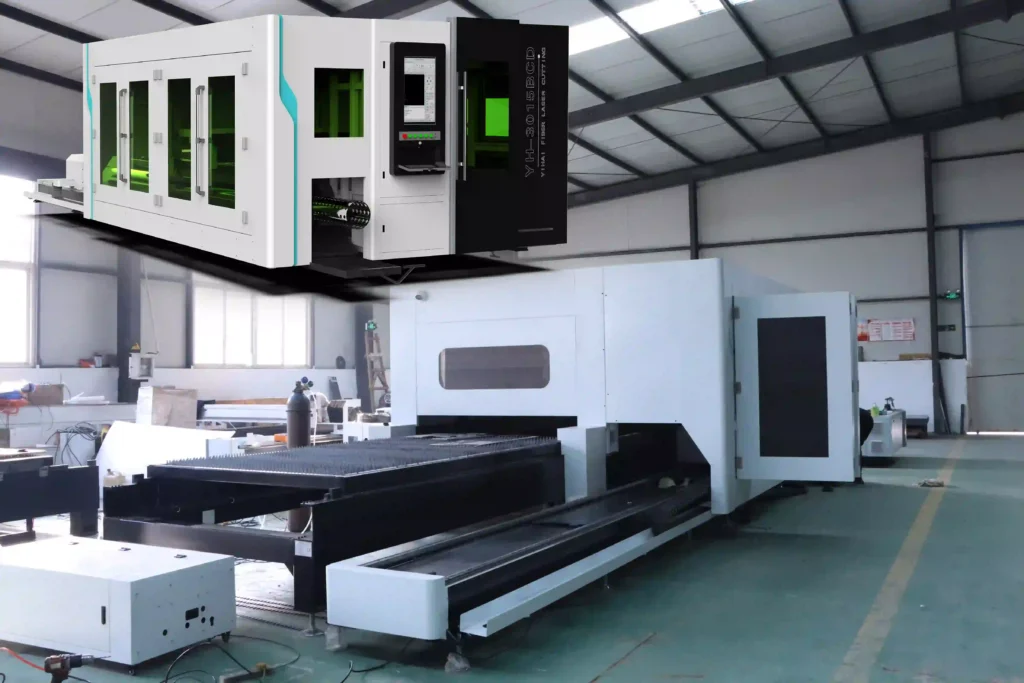
Table 1: Equipment Capex & Technical Specification Matrix across Three Price Tiers
| Parámetro | $12,900 Entry | $18,800 Enclosed | $26,800 Heavy-Duty |
|---|---|---|---|
| Frame type | Abrir una sola mesa | Full enclosure | Reinforced heavy frame |
| Tube axis | Side-mount rotary | Side-mount rotary | Pneumatic self-centering chuck |
| Fume extraction | Basic | Zone-controlled strong draft | Zone-controlled strong draft |
| Compliance | Estándar | CE / OSHA compliant | CE / OSHA compliant |
| Best fit | Startups, prototypes | Multi-shift production | Thick-wall tube, heavy plate |
| Typical duty cycle | Turno único | Dos turnos | Continuo |
Pricing data anchored to published manufacturer catalog configurations (entry open-bed, fully enclosed CE-compliant, and heavy-duty industrial chuck models).
Ⅲ. The Capital Expenditure Benchmark: Hybrid Machine vs. Two Dedicated Cutters
1. The two-machine Capex
A dedicated 3015 exchange-table flat sheet machine lists at $13,900–$17,900. A dedicated two-chuck or professional tube laser lists at $15,800–$26,800. Combined, the two-machine path costs $30,000–$44,700.
2. The hybrid Capex
An all-in-one sheet and tube laser cutting machine at the enclosed tier lists at $18,800. At the heavy-duty tier it lists at $26,800. Both tiers cost substantially less than the most affordable two-machine combination.
3. The net saving
Compared with the two-machine path, the hybrid saves $11,000–$18,000 in equipment purchase alone. That saving does not include the avoided second chiller, second control cabinet, or redundant facility foundation.
Table 2: Comparative Capex, Footprint, and Utility Overhead Benchmark
| Parámetro | Two Dedicated Machines | Hybrid Machine | Diferencia |
|---|---|---|---|
| Equipment Capex | $30,000–$44,700 | $18,800–$26,800 | $11,000–$18,000 saved |
| Laser sources | 2 | 1 | Reduced |
| Chillers | 2 | 1 | Reduced |
| CNC controllers | 2 | 1 | Reduced |
| Floor space | 90–120 m² | 50–65 m² | ~45% saved |
| Transformer load | Higher (two idle draws) | Lower (one idle draw) | Reduced kVA |
Comparative Capex benchmarks derived from standalone platform and dedicated tube cutter catalog pricing. Facility footprint, power draw, and changeover metrics reflect typical job shop operating benchmarks.
Ⅳ. Operational Constraints: Duty Cycles, Beam-On Preemption, and Takt Time Bottlenecks
1. Single-beam preemption
A hybrid machine has one laser source and one cutting head. It cannot cut sheet and tube at the same time. If a sheet job is running, the tube job waits. This is the fundamental constraint that the price tables do not show.
2. Changeover time
Switching from sheet mode to tube mode requires removing the sheet fixtures, mounting the tube chuck, and re-zeroing the rotary axis. The changeover takes 5–8 minutes. On a shop that switches twice a day, that is 10–16 minutes of lost cutting time per day.
3. The 35% decision line
When tube work is under 35% of cutting hours, the hybrid machine’s Capex and footprint savings outweigh the changeover loss. When tube work exceeds 50%, the dedicated tube machine’s higher duty cycle and faster changeover win on OEE. Between 35% and 50%, the decision depends on the shop’s specific order mix.
Table 3: Operational Constraints & Changeover Impact on OEE
| Factor | Hybrid Machine | Two Dedicated Machines |
|---|---|---|
| Parallel production | No (single beam) | Yes (two beams) |
| Changeover time | 5–8 min per mode switch | No aplicable |
| Daily changeover loss (2 switches) | 10–16 min | 0 min |
| Best tube share | Under 35% | Over 50% |
| OEE at 20% tube share | Higher (less idle) | Lower (tube machine idle) |
| OEE at 60% tube share | Lower (changeover drag) | Higher (dedicated duty) |
Facility footprint, power draw, and changeover metrics reflect typical job shop operating benchmarks.
Ⅴ. Facility Overhead & Footprint Savings: Slashing Shop Rent and Electrical Draw
1. Rent equivalent
At a typical industrial rent of $8–$15 per square meter per month, saving 40 square meters saves $320–$600 per month, or $3,840–$7,200 per year. Over a five-year horizon, that is $19,200–$36,000 in avoided rent.
2. Electrical draw
Two machines mean two chillers idling overnight, two control cabinets on standby, and two sets of servo drives holding position. The hybrid machine has one of each. The idle draw difference is small per hour, but it accumulates across 8,760 hours per year.
3. Consumable inventory
Two machines mean two sets of nozzles, two sets of protective lenses, two sets of ceramic rings, and two sets of tube chuck jaws. The hybrid machine carries one set of each, which halves the consumable inventory and the cash tied up in spare parts.
Ⅵ. Financial Payback Modeling: Net Cash Flow and Payback Horizon
1. The baseline scenario
A single-shift job shop with a 20% tube share. The shop was previously outsourcing tube work at $2,500 per month and cutting sheet on an older machine with rising maintenance costs.
2. The monthly cash flow
After the hybrid purchase, the outsourced tube work moves in-house. The monthly outsourcing bill of $2,500 is replaced by roughly $600 in operating cost (power, gas, consumables, and operator time). The monthly net cash gain is $1,900, plus the maintenance savings on the older sheet machine.
3. La amortización
At an $18,800 purchase price financed over 48 months, the monthly payment is roughly $470. The $1,900 monthly cash gain covers the payment with $1,430 to spare. The cumulative cash position reaches breakeven against the total purchase price in 10–14 months.
Table 4: Financial Payback Modeling across Production Scenarios
| Scenario | Monthly Cash Gain | Monthly Financing | Net Monthly Cash | Payback Horizon |
|---|---|---|---|---|
| Single shift, 20% tube | $1,900 | $470 | +$1,430 | 10-12 meses |
| Single shift, 35% tube | $3,200 | $470 | +$2,730 | 7–9 months |
| Two shifts, 20% tube | $3,800 | $470 | +$3,330 | 5–7 months |
Based on typical job shop equipment capital expenditure benchmarks. Financing assumes 48-month term at 8.5% APR.
Ingeniería / Dictamen de inversión
A sheet and tube laser cutting machine is not the right answer for every shop. It is the right answer when three conditions are met: tube work is under 35% of cutting hours, the shop cannot justify two dedicated machines, and floor space or electrical capacity is constrained.
Before signing a purchase order, verify four things: the actual tube share of the shop’s cutting hours, the tube diameter and wall thickness range the machine must handle, the changeover time on the specific model under consideration, and the foundation and electrical requirements for the chosen tier.
At WSL, the sheet and tube machine is specified against the shop’s actual order mix. The machine is not sold as a generic entry-level unit. It is configured to the sheet-to-tube ratio the shop actually runs.
Preguntas frecuentes (FAQ)
What is the primary operational trade-off of a sheet and tube laser cutting machine?
The primary operational trade-off is single-beam preemption. Because the machine shares one laser cutting head and optical path across both the flat cutting bed and the rotary tube axis, it cannot cut plate and tube simultaneously. If flat sheet cutting is active, tubular jobs must wait in the production queue, and vice versa.
How long does a changeover take between sheet and tube cutting modes?
On modern hybrid fiber laser cutters, mechanical and software changeover typically takes 5 to 8 minutes. The process involves clearing the flat sheet bed clearance, positioning or mounting the pneumatic chuck/tailstock, loading the profile tubing, and calling up the respective rotary CNC origin offset within the controller.
Can a sheet and tube laser cut square and rectangular tubing, or only round pipes?
Yes. The pneumatic self-centering rotary chucks equipped on standard and heavy-duty hybrid tiers can process round pipe, square tubing, rectangular profiles, and oval structural sections. Standard configurations typically support tube outside diameters ranging from 20 mm up to 220 mm (or up to 350 mm on reinforced heavy-duty models).
At what tube production volume should a job shop invest in a dedicated tube laser instead?
A job shop should transition from a hybrid machine to a dedicated tube laser cutter when tubular cutting exceeds 35% to 50% of total weekly cutting hours. At that threshold, the accumulated changeover downtime and the inability to run concurrent sheet and pipe orders begin to degrade overall shop OEE (Overall Equipment Effectiveness), justifying the higher standalone Capex.
Is an enclosed sheet and tube laser machine necessary, or is an open-bed model sufficient?
An open-bed configuration ($12,900 tier) is suitable for low-volume prototyping, R&D labs, or single-shift shops with strict budget constraints. However, multi-shift production facilities cutting reflective metals, galvanized stock, or thick alloy tubing should select a fully enclosed model ($18,800+ tier) to ensure compliance with OSHA and CE laser radiation safety standards and to isolate toxic fume particulates from the general workshop environment.
Referencias
- ISO 9013:2017 — Corte térmico — Clasificación de los cortes térmicos, ISO, 2017 , ISO, 2017
- 29 CFR 1910.176 — Manipulación de materiales — Disposiciones generales, Código Electrónico de Normativa Federal (eCFR)
- Artículo 179 del IRS: Opción de contabilizar como gasto determinados activos empresariales amortizables, Servicio de Impuestos Internos
Lecturas recomendadas
- Máquina de corte por láser de fibra de 20 kW: coste y amortización — The high-power capex model applied to thick plate.
- Precio de una máquina de corte por láser para tubos: guía sobre el coste y la amortización de los paquetes combinados — Dedicated tube machine pricing and payback.
- Coste por hora de una cortadora láser: el libro mayor de operaciones completo — The hourly operating cost behind every payback model.
- Corte por láser interno frente a externalizado: coste y retorno de la inversión — When bringing work in-house beats subcontracting.





