

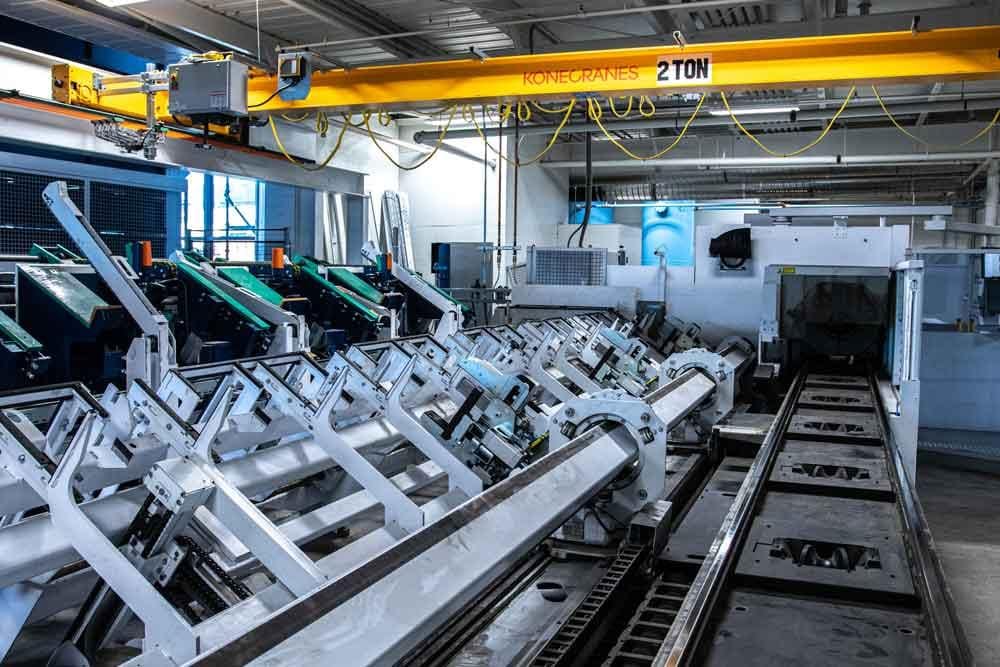
Laser load and unload automation is the option most tube laser buyers defer. The cutting head is fast, the nesting software is efficient, and the machine looks complete without it. What the quote does not show is the operator standing next to the machine for 45–75 seconds every cycle, waiting for the crane, aligning the tube, and pushing it into the chuck.
This guide prices that labor, calculates the cycle time difference, and models the payback on a $40,000 bundle loader across three production tiers.
Ⅰ. The Material Handling Bottleneck: Why Manual Tube Loading Caps Machine ROI
1. The cutting head is not the constraint
When evaluating baseline Prix d'une machine de découpe laser pour tubes models, a standard machine processes a 6-meter tube in roughly 4.16 minutes. However, the throughput bottleneck is rarely the resonator; it is the physical handling step before and after each cycle. Without dedicated laser load and unload automation, manual crane positioning, profile alignment, and chuck staging consume 45–75 seconds per tube.
2. Why idle time costs more than it looks
Every second of idle time carries the machine’s full hourly cost: depreciation, financing, floor space, and the operator’s wage. A machine that runs 4.16 minutes of cutting out of a 5-minute cycle is producing at 83% of its potential. The lost 17% is not recoverable later in the shift.
3. The compound effect of bundle loading
A bundle loader does not reduce the cut time. It reduces the handling time to 12–18 seconds, synchronized with the rear chuck retraction so the wait is nearly zero. The cycle compresses from 4.91–5.41 minutes to 4.36–4.46 minutes. On a 500-ton annual volume, that is hundreds of hours recovered.
Ⅱ. Manual Loading vs. Automatic Bundle Loading: Cycle Time & Mechanism Breakdown
1. The manual cycle
The operator uses an overhead crane to lift one tube, aligns the profile orientation, pushes the tube into the front chuck, and waits for the rear chuck to close. The sequence requires coordination between the crane operator and the machine operator. At 45–75 seconds per tube, the manual auxiliary time adds 0.75–1.25 minutes to the 4.16-minute cut.
2. The automatic cycle
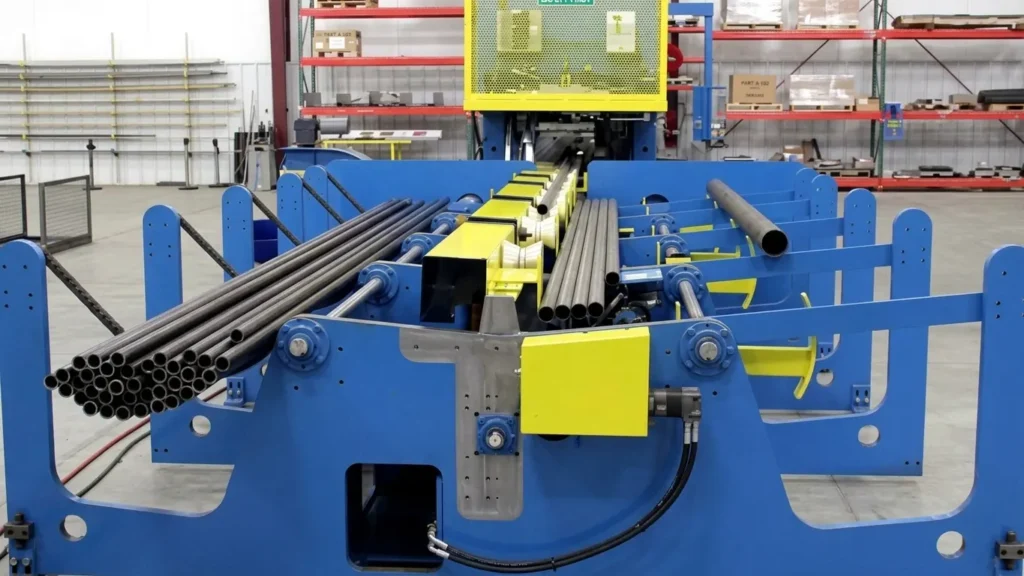
A bundle loader stores 3–5 tons of loose tube in a 6-meter magazine. A chain sorter lifts individual tubes, a servo pusher feeds them into the chuck, and the rear chuck retracts in sync with the feed. The cycle time is 12–18 seconds, and it overlaps with the rear chuck motion, so the operator does not wait.
3. What the mechanism replaces
The bundle loader replaces the crane lift, the manual alignment, and the operator’s presence during loading. It also removes the 15–20 minute machine stop that occurs every time a new bundle is staged manually, because the loader can hold multiple hours of runtime in a single charge.
Table 1: Tube Loading Cycle Time & Operator Allocation Benchmark
| Cycle Element | Manual Loading | Automatic Bundle Loader | Difference |
|---|---|---|---|
| Pure cutting time | 4.16 min | 4.16 min | 0 |
| Loading auxiliary time | 0.75–1.25 min | 0.20–0.30 min | 0.55–0.95 min saved |
| Total cycle time | 4.91–5.41 min | 4.36–4.46 min | ~0.55–0.95 min saved |
| Operators required | 2 (machine + auxiliary) | 1 (machine only) | 1 operator released |
| Bundle change stop | 15–20 min per bundle | Not applicable | Eliminated |
Ⅲ. Labor Economics: Direct Wage Elimination and Crane Utilization
1. The auxiliary operator
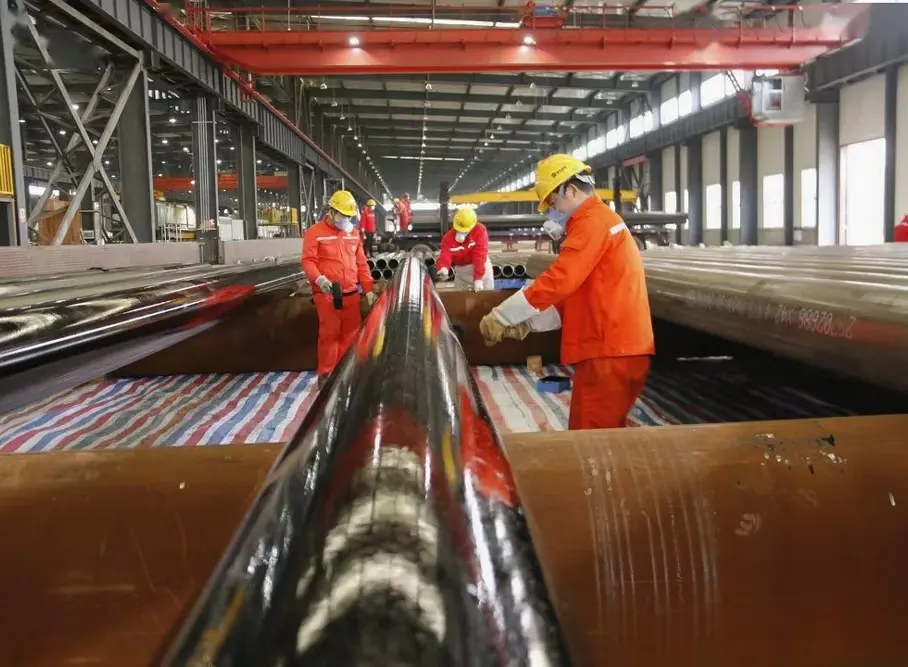
Manual tube loading requires a second person — the auxiliary loader — who works with the machine operator to position and feed tubes. The fully loaded annual cost of this position is $42,000–$50,000, including base wages, benefits, payroll taxes, and workers’ compensation insurance (US manufacturing benchmark).
2. Crane and forklift hours
The auxiliary operator also occupies the overhead crane and the forklift during loading. On a busy shop floor, crane time is a shared resource. Releasing the crane from tube loading frees it for other material movement across the shop.
3. Injury risk and insurance
Tube handling is one of the higher-risk manual tasks in a fabrication shop. Eliminating the manual lift reduces the exposure that drives workers’ compensation premiums. The premium reduction is not immediate, but it accumulates over years.
Table 2: Annual Labor & Material Handling Cost Comparison
| Cost Category | Manual Loading | Automatic Bundle Loader | Différence annuelle |
|---|---|---|---|
| Auxiliary operator (fully loaded) | $42,000–$50,000 | $0 | $42,000–$50,000 saved |
| Crane and forklift hours | Plus élevé | Inférieur | Indirect |
| Workers’ comp exposure | Plus élevé | Inférieur | Long-term |
| Loader maintenance | $0 | $1,500–$2,500/year | +$1,500–$2,500 |
| Net annual labor saving | — | — | $39,500–$48,500 |
Ⅳ. Capacity Expansion & Per-Tube Machining Cost Matrix
1. Capacity without capital
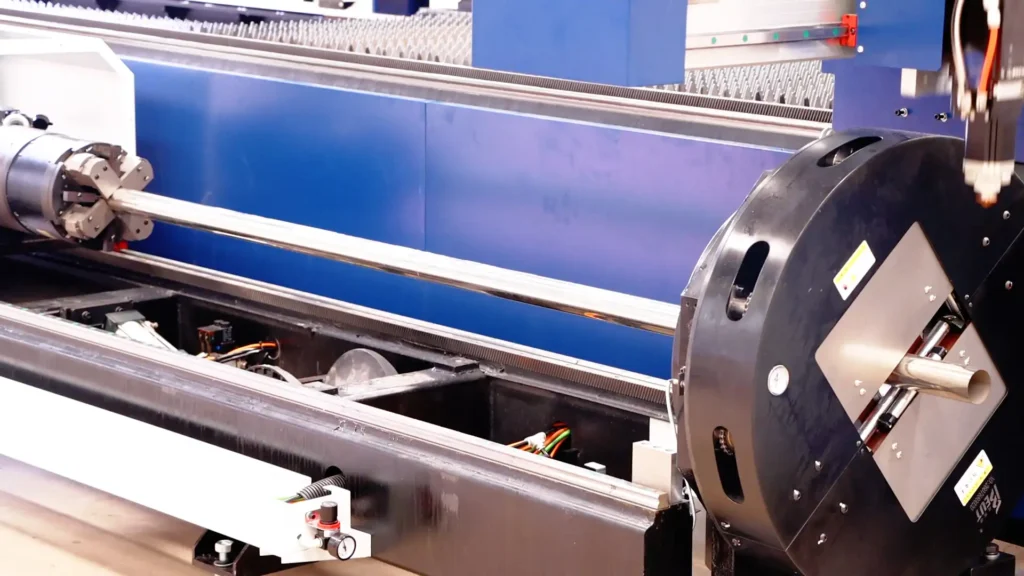
Investing in tube laser automation does not require additional square footage for a secondary system; it recovers the trapped capacity of your existing machine. Implementing laser load and unload automation raises effective beam-on cutting time from 83% to nearly 95%, expanding total structural throughput by 15%–20% without a second capital purchase.
2. Per-tube cost dilution
The fixed cost per machine hour — depreciation, financing, floor space, and base labor — is unchanged. The number of tubes processed in the same hour increases. The fixed cost is therefore spread across more tubes, and the per-tube cost falls.
3. The annual tonnage effect
At 500 tons per year, the capacity gain translates directly into more tubes processed in the same hours. At 1,500 tons, the gain fills the second shift without adding a second operator. At 3,000 tons, the loader becomes the difference between running three shifts or investing in a second machine.
Table 3: Per-Tube Processing Cost & Annual Capacity Expansion
| Annual Volume | Manual Tubes/Hour | Auto Loader Tubes/Hour | Capacity Gain | Annual Tubes Added |
|---|---|---|---|---|
| 500 t | ~11.7 | ~13.5 | +15% | ~4,300 |
| 1,500 t | ~11.7 | ~13.5 | +15% | ~13,000 |
| 3,000 t | ~11.7 | ~13.5 | +15% | ~26,000 |
Tubes per hour are derived from the cycle times in Table 1. Annual tubes added assumes the same operating hours with the loader in place.
Ⅴ. Payback Period & Breakeven Model across Three Tonnage Scenarios
1. The capex
The bundle loader capex delta is $40,000. This is an industry benchmark estimate for a 6-meter, 3–5 ton magazine with chain sorting, tube diameter and wall thickness sensing, and a servo pusher. It is not a supplier quote.
2. The annual benefit
The primary benefit is the released auxiliary operator: $42,000–$50,000 per year. The secondary benefit is the capacity expansion: the same machine produces 15% more tubes per hour. The tertiary benefit is reduced crane and forklift contention, which is real but hard to quantify.
3. The payback
At 500 tons per year, the loader pays back in roughly 11–12 months on labor alone. At 1,500 tons, it pays back in 10–11 months, with the capacity gain accelerating the return. At 3,000 tons, the payback is fastest, and the loader becomes the precondition for running three shifts without a second machine.
Table 4: Automatic Bundle Loader Capex Payback Matrix
| Annual Volume | Annual Labor Saving | Annual Maintenance | Net Annual Benefit | Simple Payback |
|---|---|---|---|---|
| 500 t | $42,000–$50,000 | $1,500–$2,500 | $39,500–$48,500 | 10–12 months |
| 1,500 t | $42,000–$50,000 | $1,500–$2,500 | $39,500–$48,500 + capacity | 10–11 months |
| 3,000 t | $42,000–$50,000 | $1,500–$2,500 | $39,500–$48,500 + capacity | 9–11 months |
Payback is simple (capex ÷ net annual benefit) and excludes Section 179 treatment. The capacity gain is not monetized in the payback calculation, so the actual payback is faster for shops that fill the added capacity.
Ⅵ. Commercial Buyer’s Checklist: Tube Geometry Limits & Workshop Layout
1. Tube geometry adaptation
A bundle loader must handle the tube profiles the shop actually cuts. Round and square tube in volume are the easiest. Rectangular, angle, and channel require a chain sorter designed for the specific profile mix. Before purchase, confirm the loader’s rated profile range matches the shop’s actual production.
2. Workshop layout and clear height
A 6-meter bundle magazine occupies floor space and requires overhead clearance for the crane that loads it. Verify that the magazine footprint fits the available floor area and that the crane can reach the magazine opening without exceeding its safe working load.
3. Integration with the existing machine
While an automatic bundle loader can be retrofitted to select tube laser cutting machine platforms, configuring it during initial machine commissioning ensures seamless rear chuck synchronization, CNC bus integration, and dual-zone safety interlock compliance.
Frequently Asked Questions (FAQ)
How much labor does an automatic bundle loader actually eliminate on a tube laser?
An automatic bundle loader replaces the continuous manual material handling typically performed by 1.5 to 2 dedicated material handlers across multiple shifts. Instead of workers using overhead cranes, slings, or forklifts to stage individual pipes every 2 to 4 minutes, a crane loads an entire raw tube bundle (up to 3–5 tons) into the storage magazine in 10 to 15 minutes. A single operator can then oversee cutting operations, reducing dedicated loading labor hours by 60% to 75%.
What is the cycle time difference between manual tube loading and automatic bundle feeding?
Manual loading and alignment of a single 6-meter (20 ft) tube into a laser chuck requires 90 to 150 seconds, during which the laser beam sits completely idle (Beam-off time). An automated bundle loader uses motorized separating belts, pneumatic singulation arms, and automated optical seam/weld detectors to pre-stage the next tube while the current tube is cutting. Tube-to-tube transfer downtime drops to 15–25 seconds, boosting overall machine Beam-on duty cycles from ~45% to over 80%.
Can an automatic bundle loader handle asymmetric or open profiles like angle iron and channels?
Standard gravity-assist or nylon-belt bundle loaders are optimized for closed symmetrical geometries: round pipes, square tubes, and rectangular structural profiles. For asymmetric shapes, C-channels, angle iron, or oval profiles that tend to interlock and jam during gravity separation, shops require an advanced loader equipped with servo-driven singulation fingers or dedicated chain-separation magazines with specialized gripper tooling.
How does automated bundle loading handle bowed, twisted, or out-of-round raw tubes?
Industrial bundle loaders incorporate mechanical self-centering V-rollers and pneumatic intermediate support arms along the loading bed to prevent sagging. Prior to chuck handoff, laser line sensors or machine-vision optical cameras scan the tube length to measure bow tolerance (camber) and rotationally align the weld seam. If a tube exceeds structural straightness tolerances (typically >2 mm per meter), the CNC controller pauses feeding and alerts the operator to avoid chuck collision.
What is the typical capital payback period for adding a bundle loader to a tube laser?
For a production job shop or OEM operating on a two-shift schedule (cutting 3,000 to 4,000 tube hours annually), an automatic bundle loader carries a typical Capex of $25,000 to $45,000. Through the combined elimination of roughly $40,000–$65,000 in annual material handling wages and a 30%–45% increase in shift output capacity, most shops achieve full capital payback within 8 to 14 months.
Références
- ISO 9013:2017 — Thermal cutting — Classification of thermal cuts, ISO, 2017
- 29 CFR 1910.176 — Handling materials — general, Electronic Code of Federal Regulations (eCFR)
- Article 179 de l'IRS — Option permettant de passer en charges certains actifs d'exploitation amortissables, Administration fiscale américaine (Internal Revenue Service)
Pour en savoir plus
- Prix des machines de découpe laser de tubes : guide sur les coûts et le retour sur investissement des formules combinées — The machine price that the loader attaches to.
- Tube Laser Cutting Machine: Zero-Tailing Chuck ROI & Scrap Reduction — Material recovery on the same machine platform.
- Coût horaire d'une découpeuse laser : le registre complet des coûts d'exploitation — The hourly cost that idle time erodes.
- Financement des lasers à fibre : location ou achat d'équipements en 2026 — Monthly payment structures and Section 179 treatment.





