
In the agricultural machinery manufacturing sector, fabrication profiles are dictated by extreme structural loads. Equipment builders process heavy-gauge Q355B structural plates for planter frames and combine chassis, alongside high-tensile wear plates (such as Hardox 450 and 500) for soil-engaging tools and grain handling liners.
Historically, agricultural OEMs and specialized job shops have relied on high-definition plasma for thick plate cutting. However, as the demand for robotic welding and faster assembly cycles increases, the hidden costs of plasma become a severe bottleneck. Secondary edge grinding, heat-affected zone (HAZ) hardening, and external processing lead times cut deep into profit margins.
This operational ledger analyzes the transition from outsourced plasma to in-house farm equipment laser cutting. We break down the capital expenditure (CapEx) of a heavy-duty 12kW workstation, the factory floor infrastructure required, and the exact Total Cost of Ownership (TCO) model for replacing plasma with high-power fiber lasers.
Ⅰ. The Ag Fabrication Bottleneck: Outsourced Plasma vs. Farm Equipment Laser Cutting
When agricultural chassis components (6mm to 16mm) are outsourced for plasma cutting, the manufacturer loses control over the supply chain. A standard 7 to 10-day lead time can stall the main assembly line, causing massive OEE (Overall Equipment Effectiveness) losses.
More critically, plasma cuts leave a heavily oxidized, hardened dross edge. To prepare these parts for robotic welding, operators must manually grind the edges—a process that consumes 12 to 18 minutes per meter. This secondary grinding labor is a massive recurring expense that rarely appears on the initial plasma quote.
2. Why Hardox and high-tensile steels demand fiber precision
For soil-engaging tools like plow shares and cultivator sweeps, agricultural manufacturers use Hardox 450/500. If cut with plasma or oxygen, the intense heat input creates a brittle martensitic layer that leads to micro-cracking under field stress.
A 12kW fiber laser using high-pressure nitrogen eliminates this. The laser produces a highly focused beam that melts and ejects the steel with minimal thermal input. The cut edge complies with ISO 9013 Range 2, ensuring the HAZ remains under 0.2mm. The part retains its original toughness and is ready for direct-to-robot fit-up, eliminating manual bevel grinding entirely.
Table 1: Agricultural Steel Processing Ledger: Plasma Outsource vs. 12kW In-House
| Cost / Operational Metric | Outsourced Plasma (Incl. Grinding) | In-House 12kW Fiber Laser | Financial Impact |
|---|---|---|---|
| Cutting Cost per Ton | $120 – $180 / ton | $45 – $60 / ton | Significant OpEx reduction |
| Secondary Grinding Labor | 12 – 18 min/meter (High) | 0 min/meter (Direct-to-weld) | Eliminates manual edge prep |
| Lead Time & WIP | 7 – 10 days | Hours (On-demand) | Slashes work-in-progress inventory |
| Robotic Weld Fit-Up | Poor (Wide gaps) | Excellent (Tight gaps) | Reduces weld wire and cycle time |
| Robotic Weld Rework Rate (Hardox) | 8% – 12% joint defect / cracking rate | < 0.5% (Zero secondary edge cracking) | Saves $14,000+ annually in NDT weld repairs |

Ⅱ. 12kW Workstation Sizing: Infrastructure & Crane Logistics
1. Footprint and civil foundation
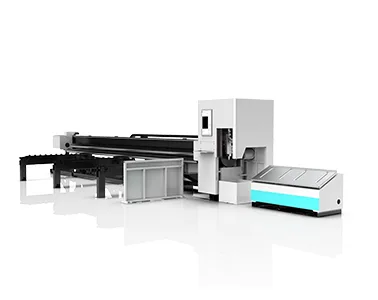
Agricultural chassis frames often span 4 to 6 meters. This requires a large-format machine bed, such as the 3kW-12kW plate and tube fiber laser cutting machine (YH6025 format). The machine’s operating footprint is approximately 32.53 m², with a machine weight exceeding 5,500 kg.
To prevent foundation settlement and vibration distortion, the floor must be reinforced with a 250mm–300mm double-layer rebar grid, capable of supporting 5 tons/m². If the machine is installed near heavy stamping presses, an isolation trench is highly recommended.Proper slab reinforcement ensures high-yield farm equipment laser cutting even under 24/7 dual-shift operations.
2. Overhead crane and material handling
Handling standard 6000mm × 2500mm steel plates for agricultural chassis requires careful space planning. The overhead crane hook must maintain a clearance of at least 4.5 meters to the floor to safely use vacuum suction lifters without hitting the laser’s protective enclosure.
Table 2: Workshop Infrastructure & Utility CapEx (6025 Format)
| Infrastructure Item | Requirement / Specification | CapEx Implication |
|---|---|---|
| Machine Footprint | ~32.53 m² (Operating) | Requires clear crane access aisles |
| Foundation Slab | 250mm reinforced concrete, isolated | Civil engineering cost: $8,000 – $15,000 |
| Transformer Capacity | 125 kVA – 150 kVA | Higher power draw vs. plasma |
| Overhead Crane | 10-ton capacity, 4.5m hook clearance | Essential for 6m plate loading |
| Extraction & Chiller | 85 – 110 kW total continuous load | Requires dedicated utility zone |

Ⅲ. Heavy Plate Utility & Assist Gas OpEx
1. Energy and consumable overhead
A 12kW fiber laser has a high electrical draw. However, when calculating the OpEx per meter, the massive reduction in secondary grinding more than compensates for the electricity cost. The consumables (nozzles, protective lenses, ceramic rings) average roughly $3.50 to $6.00 per machine hour, depending on the pierce frequency.
2. Assist gas strategy: Oxygen vs. high-pressure air
For cutting mild carbon steel (Q355B) up to 12mm, a high-pressure compressed air system (16 Bar, dried and filtered to ISO 8573-1 Class 1.2.2) can reduce gas costs by 70% compared to bottled oxygen or nitrogen.
However, for Hardox 450 and thick stainless steel, high-purity nitrogen (N₂ ≥ 99.99%) is mandatory to prevent edge oxidation and preserve the HAZ properties.
Table 3: OpEx Matrix for 12kW Cutting (16mm Hardox vs. 12mm Q355B)
| Gas Type | Material / Thickness | Gas Cost / Meter | Speed (m/min) | OpEx / Meter (Incl. Power) |
|---|---|---|---|---|
| High-Pressure N₂ | 16mm Hardox 450 | $1.80 – $2.50 | 1.2 – 1.8 | $3.20 – $4.50 |
| High-Pressure Air | 12mm Q355B | $0.15 – $0.25 | 2.5 – 3.5 | $0.80 – $1.20 |
| Oxy (O₂) | 12mm Q355B | $0.40 – $0.60 | 3.0 – 4.0 | $1.10 – $1.60 |

Ⅳ. Capital Expenditure & Financial Payback Ledger
1. The in-house tipping point
Deploying an in-house farm equipment laser cutting cell eliminates the 12% to 18% contractor markup typically added to outsourced chassis and toolbar orders. For agricultural OEMs evaluating this transition, our previous operational review on laser vs plasma cutting thick plate TCO outlines the fundamental baseline differences between the two processes. Beyond component markup, relying on external cutting lines creates scheduling friction and expensive freight surcharges for oversized weldments.
For most mid-sized agricultural machinery builders, the break-even tipping point arrives at 35 to 45 metric tons of monthly plate processing, or when external plasma cutting, grinding, and transport invoices exceed $5,500 to $7,500 per month. Crossing this threshold generates immediate positive cash flow under standard 36-month equipment financing while handing production scheduling back to the plant floor.
2. The Section 179 advantage
Under IRS Section 179, qualifying manufacturing equipment can be expensed 100% in the year it is placed in service (up to $2,560,000 in 2026). A $250,000 laser workstation creates a massive tax shield in the first year, drastically shortening the payback period.
Table 4: 5-Year Cumulative Cash Flow & Payback Timeline
| Financial Metric | Outsourced Plasma (150 tons/mo) | In-House 12kW Cell (150 tons/mo) | 5-Year Net Variance |
|---|---|---|---|
| Equipment CapEx | $0 | $250,000 (Initial purchase) | -$250,000 |
| Annual Outsourcing / OpEx | $384,000 | $110,000 | +$274,000 saved per year |
| Secondary Grinding Labor | $86,400 | $0 | +$86,400 saved per year |
| Section 179 Tax Shield | $0 | -$87,500 (35% corp rate) | Immediate cash flow boost |
| 5-Year Net Cash Position | $2,352,000 | $987,500 | $1,364,500 Net Savings |
| Payback Horizon | Không áp dụng | 10.5 – 13.8 months | Full capital recovery |

Ⅴ. Frequently Asked Questions
What is the monthly outsourcing volume threshold to justify purchasing a 12kW fiber laser?
For most agricultural fabricators, the tipping point is 35 to 45 tons of processed steel per month. When the external plasma invoice (including grinding, freight, and markup) exceeds $5,500 to $7,500 monthly, the in-house machine becomes financially superior, especially with 36-month equipment financing.
Can a 12kW fiber laser cut Hardox 450 wear plate without dross or hardened edges?
Yes. By utilizing high-pressure nitrogen and a negative focus position, the laser produces an oxide-free cut edge with a very narrow HAZ. This prevents the martensitic hardening and micro-cracking associated with plasma cutting, allowing the Hardox part to move directly to robotic welding without secondary grinding.
How much factory floor space and crane height are required for a 6025 format laser?
A standard 6025 (6m × 2.5m) machine requires approximately 32.53 m² for the machine footprint. However, total floor planning should allocate over 110 m² to accommodate a 6-meter infeed aisle and offload staging. Overhead crane hook clearance must be at least 4.5 meters for vacuum lifter access.
How does the 2026 IRS Section 179 deduction accelerate laser payback?
Under the 2026 IRS Section 179 rules, a manufacturing business can deduct the full purchase price of a laser system (up to $2,560,000) in the first year. At a 35% corporate tax rate, this immediate write-off effectively reduces the net cost of the machine, shortening the cash payback period to under 14 months.
Tài liệu tham khảo
- ISO 9013:2017 — Thermal cutting — Classification of thermal cuts, International Organization for Standardization
- ISO 8573-1:2010 — Compressed air — Contaminants and purity classes, International Organization for Standardization
- Điều 179 của Luật Thuế Thu nhập Liên bang (IRS) — Lựa chọn hạch toán vào chi phí một số tài sản kinh doanh có thể khấu hao, Cục Thuế Liên bang
Tài liệu tham khảo thêm
- Giá máy cắt laser sợi quang 12kW: Quyết định nâng cấp và thời gian hoàn vốn — Full CapEx and power infrastructure analysis for high-power upgrades.
- Laser vs Plasma Cutting: Real TCO & Payback — Detailed 5-year cost comparison for heavy plate fabrication.
- Structural Steel Fabrication: Laser Bevel Cutting & Payback Ledger — The ROI of eliminating secondary milling and drilling.
- Large Format Laser Cutter: Trailer Chassis Fabrication & TCO — Multi-meter beam cutting and workshop layout.