
Table of Contents
Ⅰ. Introduction
The advertising and metal furniture industries are undergoing a profound manufacturing transformation driven by photonic fabrication technologies. Laser cutting for signage has emerged as the dominant production methodology, enabling fabricators to produce intricate acrylic letters, illuminated displays, and durable metal logos with unmatched precision. Simultaneously, metal furniture laser fabrication is reshaping how manufacturers approach structural frames, decorative panels, and custom enclosures. The global laser cutter and engraver market reached USD 2.79 billion in 2026 and is projected to grow to USD 4.07 billion by 2035 at a CAGR of 4.3%. The advertising and signage segment alone represents approximately 28% of global laser engraving applications, with signage workshops operating systems capable of processing 200 signage panels per day.
Ⅱ. Core Laser Equipment & Process Principles
Understanding the photonic interaction mechanisms behind laser cutting for signage and metal furniture laser fabrication is essential for selecting optimal system configurations.
- Fiber Laser Cutting for Metals

Fiber lasers operate at a 1.06 µm wavelength, delivering electrical-to-optical efficiency exceeding 30%—three times higher than traditional CO₂ systems. For metal signage and furniture frames, fiber lasers achieve positioning accuracy of ±0.02 mm and cutting speeds exceeding 50 meters per minute on thin sheet metal.
- CO₂ Laser Cutting for Non-Metals
CO₂ lasers at 10.6 µm wavelength dominate acrylic, wood, and polymer processing for signage applications. These systems produce flame-polished edges on acrylic sheets up to 25 mm thick, eliminating the need for secondary edge finishing.
- Laser Welding and Marking Modalities
Laser welding utilizes high-power density thermal fusion with minimal heat input, producing narrow weld geometries ideal for thin-walled furniture frames. Laser marking employs surface oxidation or annealing to create permanent, high-contrast identifiers without material removal—critical for traceability and branding.
Table 1: Laser System Selection Guide for Signage and Furniture Manufacturing
| Application | Laser Type | Wavelength | Power Range | Key Materials | Primary Advantage |
|---|---|---|---|---|---|
| Metal signage letters | Fiber | 1.06 µm | 500W–3kW | Stainless steel, aluminum, brass | ±0.02 mm precision, high speed |
| Acrylic display panels | CO₂ | 10.6 µm | 80W–300W | Acrylic, PMMA, polycarbonate | Flame-polished edges, no finishing |
| Metal furniture frames | Fiber | 1.06 µm | 1kW–6kW | Carbon steel, stainless steel | Deep penetration, minimal distortion |
| Decorative engraving | CO₂ / Fiber | 10.6 / 1.06 µm | 30W–100W | Wood, acrylic, coated metals | High detail, permanent marks |
| Traceability marking | Fiber / UV | 1.06 / 0.355 µm | 20W–50W | All metals, plastics | Permanent, tamper-proof codes |
Ⅲ. Deep Applications in the Advertising Industry
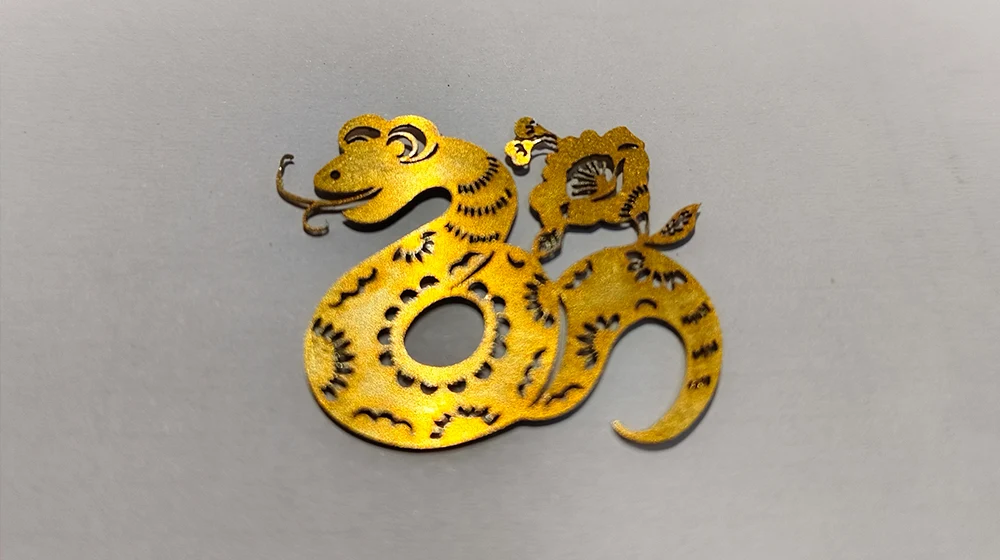
Laser cutting for signage has revolutionized how advertising fabricators produce visual communication materials, from storefront lettering to large-format illuminated displays.
- Precision Cutting of Acrylic and Metal Signage
CO₂ laser systems cut acrylic sheets with smooth, flame-polished edges that require no post-processing—delivering pristine transparent or translucent letters for illuminated signs. For metal signage, fiber laser cutting handles stainless steel, aluminum, and brass with superior precision compared to mechanical routing. The anti-vibration cutting technology available on modern fiber systems effectively reduces defect rates on thin plate edges where precision is critical in producing high-quality metal signage.
- Multi-Layer and 3D Signage Fabrication
Laser cutting enables the production of complex multi-layer signs by precisely cutting different materials—acrylic faces, metal backing plates, and LED diffuser panels—in a single workflow. The narrow kerf width (typically 0.1–0.2 mm) maximizes material utilization while maintaining tight tolerances for seamless assembly.
- Laser Marking for Branding and Serial Codes
Laser marking applies permanent logos, serial numbers, and QR codes directly onto metal sign components. These marks withstand outdoor exposure, UV radiation, and chemical cleaning—ensuring lifetime traceability and brand integrity. Laser marking automation streamlines the traceability process, adding marks in seconds with no preparation or finishing required.
Table 2: Traditional vs. Laser Signage Fabrication Comparison
| Process Parameter | Mechanical Routing | Waterjet Cutting | Laser Cutting |
|---|---|---|---|
| Edge quality | Rough, requires polishing | Good, matte finish | Excellent, polished (CO₂) / clean (fiber) |
| Minimum feature size | 3–5 mm | 1–2 mm | 0.1–0.2 mm |
| Material waste | High (wide kerf) | Moderate | Low (narrow kerf) |
| Setup time | 30–60 minutes (tooling) | 15–30 minutes | 5–10 minutes (program load) |
| Complex geometries | Limited by tool radius | Unlimited 2D | Unlimited 2D + engraving |
| Operating cost | Moderate (tool wear) | High (abrasive media) | Low (no consumables) |
Ⅳ. Deep Applications in the Metal Furniture Industry
Metal furniture laser fabrication addresses the industry’s demand for structural precision, aesthetic quality, and production agility.
- Structural Frame Cutting and Joining
Fiber laser cutting produces clean, burr-free edges on tubular and sheet metal furniture components, ensuring precise fit-up during assembly. The non-contact cutting method eliminates mechanical deformation, preserving the dimensional accuracy required for modular furniture systems. Laser welding then joins these components with deep penetration and minimal heat distortion—achieving joint strength up to 90% of base material strength.
- Decorative Panel and Perforated Screen Production
Modern furniture design increasingly incorporates decorative laser-cut screens, perforated panels, and intricate patterns. Laser cutting navigates complex geometries impossible for mechanical punches, enabling designers to realize custom patterns for office partitions, cabinet doors, and architectural room dividers.
- Surface Finishing and Traceability
Laser cleaning removes mill scale and pre-weld contaminants from furniture components without abrasive damage, restoring the passive layer on stainless steel surfaces. Post-fabrication, laser marking applies permanent part numbers and assembly codes that survive powder coating and lifetime use—enabling full supply chain traceability.
Ⅴ. Quantitative Comparison: Traditional vs. Laser Processes
The economic and technical advantages of laser cutting for signage and metal furniture laser fabrication become clear when compared directly with conventional methods.
Table 3: Process Economics and Quality Metrics
| Metric | Traditional Punch/Stamp | Plasma Cutting | Laser Cutting |
|---|---|---|---|
| Tooling investment | $500–$5,000 per die | Zero | Zero |
| Setup time | 1–2 hours | 15–30 min | 5–10 min |
| Positional accuracy | ±0.2 mm | ±0.3 mm | ±0.02 mm |
| Heat-affected zone | N/A | 2–5 mm | 0.1–0.5 mm |
| Post-process grinding | Often required | Usually required | Rarely required |
| Material utilization | 70–80% | 75–85% | 85–95% |
| Energy efficiency | Moderate | Low | High (>30% optical) |
| Design change cost | High (new dies) | Zero | Zero (program update) |
Manufacturing facilities investing in laser cutting automation can reduce material waste by up to 30% while increasing production throughput by 40%. The metal fabrication market is projected to reach USD 23.4 billion in 2026, with cutting processes representing approximately 32.6% of total market share—primarily driven by laser technology adoption.
Ⅵ. FAQ
Q1: What is the best laser type for cutting metal signage?
A: Fiber lasers are the optimal choice for metal signage fabrication. Their 1.06 µm wavelength delivers superior absorption on metals compared to CO₂ lasers, enabling faster cutting speeds, higher precision (±0.02 mm), and lower operating costs on stainless steel, aluminum, and brass.
Q2: Can laser cutting produce flame-polished edges on acrylic?
A: Yes. CO₂ laser cutting melts acrylic along the cut path, creating smooth, flame-polished edges that require no secondary finishing. This is ideal for illuminated signage and transparent display panels.
Q3: Is laser welding strong enough for load-bearing furniture frames?
A: Absolutely. Laser welding achieves joint strength up to 90% of base material strength with minimal heat distortion. The deep, narrow weld profile provides excellent structural integrity for tubular and sheet metal furniture frames.
Q4: How does laser marking survive outdoor exposure on signage?
A: Laser marks are permanent and integral to the material surface. They resist UV radiation, moisture, chemicals, and abrasion—outlasting painted, printed, or adhesive labels by decades.
Q5: What thickness range can laser systems handle for furniture fabrication?
A: Fiber lasers effectively cut carbon steel up to 20 mm and stainless steel up to 12 mm at 3 kW power. For furniture applications typically using 0.5–3 mm materials, even entry-level fiber lasers deliver exceptional speed and edge quality.
Ⅶ. Conclusion
Laser cutting for signage and metal furniture laser fabrication represent the convergence of precision engineering, design flexibility, and sustainable manufacturing. From flame-polished acrylic letters to distortion-free welded furniture frames, these photonic technologies address the most demanding challenges in visual communication and structural metalwork. As the global laser processing market accelerates and the metal fabrication sector expands toward USD 27 billion by 2030, manufacturers who integrate cutting, welding, and marking capabilities into unified digital workflows will secure decisive competitive advantages. At WSLLASER, our CE/ISO-certified fiber laser and CO₂ laser systems deliver exactly this transformative capability—engineered for precision, built for profitability, and backed by 17 years of industrial expertise.