
Table of Contents
Introduction
A laser cutting machine is only as precise as the structure beneath it. Every micron of positioning accuracy, every clean kerf edge, and every repeatable cut over a ten-hour shift begins with one overlooked component: the machine bed. Buyers evaluate laser power, cutting head brands, and control software, yet the steel or iron mass under the gantry is what actually resists vibration, thermal drift, and torsional flex during real production. This article breaks down the physics of bed architecture so procurement teams and workshop engineers can evaluate a machine on the criteria that actually determine long-term cutting quality.
Cutting a 20mm carbon steel plate at full power generates enormous reaction forces at the nozzle, and a gantry racing across a 3-meter span at high acceleration introduces inertial loads that a weak frame simply cannot absorb. When the bed flexes even fractions of a millimeter, that error transfers directly into out-of-square parts, tapered kerfs, and inconsistent hole diameters. Understanding structural mechanics is therefore not an academic exercise — it is the difference between a machine that holds tolerance for a decade and one that degrades within eighteen months.
II. The Physics of the Bed: Structural Mechanics & Dynamics

1. Static Stiffness vs. Dynamic Stiffness
Static stiffness describes how much a structure deflects under a constant load — for example, the weight of the gantry sitting at rest. Dynamic stiffness describes how the same structure responds to time-varying forces, such as the rapid acceleration and deceleration of a cutting head moving at high traverse speed. A bed can pass a simple static deflection test yet still perform poorly in production if its dynamic stiffness is inadequate, because cutting is a dynamic, not a static, process.
Torsional stiffness matters most on gantry-style machines, where the crossbeam is subject to twisting loads as the cutting head moves off-center along the Y-axis. A frame with insufficient torsional resistance will exhibit measurable twist at the beam extremities, and this twist shows up as squareness error on large-format parts, particularly on sheets wider than 2 meters.
2. Resonance and the Danger of Matching Frequencies
Every mechanical structure has a natural resonant frequency at which it will vibrate with minimal input energy. If the servo motor’s operating frequency range overlaps with the bed’s natural frequency, the structure amplifies rather than damps vibration, producing visible ripple marks on the cut edge, commonly called “chatter” in the cutting industry. Machine designers must therefore engineer bed mass and geometry so the natural frequency sits well outside the operational bandwidth of the drive system — a discipline formalized in the accuracy and repeatability testing methodology described in the international <ISO 230 series of machine tool test codes|https://www.iso.org/standard/55295.html>, which governs how positioning accuracy and repeatability are measured and reported for numerically controlled axes.
3. Internal Friction and Damping Capacity
Damping capacity refers to a material’s ability to convert mechanical vibration energy into heat through internal friction, rather than allowing the vibration to propagate through the structure. This property, independent of stiffness, is what determines how quickly oscillation dies out after a disturbance such as a sudden change in cutting direction. Materials with low internal friction will continue oscillating — effectively “ringing” — long after the triggering event, while high-damping materials absorb the energy almost immediately.
Table 1: Structural Performance Factors in Laser Cutting Machine Beds
| Performance Factor | Definition | Primary Impact on Cutting Quality |
|---|---|---|
| Static Stiffness | Resistance to deflection under constant load | Baseline flatness and squareness |
| Dynamic Stiffness | Resistance to deflection under variable/cyclic load | Accuracy during acceleration and direction changes |
| Torsional Stiffness | Resistance to twisting along the gantry beam axis | Squareness on wide-format sheets |
| Damping Capacity | Rate of vibration energy dissipation as heat | Edge finish, chatter suppression |
| Natural Frequency | Frequency at which the structure vibrates freely | Avoidance of resonance with servo drive frequencies |
III. Material Science: Welded Steel vs. Cast Iron vs. Concrete
1. Welded Steel Frames
Welded carbon steel construction dominates modern high-power fiber laser cutting machines, largely because steel plate can achieve equivalent load-bearing capacity at a fraction of the wall thickness compared to cast iron, which reduces both material cost and shipping weight. However, steel has notably low internal friction compared to gray cast iron, meaning a welded frame will ring rather than damp when struck or vibrated, unless the design compensates through geometry, ribbing, or added mass.
The quality gap within “welded steel” as a category is enormous. Thin-wall tube construction, using hollow rectangular sections in the 3–5mm wall range, is common in budget machines and behaves closer to a lightweight scaffold than a rigid machine tool foundation. Professional-grade fabrication instead uses thick solid steel plate, typically in the 12–20mm range, welded into a box-section or ribbed monocoque structure, followed by a full stress-relief annealing cycle to eliminate residual welding stresses before the machining of guideway mounting surfaces begins. Without this thermal stress-relief step, a welded frame can continue distorting for months after delivery as internal stresses slowly release, degrading factory-certified accuracy.
2. Gray Cast Iron
Gray cast iron has long been the traditional material of choice for machine tool bodies because its microstructure contains graphite flakes distributed throughout the matrix, and these flakes act as countless microscopic interfaces that dissipate vibrational energy through internal friction. Comparative damping studies across common machine tool structural materials indicate that gray cast iron’s damping capacity is roughly double that of ductile iron, which is itself roughly double that of plain structural steel, making gray iron the benchmark for vibration absorption in contact-cutting processes such as milling and turning.
For non-contact laser processing, however, the reaction forces at the nozzle are dramatically lower than those generated by a milling cutter engaging solid metal, which changes the cost-benefit calculation. Cast iron beds also carry practical liabilities at the scale required for modern laser cutting: casting a single-piece bed exceeding 6 meters in length is technically difficult, prone to internal porosity defects (“sand holes”) that create hidden weak points, and cast iron is comparatively brittle, meaning a dropped workpiece or impact at a bed corner can chip or crack the casting rather than simply deform it.
3. Polymer Concrete and Mineral Casting
Polymer concrete, also called mineral casting or synthetic granite, is a composite of quartz, granite, or basalt aggregate bound in an epoxy or vinylester resin matrix. Independent laboratory testing of polymer-concrete composites against cast iron samples found the critical damping ratio of polymer concrete measured roughly four to seven times higher than cast iron under comparable test conditions, a substantial margin that explains its growing adoption in precision grinding and high-speed machining platforms. Beyond damping, polymer concrete’s thermal conductivity is far lower than metal, meaning it responds far more slowly to ambient temperature swings — a property directly relevant to dimensional stability during long production shifts where workshop temperature can drift by several degrees.
The trade-off is manufacturing complexity and tooling cost: producing large polymer concrete or mineral-cast bed sections requires custom molds, longer cure times, and is currently more common as a hybrid element — poured into steel or cast-iron cavities to combine the load capacity of metal with the damping performance of the composite — rather than as a full-scale monolithic bed for large-format laser cutting platforms.
Table 2: Comparative Material Properties for Machine Bed Construction
| Material | Relative Damping Capacity | Thermal Response | Manufacturing Scalability | Typical Application |
|---|---|---|---|---|
| Welded Carbon Steel (thick plate) | Low–Moderate (design-dependent) | Fast response, moderate expansion | Excellent for large-format beds | High-power fiber laser cutting (6–20kW) |
| Gray Cast Iron | High (baseline reference) | Slow response, high mass buffering | Difficult at 6m+ single-piece scale | Milling, turning, small-format machines |
| Polymer Concrete / Mineral Casting | Very High (4–7x cast iron) | Very slow response, low thermal conductivity | Limited by mold/cure constraints | Precision grinding, hybrid bed inserts |
| Thin-Wall Tube Steel | Very Low | Fast, prone to localized distortion | Cheapest, fastest to fabricate | Entry-level or light-duty machines |

IV. Functional Customization: Tailoring the Bed to Operational Needs
1. Sheet Size and Span Considerations
A bed engineered for 3mm stainless steel sheet at 1.5 x 3 meters faces entirely different loading conditions than a bed built for 20mm carbon steel plate at 2.5 x 6 meters. As gantry span increases, the unsupported beam length grows, and beam deflection under self-weight and dynamic load increases geometrically rather than linearly with span, which is why wide-format machines require proportionally deeper cross-section ribbing and thicker plate rather than simple linear scaling of a smaller design.
2. Slat Table Design and Thermal Load Management
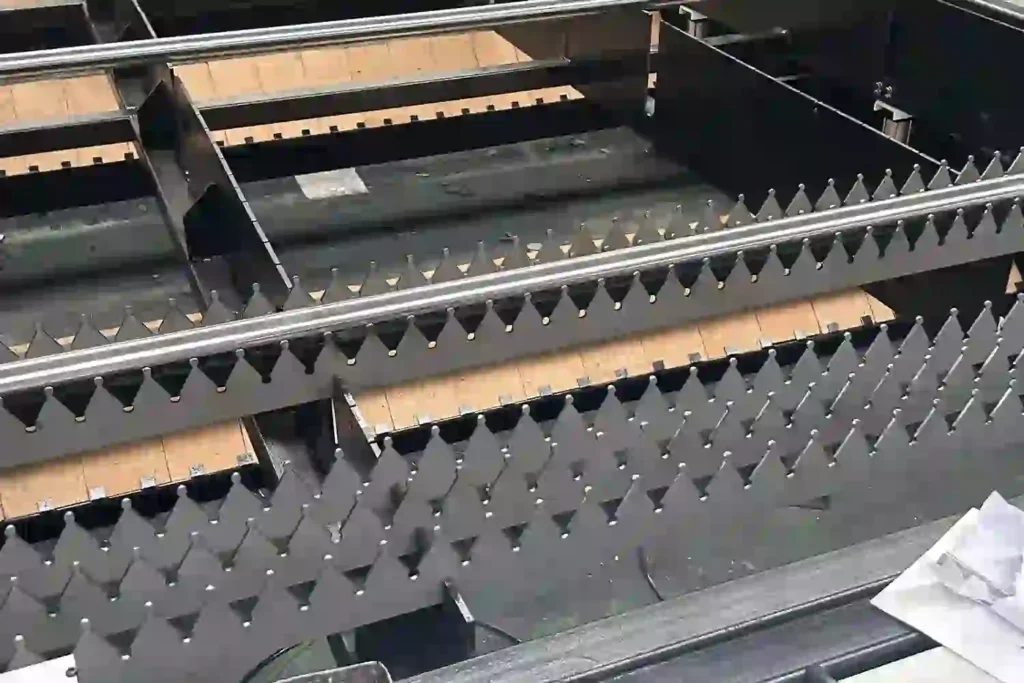
The support slats or grid table sitting atop the primary bed structure must handle direct thermal loading from the cutting process itself, since molten material and reflected laser energy strike this surface continuously. Rapid thermal annealing effects at the point of cut can locally heat slats to several hundred degrees Celsius within seconds, and repeated thermal cycling causes conventional slats to warp over time if the underlying bed structure and slat mounting geometry do not accommodate differential expansion. Better-engineered systems use replaceable, individually mounted slats precisely because localized thermal distortion is inevitable and should be a routine maintenance item rather than a structural failure.
3. Foundation Isolation and Installation Requirements
Even a well-engineered bed cannot compensate for a poorly prepared foundation. External vibration sources — nearby stamping presses, forklift traffic, or an unlevel concrete floor — can introduce disturbance frequencies that couple into the machine structure regardless of its own damping properties. Facility engineers should specify floor flatness tolerances and, where external vibration sources are unavoidable, isolation pads or dedicated foundation blocks sized to the specific machine’s mass and footprint.
4. Automation Integration Loads
Machines specified with automatic loading and unloading systems, shuttle tables, or tower storage integration carry additional cyclic loading from pallet exchange operations. The bed and its mounting interfaces must be engineered from the outset to accommodate these forces; retrofitting automation onto a bed not originally designed for it frequently introduces new vibration paths that were absent in the standalone configuration.
Table 3: Bed Design Parameters by Application Class
| Application Class | Typical Sheet Range | Gantry Span | Bed Priority | Recommended Construction |
|---|---|---|---|---|
| Light Fabrication | ≤6mm mild steel, ≤4mm stainless | Up to 2m | Speed, moderate rigidity | Ribbed welded steel, mid-wall thickness |
| Heavy Plate Cutting | 12–25mm carbon steel | 2–3m | Torsional stiffness, mass | Thick plate box-section, stress-relieved |
| Wide-Format Production | Full range, 2.5m+ width | 3–6m | Beam deflection control | Deep-ribbed monocoque, reinforced crossbeam |
| Automated / Unattended | Mixed, high cycle count | 2–4m | Fatigue resistance, mounting stability | Reinforced pallet interface zones |
5. Verifying Bed Performance Before Purchase
Buyers should request objective test data rather than marketing claims. Reputable manufacturers document positioning accuracy and repeatability using methodology consistent with the ISO 230 test code family, and should be able to provide diagonal displacement or ballbar test results, not just single-axis figures. Requesting the plate thickness specification, whether stress-relief annealing is performed, and the bed’s total mass relative to machine footprint are three simple but highly diagnostic questions during procurement.
Table 4: Buyer Diagnostic Checklist for Machine Bed Quality
| Diagnostic Question | Weak Signal (Red Flag) | Strong Signal (Confidence Indicator) |
|---|---|---|
| Steel plate thickness used | Under 6mm on primary structural members | 12mm+ on load-bearing sections |
| Stress-relief treatment | Not mentioned or unclear | Documented annealing or natural aging cycle |
| Accuracy test documentation | Single-axis spec sheet only | ISO 230-aligned laser interferometer or ballbar report |
| Bed-to-footprint mass ratio | Unusually lightweight for stated envelope | Mass consistent with published industrial baselines |
| Slat/support table design | Fixed, non-replaceable slats | Modular, individually replaceable slat sections |
FAQ
Does a heavier machine bed always mean better cutting quality?
Not necessarily. Mass contributes to vibration resistance by increasing the energy required to move the structure, but mass without adequate damping and correct geometry simply moves the resonance problem rather than solving it. A well-ribbed, moderately-weighted welded steel bed with proper stress relief can outperform a heavier but poorly designed structure. Buyers should treat published weight figures as one data point among several rather than a standalone quality metric.
Why do some laser cutting machines lose accuracy after a year of use?
The most common cause is incomplete stress relief during fabrication. If a welded steel frame is machined and assembled before residual welding stresses are fully released, those stresses continue relaxing slowly over months of thermal cycling in production, causing gradual, hard-to-diagnose geometric drift. Foundation settling and inadequate vibration isolation from surrounding factory equipment are the second most common contributors.
Is polymer concrete a realistic option for large-format fiber laser cutting beds?
Currently, full monolithic polymer concrete beds are more common in smaller precision grinding and measurement platforms than in large-format industrial laser cutting machines, primarily due to mold size limitations and cure-time economics at multi-meter scale. Hybrid designs — where polymer concrete or a similar damping compound fills cavities within a welded steel or cast structure — are a more practical route to capturing some of the damping benefit on large machines today.
How does bed rigidity affect cutting speed, not just accuracy?
A more rigid, better-damped bed allows the cutting head to accelerate and decelerate faster without inducing vibration that would otherwise force the machine controller to slow down through corners and tight contours to protect edge quality. In practice, this means two machines with identical laser power sources can have meaningfully different real-world throughput on parts with complex geometry, purely because of structural differences beneath the gantry.
What role does the guideway and rail mounting surface play alongside the bed itself?
The bed provides the foundation, but the precision-ground mounting surfaces where linear guideways attach must maintain their geometric relationship to each other over the machine’s operating life. This is why the machining sequence matters: guideway surfaces should be finish-machined only after stress-relief treatment is complete, ensuring the reference geometry does not shift as residual stresses continue to release after final machining.
Conclusion
Machine bed architecture is not a background specification — it is the structural foundation that determines whether a laser cutting machine holds its factory-certified accuracy for ten years or begins drifting within its first year of production. Welded steel, cast iron, and polymer concrete each bring distinct trade-offs across stiffness, damping, thermal response, and manufacturing scalability, and the correct choice depends on sheet thickness range, gantry span, and production intensity rather than any single material being universally superior. Workshop managers evaluating a new machine should look past headline laser power figures and ask pointed questions about plate thickness, stress-relief treatment, and documented accuracy testing before committing capital to a platform they expect to run for a decade.