

In modern metal fabrication, the bottleneck is rarely the laser source. A modern fiber laser can accelerate at 2.5G and cut thin sheet at 140 m/min. Yet, shop floor audits consistently reveal that actual OvIn modern precision metal fabrication, the operational bottleneck is rarely the laser source. High-power fiber lasers accelerate at 2.5G and achieve rapid traverse speeds beyond 140 m/min. Yet, shop-floor production audits consistently show that actual Overall Equipment Effectiveness (OEE) hovers between 35% and 45%.
The actual constraint is material flow. Waiting for an overhead bridge crane, manually unstacking raw plates, and navigating aisles clogged with flat-lying steel bundles consumes far more time than the actual thermal cutting process.
To overcome this structural ceiling, fabricators are shifting from standalone machines to integrated sheet metal automation cells. Combining vertical automated storage with lights out manufacturing protocols enables factories to double beam-on utilization while reclaiming costly workshop square footage. This engineering and operational guide examines the four mechanical, software, and financial rules required to deploy an automated sheet metal automation ecosystem that delivers an 80%+ OEE benchmark.
Ⅰ. The Floor Space & Safety Black Hole
1. The cost of flat-lying inventory
A mid-sized fabrication facility processing 1,000 tons of structural carbon steel and stainless alloy annually cannot sustain horizontal floor storage. A standard bundle of 1.5m × 3m plates occupies approximately 5.5 m² per pallet. Factoring in required forklift maneuvering aisles and bridge crane access zones, maintaining a working buffer of 120 tons (roughly 24 pallet bundles) consumes over 300 m² of prime factory floor space.
With commercial industrial rent climbing beyond $10 to $15 per m², allocating extensive real estate to passive raw material stacks creates an unnecessary drain on gross margins. By transitioning from scattered ground pallets to high-density vertical towers, sheet metal automation reclaims hundreds of square meters of prime shop floor space for secondary processes such as CNC bending, robotic welding, and automated powder coating.
2. The crane dependency and safety risks
Manual plate staging relies heavily on overhead bridge cranes, which quickly become severe transit bottlenecks when multiple high-power cutting machines run simultaneously. Operators spend 15 to 25 minutes locating the right alloy gauge, attaching magnetic lifters or mechanical plate clamps, hoisting the sheet, and aligning it on the shuttle table. Leaning into the cutting cabin to manipulate heavy plate edges exposes personnel to severe crush injuries, pinch points, and dropped-load hazards.
An automated sheet storage system eliminates this manual rigging entirely. By organizing cassettes vertically, a dual-tower structure stores 120 tons of raw steel within a footprint of approximately 90 m² (including elevator kinematics, pallet exchange interfaces, and perimeter safety zones). Before committing to a vertical layout, engineering teams should review our comprehensive CNC laser cutting machine guide to evaluate gantry dynamic loading, foundation concrete depth, and power feed clearances. Eliminating overhead crane bottlenecks through dedicated sheet metal automation ensures that high-power fiber lasers maintain continuous beam-on production.
Table 1: Manual Floor Storage vs. Automated Sheet Storage System
| Operational Metric | Manual Flat Storage + Crane | Automated Vertical Sheet Storage | Financial / Safety Impact |
| Footprint for 120 Tons | 300+ m² (Wide forklift aisles) | ~90 m² (Tower + Interface + Safety) | Reclaims 210+ m² of floor space |
| Loading Cycle Time | 15 – 25 minutes (Crane queue) | 90 – 120 seconds (Automated) | Drastically lifts beam-on time |
| Operator Requirement | 1 Crane Op + 1 Machine Op | 1 Machine Op (Unattended loading) | Reallocates 1 full-time worker |
| Workplace Hazard | High (Crush, drop, rigging risks) | Minimal (Fully enclosed light curtains) | Eliminates overhead crane accidents |
Ⅱ. The Double-Sheet Dilemma: Mechanical Separation Architecture
1. The flaw of standard vacuum picking
In any robust sheet metal automation cell, the mechanical elevator and telescopic transfer forks must maintain consistent positional accuracy while handling thin and medium gauge sheet (1.0mm to 3.0mm). When an automated vacuum array lifts oiled cold-rolled steel or mirror-finish stainless with protective film, air pressure differential and surface oil tension frequently cause the underlying sheet to adhere to the top plate.
If two sheets are loaded into the cutting cabin simultaneously, the laser beam fails to penetrate the combined thickness. This either ruins an entire sheet of valuable alloy or causes violent back-reflection that damages the cutting nozzle, capacitive sensor, and internal protective window.
2. Three-layer anti-double-sheet defense
An industrial-grade sheet metal automation setup must incorporate three independent mechanical and sensory defenses before releasing a plate to the cutting shuttle:
- Pneumatic Peeling (Corner Blow-off): High-velocity air nozzles direct targeted bursts at sheet corners while articulated vacuum cups initiate a localized mechanical peel, breaking the vacuum seal and oil film between layers.
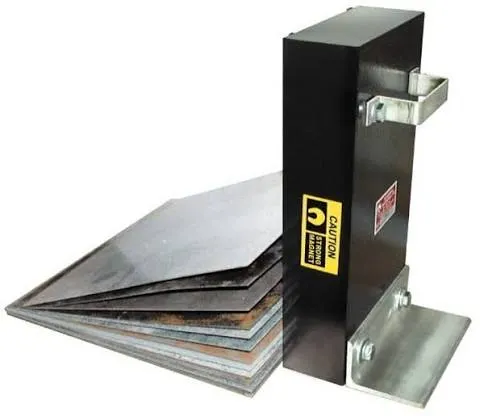
- Magnetic Fanners / Separators: High-strength permanent neodymium magnets or switchable pneumatic magnetic blocks engage the bundle perimeter. By inducing identical magnetic polarities in neighboring ferrous plates, repulsive magnetic forces push sheet edges apart.
- Ultrasonic Thickness Verification: As the vacuum arm lifts the sheet, a non-contact ultrasonic sensor measures physical thickness within an accuracy of ±0.05 mm. If the reading detects dual thickness, the cycle halts immediately and returns the plate to the cassette.
Table 2: Subsystems of Automated Sheet Loading
| Mechanical System | Primary Function | Technical Specification | Operational Impact |
| Telescopic Fork / Vacuum Lift | Extracts sheet from cassette | Payload capacity: 300 – 500 kg | Rapid cycle replenishment |
| Pneumatic Peeling System | Breaks atmospheric oil seal | Operating pressure: 6 – 8 bar | Prevents dual-sheet pickup |
| Magnetic Separators | Repels ferrous plates | Effective gap: 1mm – 5mm | Essential for oiled carbon steel |
| Ultrasonic Sensor | Validates sheet gauge | Measurement accuracy: ±0.05 mm | Prevents cutting head collisions |
Ⅲ. Lights Out Manufacturing: The Financial Engine
1. The reality of the “Unmanned” Night Shift
True lights out manufacturing does not require a factory to operate without human oversight indefinitely. Instead, it transforms the machine cell into a self-sufficient production island during non-core hours. A single daytime supervisor programs the nesting queues, replenishes raw material cassettes, and conducts daily checks. During the night, the cell executes jobs automatically—retrieving raw plates, cutting parts, and transferring completed nests to offload pallets.
To maintain unattended stability throughout an 8-hour night run, the cutting program must use micro-joint nesting strategies. Small structural tabs keep interior parts locked into the skeleton, preventing tipped parts from snagging the cutting head. The entire skeleton is then shuttled outward onto an automated rake or fork unloader and pushed directly into a scrap hopper. A truly unattended night shift relies on closed-loop sheet metal automation to execute autonomous loading, cutting, and pallet staging without human intervention.
2. The financial ledger: Manual vs. Automated
The investment justification for this level of automation rests on three tangible variables: direct labor reduction, off-peak power savings, and amplified machine utilization. For an in-depth breakdown of shuttle tables, material lifters, and multi-year capital recovery, refer to our operational framework on laser automation ROI.
Calculating the capital payback of sheet metal automation requires balancing initial machinery expenditure against dramatic reductions in per-part labor costs. A facility operating two 6kW to 12kW fiber lasers can leverage vertical storage to run an unattended 8-hour third shift, unlocking up to 160 extra production hours per month without adding headcount.
Table 3: 3-Year Financial Payback Model (Single 6kW Laser Cell)
| Cost / Benefit Metric | Manual Production (2 Shifts) | Automated System (2 Shifts + Lights Out) | 3-Year Net Variance |
| Equipment CapEx (Automation) | $0 | $180,000 (Tower + Loading Interface) | -$180,000 (Capital investment) |
| Direct Labor Cost | $260,000 (2 operators) | $130,000 (1 supervisor) | +$130,000 (Labor savings) |
| Machine Utilization (OEE) | 45% (~2,000 beam hours/yr) | 80% (~3,500 beam hours/yr) | +75% output without new lasers |
| Electricity Cost | $25,000 | $18,000 (Night shift off-peak rates) | +$7,000 (Power savings) |
| Total 3-Year Operational Cost | $285,000 | $148,000 | $137,000 Net Gain |
Note: The CapEx of $180,000 (Tower + Interface) achieves full payback in approximately 16–18 months based on labor and electricity savings alone, excluding the massive revenue generated from the additional 1,500 cutting hours per year. A granular breakdown of how night-shift electricity tariffs and assist gas consumption influence operational overhead is documented in our comprehensive audit of laser cutter cost per hour.
Ⅳ. WMS Integration and Remnant Management
1. Tracking the offcuts
In conventional workshops, partially cut skeletons and remnants are pushed into corners where they gather dust and lose material traceability. With an automated sheet storage system, offcuts are logged directly through the central Warehouse Management System (WMS).
Once a nest completes, usable remnants return to a dedicated cassette in the tower. The WMS tracks sheet dimensions, gauge, and alloy heat numbers via dynamic barcode or RFID tagging. When a smaller nested job enters the queue, the system calls the remnant cassette first, significantly lowering raw inventory scrap rates. Similar automated staging principles for structural hollow sections and heavy profiles are detailed in our technical review of tube laser automation and bundle loaders. Integrating a central WMS with our sheet metal automation infrastructure ensures full traceability for partially cut nests and raw alloy remnants.
2. Safety compliance
High-speed elevator cars and autonomous vacuum gantries present significant kinetic hazards that demand strict physical and optical zoning. Comprehensive workshop safety enclosures and Category 4 optical curtains are mandatory components of an industrial sheet metal automation line.
Optical safety light curtains (PL e / Category 4 compliant) secure the cassette replenishment bay and part offload zone. If an operator steps across an active optical boundary, safety relays dump pneumatic holding pressure and trigger servo motor electromechanical brakes in under 20 milliseconds, locking the gantry safely in place.
Table 4: Daily Checklist for Automated Sheet Storage
| Inspection Item | Frequency | Inspection Standard | Risk if Ignored |
| Safety Light Curtains | Daily | Verify instant emergency stop response | Severe crush/impact hazard |
| Vacuum Cup Lip Seals | Weekly | Check for tear-outs and air leakage | Dropped plates, double picking |
| Telescopic Fork Drive | Monthly | Inspect chain tension and guide lubrication | Mechanical binding, shuttle jam |
| Ultrasonic Calibration | Monthly | Test against verified 1.0mm feeler gauge | False triggers or nozzle collisions |

Ⅴ. Frequently Asked Questions (FAQ)
What is sheet metal automation?
Sheet metal automation refers to integrating automated vertical storage towers, vacuum loading gantries, dynamic shuttle tables, and unload systems with CNC fiber laser cutters. This setup automates material handling from raw plate intake to finished part unloading, reducing manual overhead crane reliance and enabling unattended production shifts.
What is the typical ROI of a sheet metal automation system?
For a facility running multiple shifts, an automated tower and loading system typically recovers its capital investment within 14 to 18 months. Financial payback stems from eliminating manual crane operators, taking advantage of lower night-shift electricity tariffs, and pushing laser OEE from 40% to over 80%.
How does a sheet storage system prevent double-sheet picking?
Modern vertical storage towers incorporate a three-stage defense: pneumatic peeling nozzles to break surface oil tension, magnetic fanners to repel adjacent ferrous sheets, and an ultrasonic thickness gauge that checks sheet gauge before delivery to the cutting table.
Can lights out manufacturing run entirely without human operators?
The cutting cell operates autonomously during scheduled night shifts, handling sheet loading, thermal cutting, and skeleton unloading. Human involvement remains necessary during normal day shifts for nesting programming, raw cassette restocking, finished part deburring, and preventive maintenance.
参考文献
- ISO 9013:2017 — Thermal cutting — Classification of thermal cuts, International Organization for Standardization
- ISO 11553-1:2020 — Safety of machinery — Laser processing machines, International Organization for Standardization
- ISO 8573-1:2010 — Compressed air — Contaminants and purity classes, International Organization for Standardization
Further Reading
- Laser Automation ROI: Pallet Changers & Loading Systems — Understanding the financial returns of automated laser cells.
- CNC Laser Cutting Machine: Workshop Setup Guide — Power, foundation, and floor planning for automated systems.
- Tube Laser Load and Unload Automation: Scrap & Labor ROI — How automatic bundle loaders and sorting arms optimize tube processing cells.
- Laser Cutter Cost Per Hour: The Full Operating Ledger — Calculating the true savings of a lights-out operation.