A fabrication shop cutting stainless steel or aluminum on a fiber laser consumes nitrogen at a rate that surprises most owners when they add up the monthly bill. The gas is invisible, but the invoice is not. For a shop running a 12kW machine on a single shift, the liquid nitrogen bill can exceed the monthly payment on the machine itself.
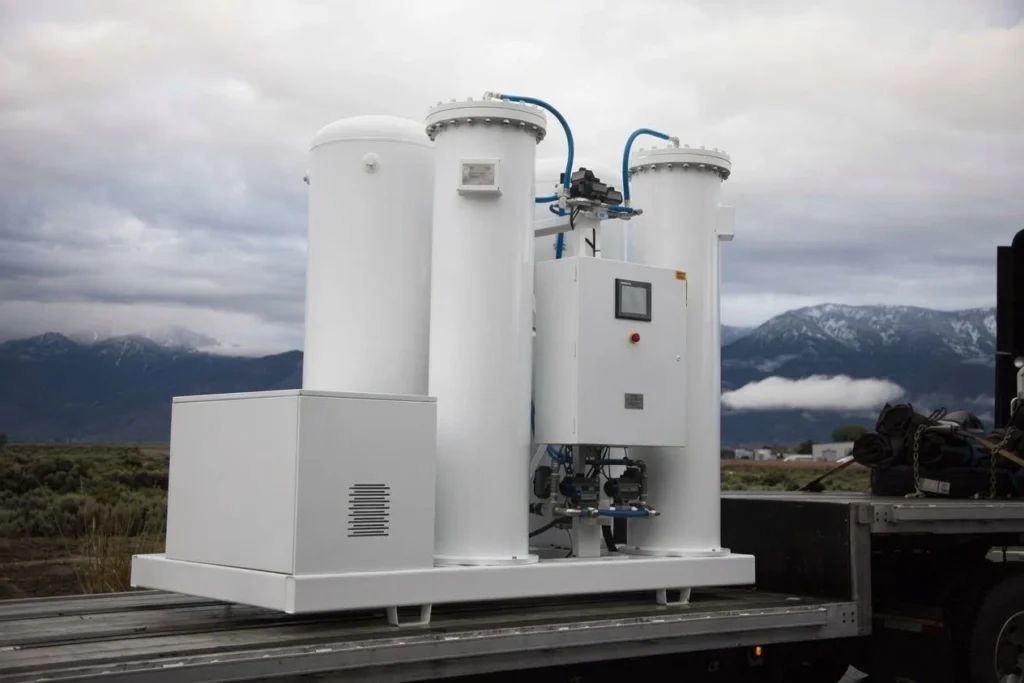
The alternative is a nitrogen generator for laser cutting — a PSA (Pressure Swing Adsorption) system that produces high-purity nitrogen on-site from compressed air. This guide compares the cost of on-site generation against bulk liquid nitrogen, cylinder supply, and dewar delivery. It covers the purity requirements, the equipment cost, and the payback model that determines when the generator pays for itself.
Ⅰ. The Hidden Cost of Bulk Liquid Nitrogen
1. The gas consumption rate
A 12kW fiber laser cutting 3mm to 6mm stainless steel uses nitrogen at 14–18 bar as the assist gas. The flow rate depends on the nozzle diameter and the material thickness, but a typical production setting consumes 40 to 60 cubic meters per hour.
At a bulk liquid nitrogen price of $0.40 to $0.80 per cubic meter — as analyzed in our benchmark on laser cutting gas cost — the gas cost per cutting hour is $24 to $48. On a machine that runs 160 hours per month, the monthly gas bill is $3,840 to $7,680.
2. The boil-off loss
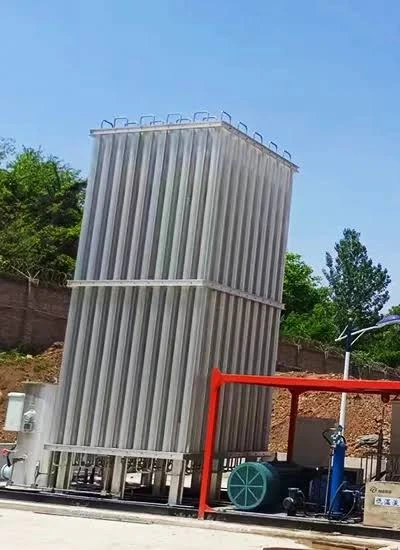
Liquid nitrogen is stored in a cryogenic tank at −196°C. Even with vacuum insulation, the tank absorbs heat from the ambient environment, and a fraction of the liquid boils off every day. The evaporation rate for a standard vertical tank is 1.0% to 2.5% of the tank capacity per day, depending on the tank size and the ambient temperature.
On a 3,000-liter tank, a 1.5% daily evaporation rate equals 45 liters of nitrogen lost per day. That is gas the shop paid for and never used.
3. The ancillary costs
The liquid nitrogen supply chain carries costs beyond the gas itself. The tank rental is $150 to $400 per month. The delivery surcharge for cryogenic gas is $50 to $150 per delivery. The dewar or cylinder handling — if the shop uses a smaller supply — adds labor hours every time a container is changed.
Table 1: Gas Supply Mode Comparison
| Parameter | Cylinder / Dewar | Bulk Liquid Tank | On-Site PSA Generator |
|---|---|---|---|
| Purity available | 99.999% | 99.999% | 99.9%–99.999% (adjustable) |
| Gas cost per m³ | $0.80–$1.50 | $0.40–$0.80 | $0.05–$0.07 |
| Tank rental | $0 | $150–$400/month | $0 |
| Delivery surcharge | Per delivery | Per delivery | $0 |
| Boil-off loss | Minimal (small volume) | 1.0%–2.5%/day | None |
| Labor for changeover | High (frequent) | Low | None |
| Floor space | Small | 15–25 m² outdoor pad | 3–6 m² indoor |
Ⅱ. How On-Site PSA Generators Work
1. The pressure swing adsorption process
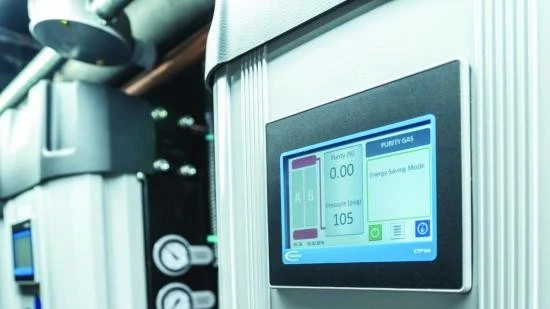
In an industrial psa nitrogen generator laser configuration, the system separates nitrogen from compressed air using a carbon molecular sieve (CMS). The CMS is a porous carbon material with pores sized to adsorb oxygen molecules preferentially. When compressed air passes through the CMS bed, the oxygen is trapped, and the nitrogen passes through.
Two beds operate in sequence. While one bed is producing nitrogen, the other is regenerating by releasing the adsorbed oxygen to the atmosphere. The cycle repeats continuously, and the output is a continuous stream of high-purity nitrogen.
2. The purity requirement for laser cutting
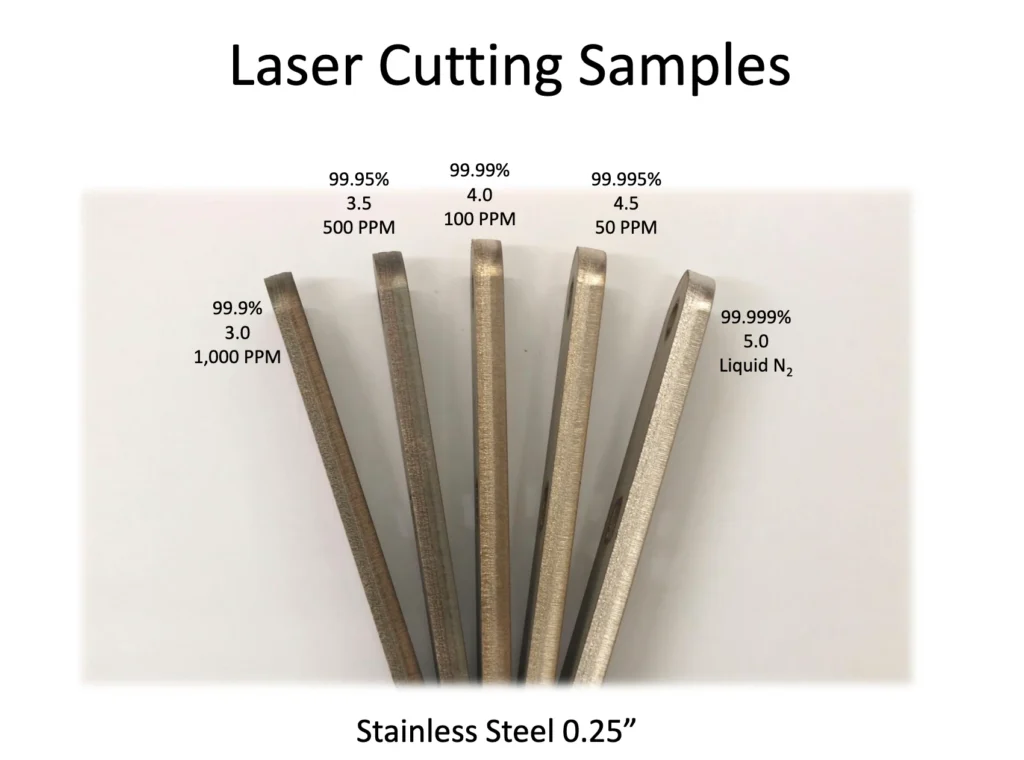
Fiber laser cutting requires nitrogen purity of 99.99% or higher for stainless steel. The purity affects the cut edge: at 99.9%, the edge may show slight oxidation; at 99.99%, the edge is clean and bright; at 99.999%, the edge is fully oxide-free.
A PSA generator can produce any of these purity levels, but the energy consumption rises as the purity requirement increases. The generator is typically set to the purity the shop actually needs, not the highest purity the system can produce.
3. The high-pressure booster
The PSA generator produces nitrogen at low pressure — typically 7 to 10 bar. The laser cutting head requires 14 to 25 bar. A high-pressure booster compresses the nitrogen from the generator output to the cutting pressure.
The booster adds energy consumption, but it also allows the generator to deliver nitrogen at the pressure the cutting process requires without a separate high-pressure storage system.
Table 2: Nitrogen Purity vs Cut Edge Quality (Stainless Steel)
| Purity Level | Oxygen Content | Cut Edge Appearance | Typical Application |
|---|---|---|---|
| 99.9% (3N) | < 1,000 ppm | Slight oxidation, light discoloration | Non-cosmetic parts |
| 99.99% (4N) | < 100 ppm | Clean, bright edge | Standard stainless cutting |
| 99.999% (5N) | < 10 ppm | Fully oxide-free, bright white edge | Cosmetic and weld-prep parts |
Ⅲ. The Three-Way Cost Comparison
1. The cost per cubic meter
When analyzing liquid nitrogen vs nitrogen generator economics, the cost of on-site nitrogen generation is dominated by the electricity consumed by the compressor and the booster. The PSA process itself does not consume gas or chemicals — it consumes power.
A typical PSA system producing 99.99% nitrogen at 16–25 bar consumes 0.28 to 0.35 kWh per cubic meter of nitrogen produced. At an industrial electricity rate of $0.12 per kWh, the electricity cost is $0.034 to $0.042 per cubic meter. Adding the filter and molecular sieve maintenance — typically $0.015 per cubic meter — brings the total to $0.05 to $0.06 per cubic meter.
2. The hourly comparison
At a flow rate of 50 cubic meters per hour, the liquid nitrogen cost is $20 to $40 per hour, depending on the local gas price. The on-site generation cost is $2.50 to $3.00 per hour, including electricity and maintenance.
The difference is roughly $17 to $37 per cutting hour. On a 160-hour monthly schedule, the monthly saving is $2,720 to $5,920.
3. The annual comparison
Over a full year, the liquid nitrogen bill for a single-shift shop is $30,000 to $60,000. The on-site generation cost — electricity plus maintenance — is $4,000 to $6,000. The annual saving is $26,000 to $54,000.
The saving is not a one-time benefit. It continues for the life of the generator, which is typically 10 to 15 years with proper maintenance.
Table 3: Monthly and Annual Operating Cost Comparison (12kW Laser, 160 hrs/month)
| Cost Category | Bulk Liquid N₂ | On-Site PSA Generator | Difference |
|---|---|---|---|
| Gas cost per hour | $20–$40 | $2.50–$3.00 | $17.50–$37.00 saved |
| Monthly gas cost (160 hrs) | $3,200–$6,400 | $400–$480 | $2,720–$5,920 saved |
| Tank rental | $150–$400 | $0 | $150–$400 saved |
| Delivery surcharge | $100–$300 | $0 | $100–$300 saved |
| Monthly total | $3,450–$7,100 | $400–$480 | $3,050–$6,620 saved |
| Annual total | $41,400–$85,200 | $4,800–$5,760 | $36,600–$79,440 saved |
Ⅳ. Nitrogen Generator Cost and Payback Model
1. The system cost
When calculating the total nitrogen generator cost, a complete on-site nitrogen generation system includes the PSA generator, the feed air compressor, the refrigerated dryer, the filtration train, the high-pressure booster, and the nitrogen receiver tank. The installed cost for a system sized for a 12kW laser is typically $35,000 to $55,000, depending on the capacity, the purity level, and the pressure requirement.
The system is a capital investment, not a consumable. It is depreciated over its useful life and qualifies for Section 179 expensing in the year it is placed in service.
2. The financing model
Utilizing structured fiber laser financing, a shop that finances the system over 36 months at an 8.5% APR has a monthly payment of approximately $1,100 to $1,750 for a $35,000 to $55,000 system.
The monthly saving from eliminating the liquid nitrogen bill is $3,050 to $6,620. The net cash position — saving minus financing — is positive from the first month.
3. The payback calculation
The simple payback on the system, without financing, is the capital cost divided by the monthly saving. At $35,000 to $55,000 capital cost and $3,050 to $6,620 monthly saving, the payback is 6 to 18 months.
With financing, the shop generates positive cash flow from month one. The system pays for itself through the monthly payment, and the cash saving accumulates as working capital.
Table 4: Payback Model by Monthly Gas Spend
| Monthly Liquid N₂ Spend | Monthly Saving with PSA | Estimated System Cost | Simple Payback (Months) |
|---|---|---|---|
| $3,450 | $3,050 | $35,000 | 11.5 |
| $5,200 | $4,800 | $45,000 | 9.4 |
| $7,100 | $6,620 | $55,000 | 8.3 |
Ⅴ. Frequently Asked Questions
Can a PSA nitrogen generator produce high enough purity for laser cutting?
Yes. A properly sized PSA system produces 99.99% to 99.999% nitrogen, which is sufficient for stainless steel and aluminum cutting. The purity level is adjustable within the system’s design range, and the generator is set to the purity the cutting process requires.
What is the maintenance cost of a PSA nitrogen generator?
The maintenance consists of filter replacement, molecular sieve replacement at the end of its service life (typically 5 to 10 years), and routine compressor service. The annual maintenance cost is approximately 5% of the system capital cost, or $0.015 per cubic meter of nitrogen produced.
Does the generator replace the existing air compressor?
No, the PSA generator requires a dedicated feed air compressor to supply clean, dry compressed air at 7 to 10 bar. This compressor is separate from the shop’s existing compressed air system and is sized for the generator’s air consumption.
What happens if the nitrogen demand exceeds the generator capacity?
The generator is sized for the shop’s peak demand. If the demand exceeds the capacity, the system pressure drops, and the cut quality degrades. Most systems include a nitrogen receiver tank that buffers the peak demand, and some systems include a backup liquid nitrogen connection for peak periods.
Is on-site nitrogen generation suitable for a shop that cuts mostly carbon steel?
No. Carbon steel is typically cut with oxygen or high-pressure air rather than expensive nitrogen. For shops processing thin-to-medium carbon steel, deploying a dedicated air compressor for laser cutting delivers immediate savings without requiring a nitrogen generator. The generator is justified primarily for shops with dedicated stainless steel or aluminum production.
Ⅵ. Commercial Verdict: The Generator Pays for Itself
The nitrogen generator for laser cutting is not a small accessory. It is a capital investment that replaces a recurring gas bill with a fixed monthly payment. For a shop cutting stainless steel at production volume, the payback is measured in months, not years.
The decision comes down to the annual gas spend. A shop that spends less than $1,500 per month on nitrogen does not have the volume to justify the generator. A shop that spends more than $3,000 per month has a clear case for on-site generation.
The generator is not a universal solution. It is the right investment for the shop that cuts stainless steel daily, that pays the liquid nitrogen bill every month, and that wants to convert that bill into a capital asset.
References
- CGA — Compressed Gas Association: Cryogenic Liquid Storage and Handling Standards, Compressed Gas Association
- ISO 8573-1:2010 — Compressed air — Contaminants and purity classes, International Organization for Standardization
- ISO 9013:2017 — Thermal cutting — Classification of thermal cuts, International Organization for Standardization
Further Reading
- Laser Cutting Gas Cost: Nitrogen vs Compressed Air Savings — The full gas cost comparison across supply modes.
- Air Compressor for Laser Cutting: Cut Gas Costs by 75% — When compressed air replaces nitrogen on carbon steel.
- Fiber Laser Financing: 2026 Equipment Lease vs Buy — Monthly payment structures and Section 179 treatment.
- Laser Cutter Cost Per Hour: The Full Operating Ledger — The hourly cost model that incorporates gas, power, and consumables.