
When analyzing laser vs plasma cutting for heavy fabrication, shop owners often focus solely on the initial capital expenditure (CapEx). A 260A or 400A plasma table costs a fraction of a 15kW or 20kW fiber laser system. Based on the sticker price alone, plasma appears to be the rational choice.
However, this initial price is an illusion. It ignores the daily operating reality of heavy fabrication: the endless consumption of electrodes and nozzles, the hidden labor of secondary grinding, and the slow-down caused by tapered edges. This guide provides a detailed TCO (Total Cost of Ownership) analysis, comparing fiber laser and plasma cutting on 20mm to 50mm carbon steel, to reveal where the real financial bleed occurs.
Ⅰ. The Consumable Bleed: Electrodes vs. Optics
1. The plasma consumable reality
Plasma cutting relies on a consumable cartridge consisting of an electrode, a nozzle, and a swirl ring. As the arc operates at extreme temperatures, the electrode pits and the nozzle orifice erodes.
In high-volume thick plate cutting, these consumables are replaced frequently—often every 1,000 to 2,000 pierces. The cost of these consumables adds up rapidly, turning a cheap machine into a continuous cash drain.
2. The fiber laser advantage
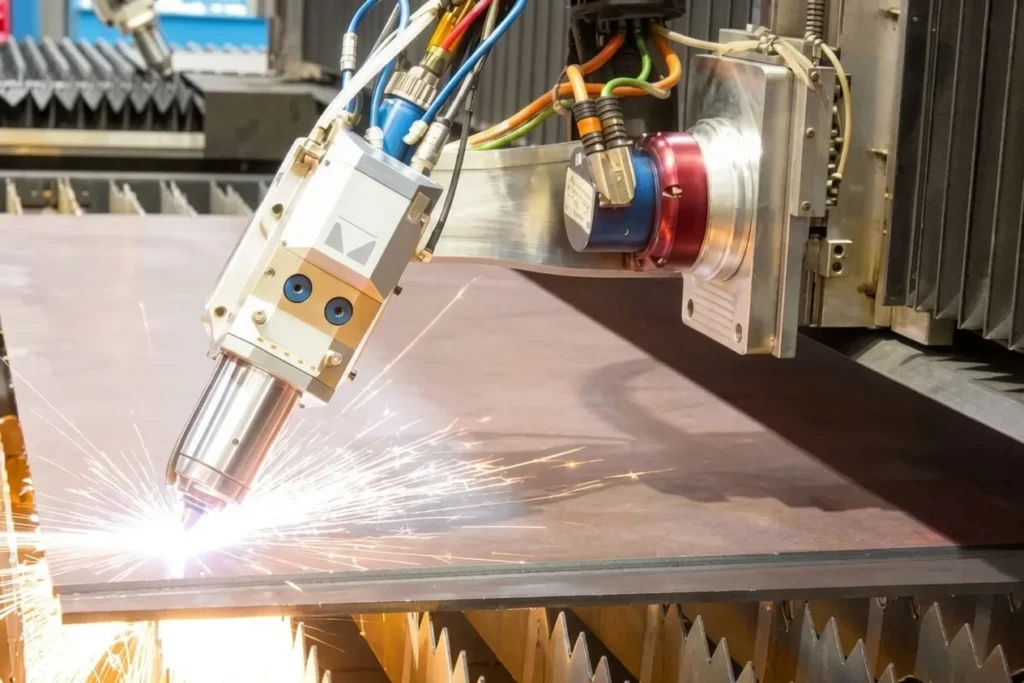
A high-power fiber laser uses a non-contact optical process. The primary consumables are the protective window and the nozzle. Because there is no electrical arc or high-velocity plasma jet eroding the tip, the nozzle life is significantly longer, and the protective windows last hundreds of cutting hours. The consumable cost per meter of cut is radically lower.
Table 1: Consumable and Gas Cost per Running Hour (25mm Carbon Steel)
| Категория затрат | High-Def Plasma (260A) | Fiber Laser (15kW) | Примечания |
|---|---|---|---|
| Consumable Cost / Hour | $18.00 – $25.00 | $4.00 – $7.00 | Electrodes & nozzles vs. windows & laser nozzles |
| Assist Gas Cost / Hour | $10.00 – $15.00 | $6.00 – $10.00 | High gas volume vs. oxygen-assisted cutting |
| Power Consumption / Hour | $8.00 – $12.00 | $10.00 – $14.00 | Laser source and chiller draw more power |
| Total OpEx / Hour | $36.00 – $52.00 | $20.00 – $31.00 | Plasma loses on consumables and gas |

1. The geometry of the plasma arc
The physics of a plasma arc inherently produces a cut edge with a distinct taper (bevel). On a 25mm plate, the bottom of the kerf is significantly wider than the top. This taper creates an immediate problem for welding: the joint gap is inconsistent.
To achieve a code-compliant weld, the operator must manually grind the edge to square it up, or use excessive weld wire to fill the gap. This secondary grinding is a hidden labor cost that is rarely factored into the initial machine purchase.
2. The laser edge is weld-ready
A fiber laser produces a highly focused beam, resulting in a kerf that is nearly perfectly parallel. The laser cut edge complies with ISO 9013 Range 2 standards, meaning the edge is square enough to fit up directly for welding without secondary grinding.
Table 2: Edge Quality & Secondary Labor Comparison (25mm Carbon Steel)
| Параметр | High-Def Plasma | Волоконный лазер | Влияние на производство |
|---|---|---|---|
| Kerf Taper | 2.0° – 4.5° | < 0.5° | Laser eliminates the need for edge squaring |
| ISO 9013 Quality | Range 4 – 5 | Range 2 – 3 | Laser provides superior geometric tolerance |
| Secondary Grinding Time | 3 – 5 min / meter | 0 min / meter | Eliminates $45/ton labor cost |
| Weld Fit-Up | Requires wide gap bridging | Tight fit-up, less filler wire | Saves weld wire and time |

Ⅲ. The 5-Year TCO Model: CapEx vs. OpEx
1. Factoring in the true cost
When comparing laser vs plasma cutting, we must look at the 5-year horizon. The plasma machine is cheaper to buy, but its higher operating costs (consumables, gas, grinding labor) accumulate year over year.
2. The break-even point
For a shop cutting 2,500 tons of 25mm carbon steel annually, the higher CapEx of a 15kW or 20kW fiber laser system is offset by its massive savings in consumables and secondary labor. The break-even point typically occurs within the first 18 to 24 months.
Table 3: 5-Year Total Cost of Ownership Comparison (Annual Volume: 2,500 Tons)
| Категория затрат | High-Def Plasma | Fiber Laser (15kW) | Savings with Laser |
|---|---|---|---|
| Initial Equipment CapEx | $120,000 | $350,000 | (Laser costs $230k more) |
| 5-Year Consumables & Gas | $450,000 | $180,000 | $270,000 saved |
| 5-Year Secondary Grinding Labor | $225,000 | $0 | $225,000 saved |
| 5-Year Power & Maintenance | $85,000 | $110,000 | (Laser costs $25k more) |
| Total 5-Year TCO | $880,000 | $640,000 | $240,000 Net Savings |

Ⅳ. Operational Bottlenecks: Workflow and Floor Space
1. The bottleneck of secondary handling
Plasma cutting creates a rigid workflow: cut the part, crane it to the grinding bay, grind the edges, then crane it to the welding station. This creates WIP (work-in-progress) inventory and uses valuable overhead crane time.
2. Single-pass processing
With a laser, the part moves directly from the cutting bed to the welding table. The elimination of the grinding station frees up floor space (typically 45 to 80 square meters) and allows the operator to focus on higher-value tasks. This lean workflow is especially critical in structural steel fabrication, where eliminating secondary bevel grinding drastically shortens lead times.
Table 4: Workflow and Shop Floor Impact
| Operational Metric | Плазменная резка | Fiber Laser Cutting | Преимущество |
|---|---|---|---|
| Material Handling Steps | 3 (Cut -> Grind -> Weld) | 1 (Cut -> Weld) | Reduced WIP and crane congestion |
| Floor Space for Secondary Ops | 45 – 80 m² | 0 m² | Frees up shop floor for new machines |
| Operator Requirement | 1 CNC Op + 2 Grinders | 1 CNC Op | Alleviates skilled labor shortage |
| OEE (Overall Equipment Effectiveness) | 45% – 55% | 75% – 85% | Higher throughput per machine |
Ⅴ. Commercial Verdict: Resolving the Laser vs Plasma Cutting Debate
If your shop cuts mostly thin gauge material (under 6mm), plasma remains a cost-effective, fast solution. However, for 20mm to 50mm heavy plate fabrication, the financial equation flips.
The fiber laser’s ability to produce weld-ready, square edges in a single pass eliminates the most expensive hidden cost in heavy fabrication: grinding labor. When you calculate the total cost of ownership over five years, the laser’s higher initial price is quickly swallowed by the daily savings in consumables, gas, and manpower.
Ⅵ. Frequently Asked Questions
Is laser vs plasma cutting cheaper for thick plate?
Plasma is only cheaper on the initial purchase price. A 260A plasma machine costs roughly one-third of a 15kW laser. However, plasma’s high consumable usage and the labor cost of grinding tapered edges make its 5-year Total Cost of Ownership significantly higher than a laser system.
Can a fiber laser cut through 25mm carbon steel?
Yes. A modern 15kW fiber laser reliably cuts 25mm carbon steel at production speeds (2.0–2.5 m/min) using oxygen assist gas. The cut edge is nearly vertical, allowing it to go directly to the welding station without additional grinding.
How much time is saved by eliminating secondary grinding?
On 25mm plate, grinding a plasma-cut edge to prepare for welding takes 3 to 5 minutes per meter. For a shop processing 2,500 tons a year, this translates to hundreds of hours of manual labor saved, directly improving the shop’s bottom line and reducing worker fatigue.
Does laser cutting use more electricity than plasma?
Yes, the laser source and chiller draw more power per hour. However, the electrical cost is a small fraction of the total operating cost. The massive savings in consumables (electrodes/nozzles) and labor far outweigh the additional electricity bill.
Список литературы
- ISO 9013:2017 — Thermal cutting — Classification of thermal cuts, International Organization for Standardization
- AWS D1.1/D1.1M:2020 — Structural Welding Code — Steel, American Welding Society
- FMA — Fabricators & Manufacturers Association: Laser and Plasma Cutting Cost Benchmarks, Ассоциация производителей и изготовителей
Дополнительная литература
- Structural Steel Fabrication: Laser Bevel Cutting & Payback Ledger — Analyzing the ROI of integrated laser beveling for heavy plates.
- 12kW Fiber Laser Cutting Machine Price: Upgrade Decision & Payback — Detailed capex and power infrastructure requirements.
- Стоимость часа работы лазерного резака: полный учетный журнал эксплуатационных расходов — Breaking down the hourly operational costs of a laser cell.
- Лазерная резка собственными силами или аутсорсинг: затраты и окупаемость инвестиций — When bringing cutting operations in-house makes financial sense.