
Every fiber laser cutting operation generates fume. Carbon steel produces iron oxide particulate. Stainless steel produces hexavalent chromium. Galvanized sheet produces zinc oxide. Aluminum and magnesium produce fine metallic dust with combustion characteristics that fall under combustible dust regulation.
A laser cutting fume extractor is not an optional accessory. It is the equipment that determines whether the workshop meets OSHA and CE indoor air quality standards, whether the building’s fire insurance remains valid, and whether the operator’s eight-hour exposure stays within permissible limits. This guide covers the regulatory thresholds, the airflow sizing for open versus enclosed tables, the dust collector architecture that prevents fire and explosion, and the five-year operating cost ledger.
Ⅰ. Environmental & Health Mandates: OSHA, CE, and Shop Air Quality Limits
1. Carbon steel and galvanized fume
Carbon steel cutting produces iron oxide fume with a particle size distribution centered around 0.1–1.0 μm. The OSHA permissible exposure limit for iron oxide fume is 10 mg/m³ as an 8-hour time-weighted average. Galvanized steel adds zinc oxide fume, which carries a separate PEL of 5 mg/m³ and causes metal fume fever at higher exposures.
2. Stainless steel and hexavalent chromium
Stainless steel contains chromium. When the laser cuts stainless, a fraction of that chromium oxidizes to hexavalent chromium (Cr⁶⁺), a known carcinogen. The OSHA PEL for hexavalent chromium is 5 μg/m³—three orders of magnitude tighter than the iron oxide limit. A filter system that meets the iron oxide requirement may not meet the hexavalent chromium requirement.
3. Aluminum and magnesium: combustible dust and explosion hazard
Aluminum and magnesium alloys produce fine metallic dust during laser cutting. This dust is classified as combustible under NFPA 652. A dry cartridge dust collector handling aluminum or magnesium dust can become a deflagration hazard if a spark reaches the accumulated dust in the hopper or on the filter media.
For aluminum and magnesium cutting, a standard dry cartridge collector is not acceptable. The correct configuration is either a wet scrubber that suppresses ignition, or a dry collector equipped with explosion venting, a chemical isolation valve, and a spark arrestor on the inlet duct. This is a code requirement, not a recommendation.
Table 1: OSHA & CE Permissible Exposure Limits (PEL) for Metal Laser Fumes
| Chất liệu | Primary Fume Component | OSHA PEL (8-hr TWA) | Filter Rating Required | Indoor Recirculation Compliance |
|---|---|---|---|---|
| Thép cacbon | Iron oxide | 10 mg/m³ | MERV 15–16 | Permitted with HEPA final stage |
| Galvanized steel | Zinc oxide | 5 mg/m³ | MERV 15–16 | Permitted with HEPA final stage |
| Thép không gỉ | Hexavalent chromium | 5 μg/m³ | HEPA H13 minimum | HEPA mandatory before recirculation |
| Aluminum / magnesium | Metallic dust (combustible) | 5 mg/m³ (respirable) | Wet scrubber or explosion-vented dry | Not permitted with standard dry collector |
Ⅱ. Airflow Engineering: Calculating Required CFM for Open vs. Enclosed Tables
1. Enclosed systems capture at the source
A fully enclosed laser housing contains the cutting process inside a sealed chamber. The extraction fan needs only to maintain a slight negative pressure inside the enclosure to prevent fugitive emissions. For a 3015 enclosed table, the required airflow runs 2,000–3,000 CFM—significantly lower than an open frame of the same size.
The enclosure does the containment work. The fan handles a smaller air volume because the fume never escapes into the shop until it reaches the extraction point.
2. Open frame tables rely on capture velocity
An open frame table has no enclosure. Fume escapes upward from the cutting zone, and the extraction must create sufficient capture velocity at the table surface to pull it downward before it disperses into the shop. The required capture velocity for laser fume is 0.5–1.0 m/s at the extraction point.
For a 3015 open table, the required airflow to achieve that capture velocity across the full table surface runs 4,000–6,000 CFM. For a 6025 table, it runs 8,000–12,000 CFM—a fan load that directly translates into a larger motor and a larger electricity bill.
3. Partitioned downdraft: cutting the CFM requirement
A partitioned downdraft table divides the table surface into zones, each with its own damper. Only the zone under the cutting head is open at any moment; the rest remain closed. Instead of pulling air through the entire table surface, the fan pulls only through the active zone.
This reduces the effective extraction area to roughly one-fifth of the full table, which cuts the required CFM by 50–65%. The table’s CNC fiber laser cutting table selection guide covers the zoning configurations available across table sizes.
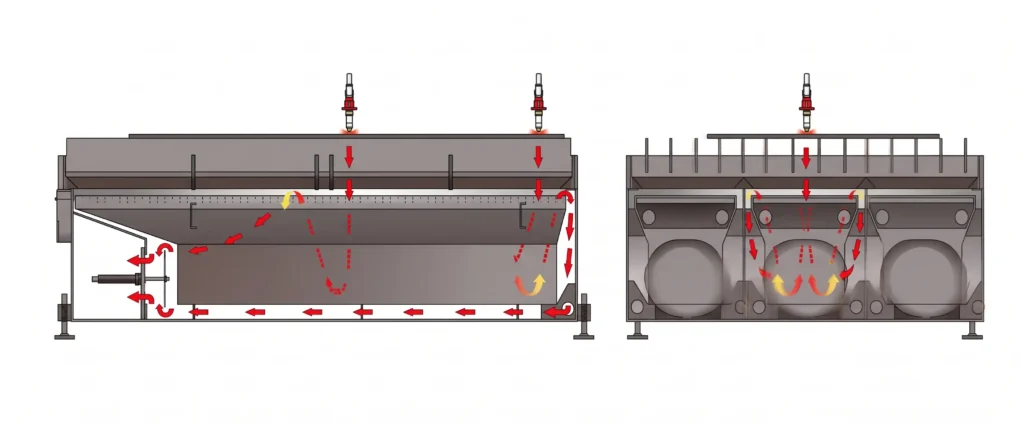
Table 2: Airflow (CFM) & Static Pressure Sizing by Laser Table Dimensions
| Table Size | Enclosure Type | Airflow (CFM) | Airflow (m³/h) | System Static Pressure | Fan Motor Power |
|---|---|---|---|---|---|
| 3015 (5×10 ft) | Fully enclosed | 2,000–3,000 | 3,400–5,100 | 1,500–2,000 Pa | 3.0–5.5 kW |
| 3015 (5×10 ft) | Open frame | 4,000–6,000 | 6,800–10,200 | 2,000–2,500 Pa | 7.5–11 kW |
| 4020 (6.5×13 ft) | Fully enclosed | 2,500–3,500 | 4,200–6,000 | 1,500–2,000 Pa | 4.0–7.5 kW |
| 6025 (8×20 ft) | Open frame, partitioned | 4,500–6,500 | 7,600–11,000 | 2,000–2,500 Pa | 7.5–11 kW |
| 8025 (8×26 ft) | Open frame, partitioned | 6,000–8,000 | 10,200–13,600 | 2,500–3,000 Pa | 11–15 kW |
Ⅲ. Laser Cutting Fume Extractor Anatomy: Flame-Retardant Cartridges & Spark Arrestors
1. Dry cartridge collector
A dry cartridge collector uses pleated filter media to capture fume particles, with a pulse-jet cleaning cycle that blasts compressed air through the cartridge to knock accumulated dust into the hopper. The cartridges must be flame-retardant and rated for the particle size being captured.
For stainless steel, a HEPA final stage is mandatory before the air is returned to the shop. For aluminum and magnesium, a dry cartridge collector requires explosion venting and inlet spark arrestor hardware to satisfy NFPA 652.
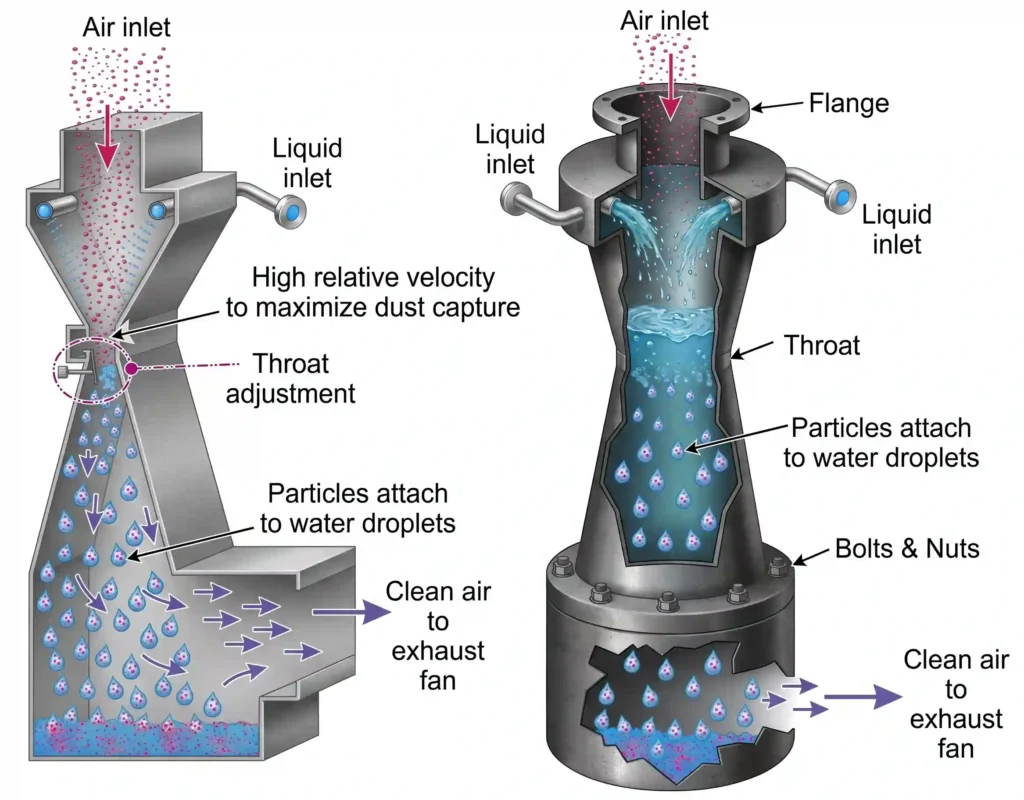
2. Wet scrubber
A wet scrubber pulls the fume through a water curtain or spray chamber, where particles are captured by water droplets and settle into a collection tank. The water suppresses sparks and eliminates the dust explosion hazard entirely.
Wet scrubbers are the correct choice for aluminum and magnesium cutting, where combustible dust classification makes dry collection impractical. The trade-off is the wastewater handling cost and the continuous maintenance of the water system.
3. Spark arrestor and pre-filtration
Regardless of collector type, the inlet duct should include a spark arrestor—a baffle or cyclone that causes sparks and glowing particles to fall out of the air stream before reaching the filter media. Without it, a spark can ignite the accumulated dust in the collector and cause a fire or deflagration.
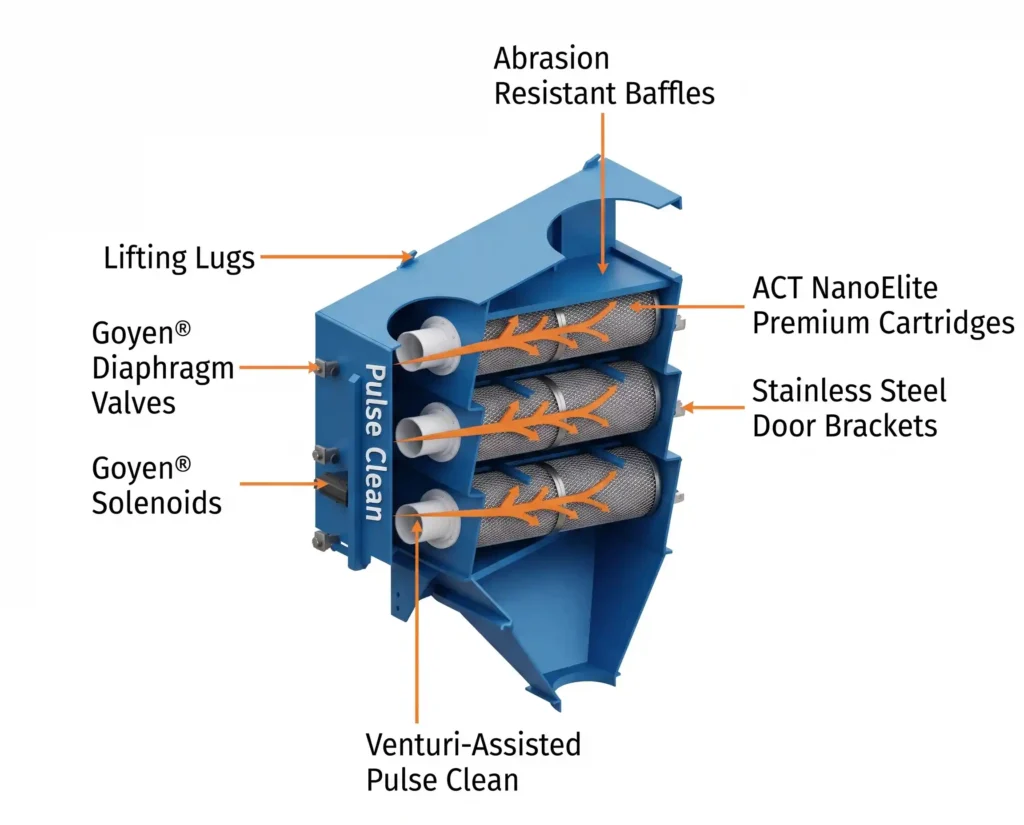
Table 3: Dry Cartridge vs. Wet Scrubber Dust Extraction Ledger
| Tham số | Dry Cartridge Collector | Wet Scrubber |
|---|---|---|
| Suitable for carbon/stainless | Yes | Yes |
| Suitable for aluminum/magnesium | Only with explosion venting | Yes (preferred) |
| Initial capex | $8,000–$25,000 | $15,000–$40,000 |
| Footprint | 2–4 m² | 3–6 m² |
| Wastewater / hazardous waste cost | $0 | $2,000–$5,000/year |
| Daily maintenance | Pulse-jet check, hopper empty | Water level, pH, sludge removal |
| Fire/explosion risk | Moderate to high (Al/Mg) | Thấp |
Ⅳ. Operating Cost & Maintenance Ledger: Filter Lifespan & Power Consumption
1. Fan motor power and transformer sizing
A 7.5–15 kW extraction fan is a significant electrical load. It must be included in the facility’s total connected load calculation alongside the laser source, chiller, and air compressor. The laser cutter power requirements and installation guide covers the transformer sizing formula that incorporates the extraction fan load.
2. Filter cartridge lifespan
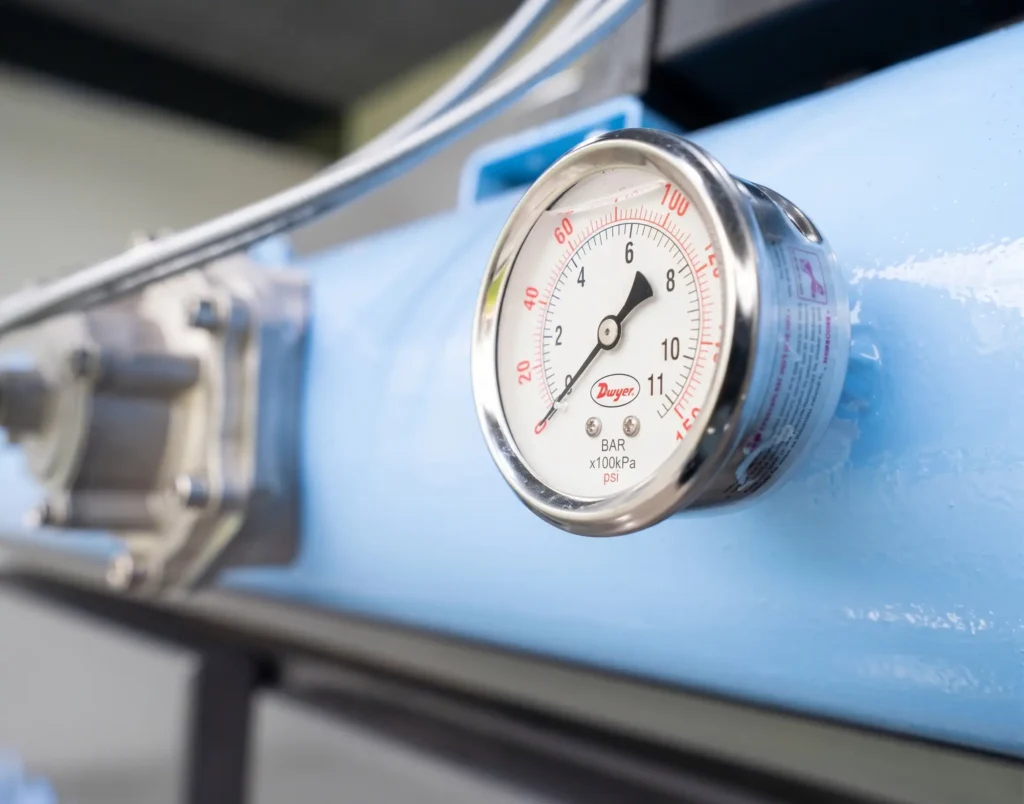
Flame-retardant nanofiber polyester cartridges typically last 2,500–4,000 operating hours before replacement. The lifespan depends on the fume loading, the pulse-jet cleaning frequency, and whether the inlet spark arrestor is functioning. A differential pressure gauge on the collector indicates when the cartridges are loaded and require replacement.
3. Pulse-jet compressed air consumption
The pulse-jet cleaning system uses compressed air to knock dust off the cartridges. The air consumption depends on the number of cartridges and the cleaning frequency, typically 0.1–0.3 m³/min for a 3015-class collector. This air must be clean and dry, which means it shares the same filtration requirements as the laser assist air.
4. Five-year cost projection
The table below consolidates the five-year operating cost of a typical 3015-class industrial laser cutting fume extractor, covering filter replacement, fan electricity, pulse-jet air, and hazardous waste disposal.
Table 4: 5-Year Operating & Maintenance Ledger for Industrial Laser Dust Collectors
| Cost Category | Annual Cost | 5-Year Total |
|---|---|---|
| Flame-retardant cartridges (2,500–4,000 hr life) | $3,000–$6,000 | $15,000–$30,000 |
| Fan motor electricity (7.5 kW, 4,000 hr/yr) | $2,700–$3,600 | $13,500–$18,000 |
| Pulse-jet compressed air | $600–$1,200 | $3,000–$6,000 |
| Hazardous waste disposal (filter media) | $500–$1,500 | $2,500–$7,500 |
| Total 5-year operating cost | $6,800–$12,300 | $34,000–$61,500 |
Assumes 4,000 operating hours per year, $0.12/kWh electricity, and standard dust loading. Heavy stainless or galvanized cutting shortens cartridge life.
Ⅴ. Frequently Asked Questions
How many CFM is needed for a 5×10 fiber laser cutter?
An enclosed 5×10 table requires 2,000–3,000 CFM. An open frame 5×10 requires 4,000–6,000 CFM without partitioning, or roughly 2,500–3,500 CFM with a partitioned downdraft system. The fan motor ranges from 3.0 kW for enclosed to 11 kW for open frame without partitioning.
Is a spark arrestor necessary for fiber laser dust collectors?
Yes, on any dry cartridge collector. The spark arrestor prevents glowing particles from reaching the filter media and igniting accumulated dust. For aluminum or magnesium cutting, NFPA 652 also requires explosion venting and isolation hardware on the collector itself. A wet scrubber eliminates this requirement by suppressing sparks in water.
Can laser exhaust be vented directly outside without filtration?
Only if local regulations permit unfiltered discharge and the exhaust stack is positioned to prevent re-entrainment into the building or neighboring properties. Most jurisdictions require filtration before discharge, and indoor recirculation always requires HEPA filtration for stainless steel (hexavalent chromium) and carbon steel (iron oxide).
Tài liệu tham khảo
- 29 CFR 1910.1000 — Air Contaminants (OSHA Permissible Exposure Limits), U.S. Code of Federal Regulations
- ISO 21904-1 / ISO 15012-1 — Health and Safety in Welding and Allied Processes, International Organization for Standardization
- NFPA 652 — Standard on the Fundamentals of Combustible Dust, National Fire Protection Association
Tài liệu tham khảo thêm
- Machine Bed Architecture & Foundation Vibration Control — How bed construction and foundation design interact with extraction ducting.
- Laser Cutter Cost Per Hour: The Full Shop Floor Operating Ledger — Every operating cost line, including extraction, in one model.
- Sheet Metal Automation: Lights-Out Manufacturing — How automated systems handle fume extraction during unattended night shifts.
- Fiber Laser Cutting Machine for Sale: Industrial Buyer’s Evaluation Guide — Full enclosure and environmental certification checklist.
- Máy cắt laser sợi quang kín hoàn toàn có bàn trao đổi — Engineered with negative-pressure zoned extraction chambers for effortless OSHA and CE shop compliance.