
Table of Contents
Ⅰ. Introduction
What is laser cutting machine technology, and why has it become the backbone of modern metal fabrication services? A laser cutting machine is a CNC-controlled system that uses a concentrated beam of coherent light to melt, burn, or vaporize material—most commonly metals—with extraordinary precision. According to The Business Research Company, the global laser cutting machine market reached $6.65 billion in 2026 and is projected to grow to $9.52 billion by 2030 at a CAGR of 9.4%. This explosive growth is driven by surging demand across automotive, aerospace, and electronics sectors. In this guide, we break down exactly what is a fibre laser cutting machine, how the core physics work, and why the right machine configuration can transform your production floor.
Ⅱ. The Core Principle: How Does a Laser Cutting Machine Work?
At its essence, laser cutting is a thermal separation process. Instead of mechanical force, it harnesses electromagnetic energy to remove material. Understanding this principle is critical for any manufacturer evaluating capital equipment.
1. The Generation of the Laser Beam
The process begins inside the laser source, where electrical energy excites a gain medium—typically ytterbium-doped fiber for modern industrial systems. This stimulated emission produces a coherent, monochromatic beam at approximately 1,064 nm wavelength. Unlike conventional light, laser photons travel in phase, enabling the beam to carry immense energy in a tightly controlled path. For a deeper technical overview of this energy conversion process, see the fundamentals of laser cutting basics.
2. Focusing and High Energy Density
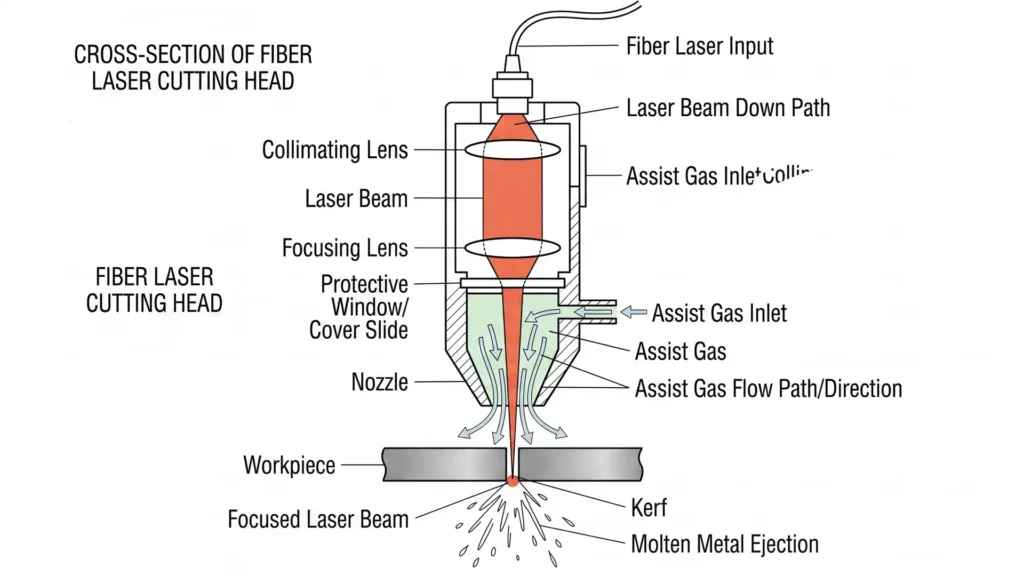
Once generated, the beam travels through fiber optic cables or mirror arrays to the cutting head, where a convex lens focuses it onto a spot diameter as small as 25–100 µm. This focusing action creates energy densities exceeding 10⁶ W/cm²—hot enough to melt or vaporize metal almost instantaneously. Research published in the International Journal of Advanced Manufacturing Technology confirms that focus position has the dominant effect on kerf width and cut quality, more than cutting speed or gas pressure alone.
3. The “Melt and Blow” Process
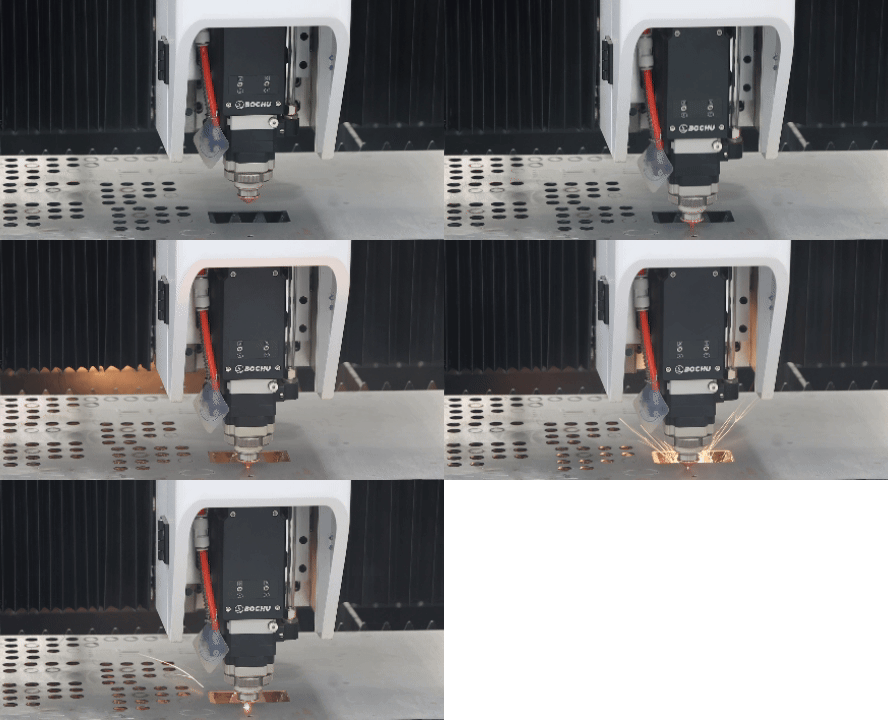
Here is where physics meets engineering precision. The focused beam heats the material above its melting point. Simultaneously, a coaxial laser de gas jet—typically nitrogen, oxygen, or compressed air—blows the molten material out of the kerf at pressures ranging from 0.3 to 2.0 MPa depending on material thickness. This “melt and blow” mechanism is the defining characteristic of industrial laser cutting.
Table 1: Three Physical Mechanisms of Laser Cutting
| Mechanism | Process Description | Assist Gas | Typical Application |
|---|---|---|---|
| Melt Cutting | Laser melts material; inert gas blows molten metal from kerf | Nitrogen (N₂) | Stainless steel, aluminum (oxide-free edges) |
| Oxidation-Assisted Cutting | Oxygen reacts with heated metal, adding exothermic energy | Oxygen (O₂) | Mild steel, thick carbon steel |
| Vaporization Cutting | Material heated until direct vaporization/ablation | Nitrogen or Air | Thin materials, precision micro-features |
Ⅲ. Anatomy of a Laser Cutter: Core Structural Components
A laser cutting machine is far more than its laser source. Stable, repeatable production depends on the seamless integration of optical, mechanical, thermal, and control subsystems.
Table 2: Core Structural Components and Functions
| Component | Primary Function | Critical Parameter |
|---|---|---|
| Laser Source | Generates coherent laser beam | Wavelength, output power (1–30 kW), beam quality (M²) |
| Cutting Head | Focuses beam and directs assist gas | Focal length, nozzle diameter, stand-off distance |
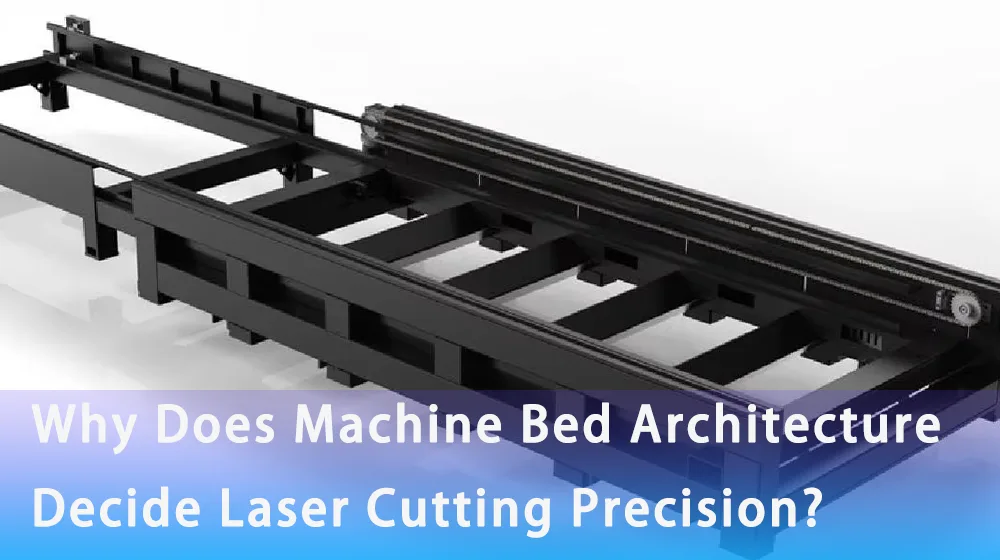
| Machine Bed Frame | Provides rigid motion platform | Positioning accuracy (±0.01 mm), repeatability |
| CNC Control System | Converts CAD data into toolpaths | Axes coordination, adaptive parameter control |
| Chiller | Maintains thermal stability of source and optics | Cooling capacity, temperature stability (±0.5°C) |
| Exhaust System | Removes smoke, particulates, and fumes | Airflow volume (m³/h), filtration efficiency |
1. The Laser Source
The laser source is the heart of the system. Modern industrial machines predominantly use fiber laser sources due to their superior wall-plug efficiency—approximately 2–3× better than CO₂ systems—and minimal maintenance requirements. Fiber lasers also excel at cutting reflective metals such as aluminum, brass, and copper, which historically challenged CO₂ systems.
Table 3: Fiber Laser vs. CO₂ Laser Cutting Systems
| Parameter | Fiber Laser | CO₂ Laser |
|---|---|---|
| Wavelength | 1,064 nm | 10,600 nm |
| Beam Spot Size | 25–100 µm | 100–250 µm |
| Kerf Width | 0.10–0.15 mm | 0.20–0.40 mm |
| Energy Efficiency | 25–30% | 10–15% |
| Maintenance | Low (no mirrors) | High (mirror alignment, gas refill) |
| Best For | Metals, reflective materials | Non-metals, thick mild steel |
2. The Laser Cutting Head
The cutting head houses the focusing lens, protective windows, and the gas nozzle. Its ability to maintain precise stand-off distance—typically 0.5–1.5 mm above the workpiece—directly determines edge quality. Capacitive height sensors continuously adjust this distance in real time, compensating for sheet warp and surface variation.
3. The Machine Bed Frame
Rigidity is non-negotiable. A high-quality machine bed uses stress-relieved welded steel or cast iron construction to dampen vibration during high-speed traversal. Positioning accuracy of ±0.01 mm and repeatability of ±0.005 mm are now standard benchmarks for industrial-grade equipment.
4. CNC Control System
The CNC controller translates CAD/CAM files into synchronized motion commands. Modern systems support adaptive process control—adjusting laser power, speed, and gas pressure dynamically based on material thickness and geometry. This integration with automation is why some automated cells now achieve operational uptime improvements exceeding 40%.
5. Auxiliary Systems: Chiller & Exhaust
The chiller maintains the laser source and optics within a tight thermal window. Even a 1°C drift can alter beam characteristics and degrade cut quality. The exhaust and dust collection system is equally critical—it removes hazardous particulates and prevents contamination of optical surfaces, extending lens life and protecting operator health.
Ⅳ. Key Functions and Industrial Advantages
For manufacturers and procurement managers, the question is simple: what tangible benefits does this technology deliver? The answer lies in three core advantages backed by industry data.
1. Extreme Precision and Narrow Kerf
Fiber lasers achieve kerf widths as narrow as 0.10–0.15 mm on thin materials—approximately 65% narrower than plasma cutting—with thermal distortion limited to 0.08 mm/m in stainless steel. This precision minimizes material waste and often eliminates secondary finishing operations.
2. High-Speed Processing and Flexibility
Fiber laser systems cut thin metal sheets at speeds up to three times faster than CO₂ lasers while consuming significantly less electrical energy. Combined with rapid job changeover via CNC nesting software, this speed translates directly into higher throughput and shorter lead times for metal fabrication services.
3. Broad Material Compatibility
From mild steel and stainless steel to aluminum, brass, copper, and even certain coated materials, modern fiber laser platforms handle an exceptionally broad material spectrum. The 1,064 nm wavelength provides superior absorption on reflective metals compared to CO₂ systems, opening applications in electronics, EV battery enclosures, and renewable energy component manufacturing.
Table 4: Material Compatibility and Recommended Assist Gas
| Material | Thickness Range | Recommended Gas | Edge Quality |
|---|---|---|---|
| Mild Steel | 0.5–25 mm | Oxygen (fast) / Nitrogen (clean) | Good to Excellent |
| Stainless Steel | 0.5–30 mm | Nitrogen (99.99% purity) | Excellent (oxide-free) |
| Aluminum | 0.5–20 mm | Nitrogen or Compressed Air | Good |
| Brass | 0.5–12 mm | Nitrogen | Good |
| Copper | 0.5–8 mm | Nitrogen (high pressure) | Good |
Ⅴ. FAQ
Q1: What is a fibre laser cutting machine compared to a standard laser cutter?
A fibre laser cutting machine uses a solid-state fiber laser source with a 1,064 nm wavelength. It offers higher efficiency, lower maintenance, and superior performance on reflective metals compared to traditional CO₂ systems.
Q2: How thick of a material can a laser cutting machine handle?
Industrial fiber laser systems commonly cut mild steel up to 25–30 mm, stainless steel up to 30 mm, and aluminum up to 20 mm, depending on laser power and assist gas configuration.
Q3: Why does assist gas type matter so much?
The laser de gas directly influences cut speed, edge oxidation, and dross formation. Nitrogen produces oxide-free edges ideal for welding or painting; oxygen increases speed on carbon steel but leaves an oxidized edge.
Q4: What maintenance does a laser cutting machine require?
Key maintenance includes lens and nozzle inspection, chiller coolant checks, exhaust filter replacement, and periodic focus calibration. Fiber lasers require significantly less maintenance than CO₂ systems due to the absence of optical mirrors.
Q5: Is a laser cutting machine suitable for small-batch or prototype work?
Yes. CNC-controlled laser cutting excels in both high-volume production and small-batch prototyping due to zero tooling changeover and rapid nesting software deployment.

Ⅵ. Conclusion
What is laser cutting machine technology if not the convergence of optical physics, precision mechanics, and intelligent automation? From the generation of the laser beam to the final melt and blow ejection of molten metal, every subsystem in a modern laser cutter is engineered for one purpose: delivering repeatable, high-quality cuts at industrial scale. As global demand accelerates—fueled by electric vehicle manufacturing, aerospace lightweighting, and smart factory integration—investing in the right laser cutting platform is no longer optional for competitive metal fabrication services. For more insights into CNC laser technology and production optimization, explore our technical blog.