

This is not a black-box auto-quoting tool. This is a transparent pricing guide for industrial laser cutting. Whether you are a job shop owner setting rates for the first time, an estimator building a quoting model, or a procurement manager checking whether a supplier’s price is fair, this article gives you the actual cost formulas and market logic behind professional laser cutting quotes.
A laser cutting quote is built from four components: material cost, cutting cost per meter, pierce cost per hole, and handling or setup fees. The shops that quote well know each of these numbers. The shops that quote badly either lose money on every job or lose the job because the price is too high. This guide breaks down the full model so you can quote with confidence.
En WSL Laser, we supply the machines that job shops use to build their businesses. We know what it costs to run them, and we know what a sustainable quote looks like.
Ⅰ. The Two Quoting Models, and the Formula That Works
1. Hourly Rate vs. Per-Meter Pricing
Industrial laser cutting shops price work in two ways. The first is a flat hourly rate that covers the machine, the operator, and a margin. The second is a parametric quote based on cut length, pierce count, and material. The hourly model is fast and works well for prototypes and short runs. The per-meter model is more accurate and is the standard for production work.
The per-meter model wins over time because it forces the shop to understand exactly where the cost lives in each part. A part with 50 pierce holes and 10 meters of cutting costs more than a part with 20 pierce holes and 8 meters, even if the material is the same. The quoting formula reflects that.
| Quoting Model | How It Works | Ideal para |
|---|---|---|
| Hourly Rate | Fixed charge per machine hour, typically $80–$150 | Short runs, prototypes, one-off jobs |
| Per-Meter / Per-Pierce | Cut length × rate + pierce count × rate + material | High-volume repeat production |
2. The Part-Level Quoting Formula
The most reliable way to quote a laser-cut part is to add up the four cost components:
| Componente | Formula Input | What It Covers |
|---|---|---|
| Material | Material Cost × (1 + Markup) | Sheet cost plus handling and margin |
| Cutting | Cut Length × Rate per Meter | Machine time for the cutting path |
| Piercing | Pierce Count × Rate per Pierce | Each pierce cycle’s time and gas |
| Handling | Fixed or per-part charge | CAD, loading, sorting, packaging |
A 20mm carbon steel pierce takes 2 to 3 seconds and consumes high-pressure oxygen. It must be priced separately. A 1mm stainless steel part cut with fly piercing has a pierce cost that is almost negligible. The quoting model must reflect these differences or the shop will underprice thick plate work and overprice thin sheet work.
Ⅱ. Machine Hourly Cost: Know Your Number Before You Quote
1. The Machine Burden Rate Formula
The foundation of any accurate quote is the machine’s true hourly cost. This is not the same as the electricity bill. It is the full burden rate that includes depreciation, rent, financing, and the variable costs of power, gas, labor, and consumables.
| Cost Component | What It Includes |
|---|---|
| Depreciation | Machine purchase price ÷ service life in hours |
| Rent and Overhead | Shop floor space, insurance, admin share |
| Financing | Monthly payment ÷ monthly cutting hours |
| Power | Electrical cost per cutting hour |
| Assist Gas | Nitrogen, oxygen, or compressed air per hour |
| Labor | Operator wage including burden |
| Consumibles | Nozzles, protective windows, filters |
A 6kW machine with a $180,000 purchase price, running 200 hours per month, with gas, labor, and consumables included, typically carries a full hourly cost between $35 and $55. The exact number depends on the gas strategy and the local labor market. The assist gas component is often the most controllable variable, as explained in our Guía sobre el coste del gas para el corte por láser.
2. The Variable Cost of Gas in Every Quote
Gas choice changes the quote. A 3mm carbon steel part cut with compressed air carries a gas cost of $2 to $5 per hour. The same part cut with nitrogen carries $15 to $30. If the shop quotes both jobs at the same price, the nitrogen job is far less profitable.
This is why quoting and gas strategy are linked. A shop that knows its gas cost per material and thickness can quote precisely. A shop that ignores gas cost quotes a single rate and hopes for the best. The difference shows up on the income statement at the end of the month.
Ⅲ. Setting the Margin
1. What the Market Will Bear
The market rate for industrial laser cutting varies by region, but the range is well established. In North America and Western Europe, job shops typically charge between $80 and $150 per machine hour, or the equivalent in per-meter and per-pierce rates. In more competitive markets, the rate drops, but the cost structure drops with it.
The margin is what remains after the machine burden rate and the material cost are covered. A shop with a $45 per hour burden rate and an $80 per hour billing rate carries a 44% gross margin. A shop with the same burden rate and a $60 billing rate carries only 25%. Both shops have the same machine. The difference is the quoting discipline.
2. Margin by Job Type
Not all jobs deserve the same margin. High-volume repeat work with stable setups can be quoted at a lower margin because the volume compensates. One-off prototypes and rush jobs should carry a higher margin because they consume more setup time and interrupt production flow.
The smart shop builds a quoting model that differentiates by order type. Production work pays the bills. Prototype work pays for the interruptions. A shop that quotes both at the same rate is leaving money on the table in one direction and pushing it away in the other. The full business logic behind this is covered in our laser cutting business guide.
Ⅳ. Fast Quoting in Practice
1. Parametric Quoting from CAD Files
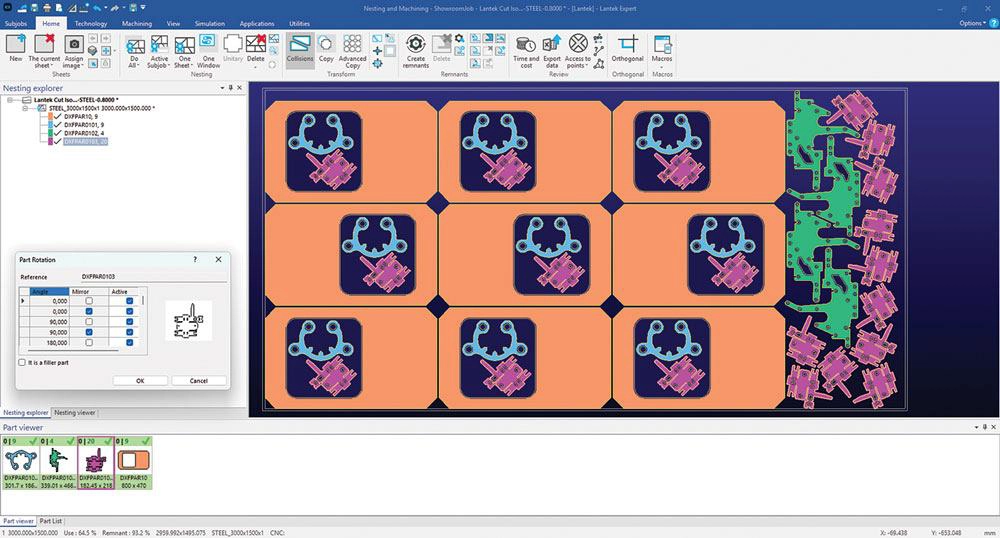
Modern laser cutting shops quote from CAD files. The cutting software extracts the cut length, pierce count, and part bounding box directly from the drawing. These numbers feed directly into the quoting formula. What used to take an hour of manual calculation now takes minutes.
The accuracy is better too. The software counts every pierce, measures every meter of cutting, and flags features like small holes or fine contours that will slow the machine down. The quote is built from the same data that drives the machine, which eliminates the gap between what was quoted and what actually happens on the shop floor.
2. Nesting and Material Utilization
The quote must also account for material utilization. A part that nests efficiently on a standard sheet leaves less waste and costs less in material. A part with an awkward shape that wastes half the sheet must carry that waste in its quote.
Nesting software calculates the material utilization before the quote is issued. If a part nests at 85% utilization on a standard sheet, the material cost is predictable. If it nests at 60%, the material cost rises and the quote must rise with it. A shop that quotes before nesting is guessing.
Ⅴ. FAQ: Laser Cutting Quote Questions
1. What is a fair price per meter for laser cutting?
The price per meter depends on the material, the thickness, and the machine power. For 3mm carbon steel, a typical range is $0.30 to $0.80 per meter of cutting, excluding material. For 10mm plate, the rate rises to $1.00 to $2.50 per meter because the machine runs slower and the gas consumption is higher. These are market reference points, not universal prices.
| Material & Thickness | Typical Price per Meter | Notas |
|---|---|---|
| 3mm Carbon Steel | $0.30–$0.80 | Excluding material cost |
| 10mm Carbon Steel | $1.00–$2.50 | Slower speed, higher gas use |
| 1mm Stainless Steel | $0.50–$1.20 | Nitrogen assist required |
| 3mm Aluminum | $0.60–$1.50 | Higher power required |
2. How do I quote pierce holes?
Pierce holes are priced individually because each pierce consumes time and gas. A typical rate is $0.10 to $0.50 per pierce depending on the material thickness. Thick plate pierces are more expensive because they take longer and use more oxygen. Thin sheet pierces are cheaper, especially with fly piercing technology.
3. Should I charge extra for thin sheet cutting?
No. Thin sheet cuts fast and the machine cost per meter is low. The challenge with thin sheet is not the cutting itself, but the material handling and the risk of warping. These costs are usually covered in the handling charge, not in the per-meter rate.
4. How do I handle material costs in a quote?
Material cost is passed through with a markup, typically 10 to 30 percent. The markup covers procurement, storage, handling, and the risk of sheet damage before cutting. Some shops also charge for the skeleton waste if the part does not nest efficiently. The key is transparency: the customer should see the material cost as a separate line item.
5. What is the biggest quoting mistake new shops make?
Underquoting. New shops are eager to win work and price too low. They discover later that the gas, the pierce cycles, and the handling have eaten the margin. The fix is to build a quoting model that includes every cost component before the first job is accepted. If the model is right, the quote protects the margin automatically.
Ⅵ. Conclusion: Quoting Is a System, Not a Guess
A laser cutting quote is not a number pulled from the air. It is the output of a system that knows the machine’s hourly cost, the material markup, the cut length, and the pierce count. The shops that treat quoting as a system stay profitable through market shifts. The shops that treat it as a guess ride the margin rollercoaster until it throws them off.
En WSL Laser, we build machines for shops that take their numbers seriously. The machine is the platform. The quoting model is the profit engine.
Referencias
- ISO 9013: Corte térmico — Clasificación de los cortes térmicos, Tienda online de ANSI.
- Improving Compressed Air System Performance: A Sourcebook for Industry, U.S. Department of Energy.
- Industrial Metal Fabrication and Job Shop Benchmarking Surveys, Asociación de Fabricantes y Productores.





