
A fabrication shop can spend more on assist gas in a year than it spends on the machine’s electricity, maintenance, and consumables combined. Evaluating liquid oxygen for laser cutting alongside bulk nitrogen and compressed air determines whether that money buys cutting speed or disappears into the atmosphere.
This guide compares the three supply modes on the variables that determine the true cost of operation: the storage infrastructure, the Capex to install it, the boil-off loss that occurs whether the machine runs or not, and the cost per cutting hour on different materials.
Ⅰ. The Storage Modes and Infrastructure Capex
1. Bulk Liquid Tanks: Oxygen and Nitrogen
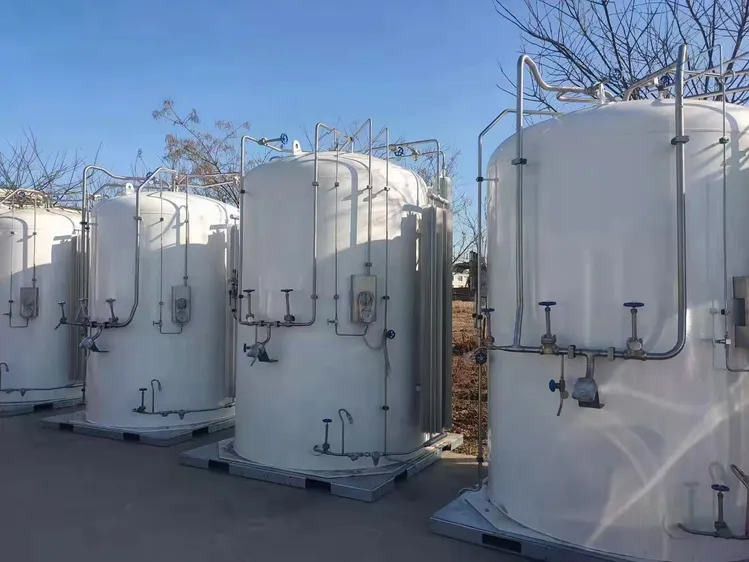
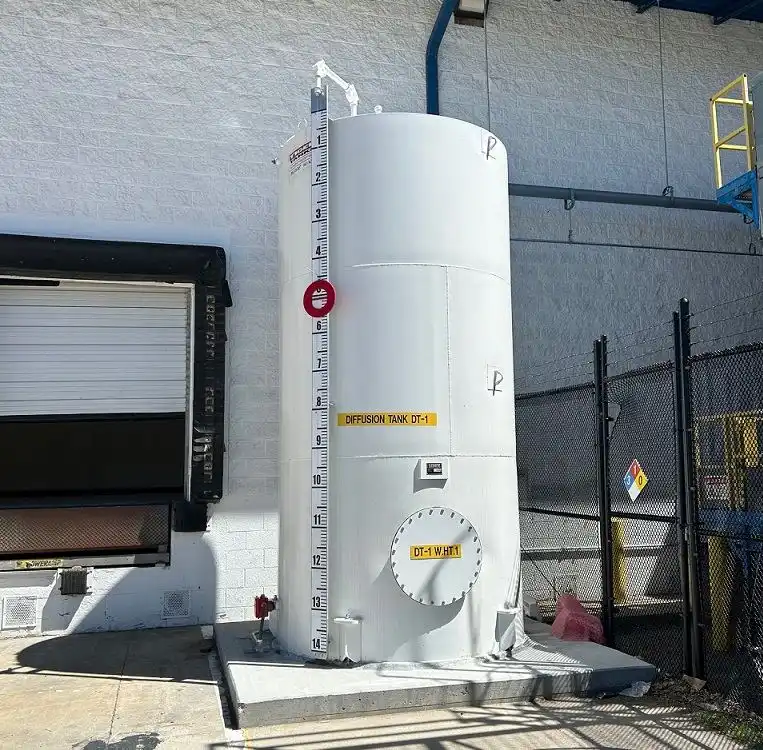
A bulk liquid tank is the highest-volume supply mode. The tank is installed outside the shop, connected to a vaporizer that converts the liquid to gas, and piped to the cutting machine. The supply is refilled by a cryogenic delivery truck on a scheduled route.
The infrastructure requirement is significant. The tank requires a concrete pad rated for the full weight of a filled tank. The pad must be sized to meet the local fire code separation distance from buildings and property lines. The vaporizer, the pressure regulator, and the safety relief valves are part of the installation.
For a liquid oxygen tank, there is an additional requirement. Oxygen is a strong oxidizer. The piping, the valves, and the tank fittings must be cleaned for oxygen service and free of any hydrocarbon contamination. A single drop of oil in an oxygen line is a fire hazard.
2. Dewars and Cylinders
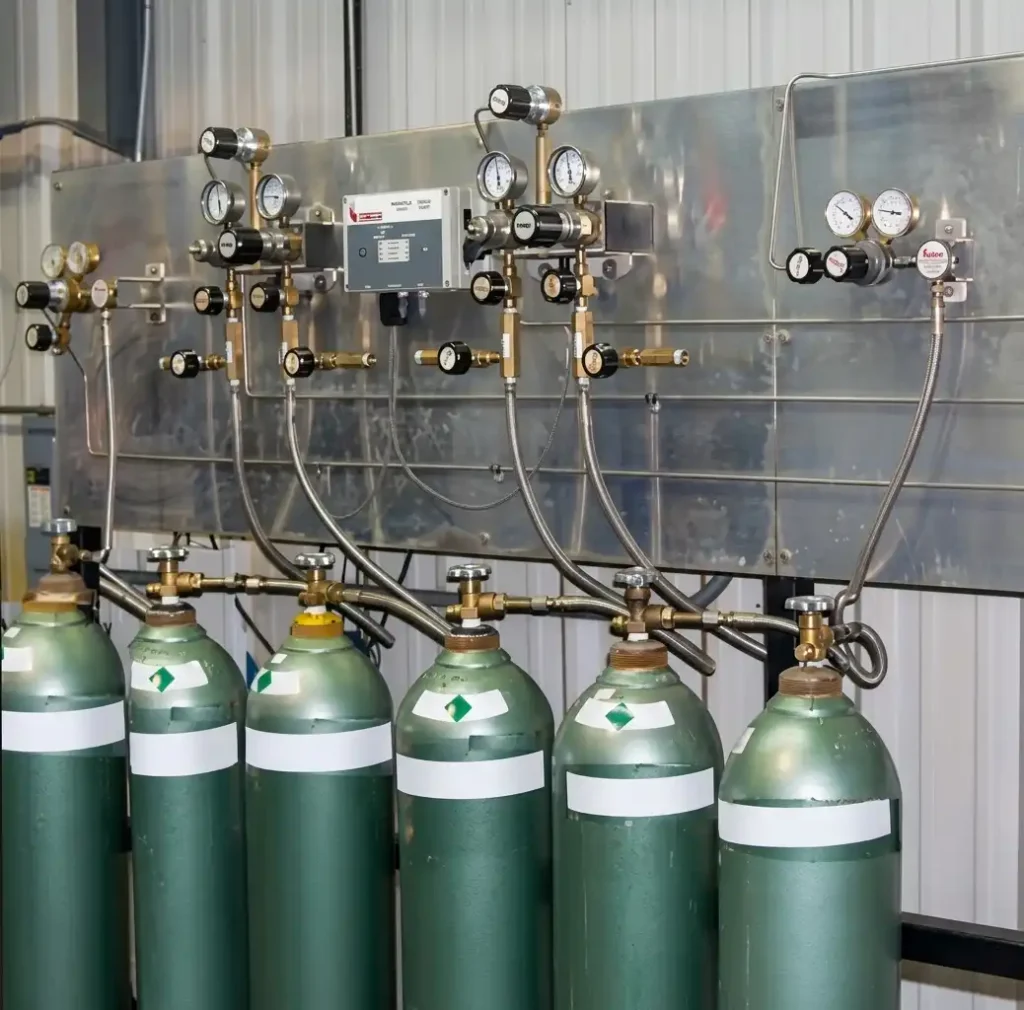
A dewar is a vacuum-insulated container that holds liquid gas at low volume. The dewar is delivered by a small truck, connected to the machine, and returned when empty. A cylinder bank is a manifold of high-pressure gas cylinders, used for smaller shops or for gases that are not available in liquid form at the required volume.
The Capex for a dewar or cylinder system is lower than a bulk tank, but the operating cost per cubic meter is higher. The delivery frequency is higher, and the labor to change the containers is a recurring cost.
3. Compressed Air
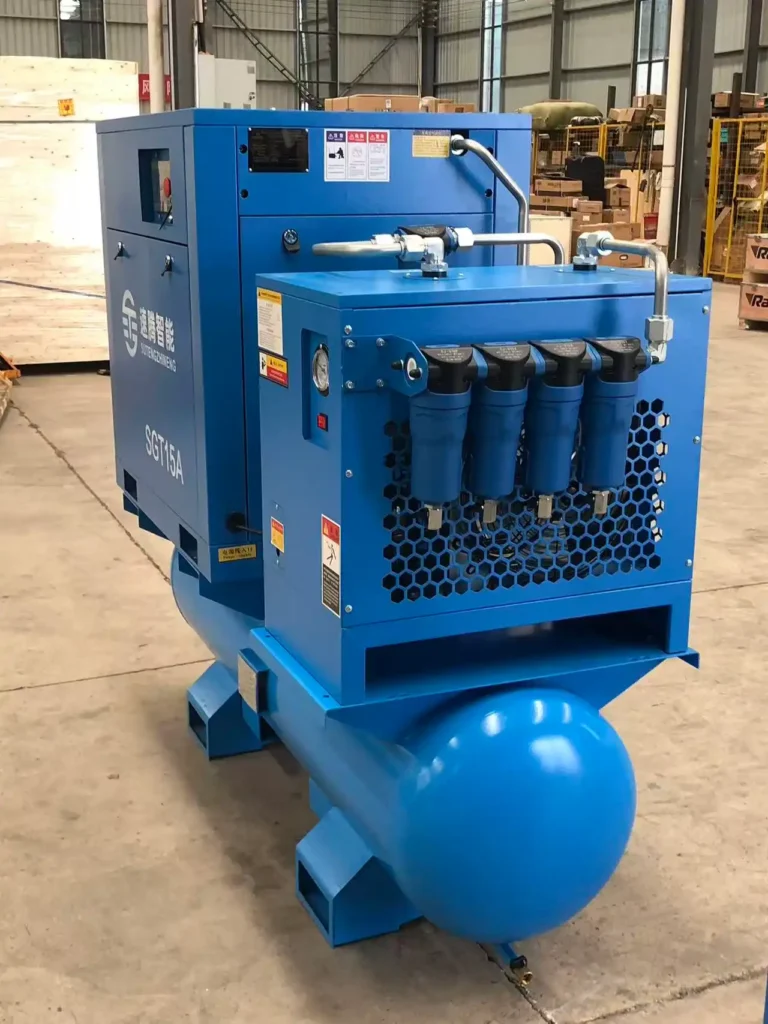
Compressed air is generated on-site by a dedicated air compressor for laser cutting, eliminating external gas deliveries. The compressor draws ambient air, compresses it to the required pressure, and passes it through a filtration train to remove oil, water, and particulate.
The Capex for a compressed air system is lower than a bulk tank, but the system is electrically intensive. The compressor is the largest electrical load in the shop after the laser source itself.
Table 1: Gas Supply Infrastructure and Capex Comparison
| Paramètre | Bulk Liquid Tank (O₂ / N₂) | Dewar / Cylinder | Compressed Air System |
|---|---|---|---|
| Outdoor footprint | 15–25 m² concrete pad | Minimal | 3–6 m² indoor |
| Vaporizer / regulator | Required | Built into dewar | Built into compressor |
| Safety separation | Fire code required | Storage cabinet | Aucun |
| Typical Capex | $15,000–$30,000 (tank pad & piping) | $0 (supply contract) | $18,000–$30,000 (compressor) |
| Delivery frequency | Scheduled truck | Weekly or bi-weekly | Aucun |
Ⅱ. The Gas Selection Matrix: When to Use Liquid Oxygen for Laser Cutting
1. Carbon Steel: Oxygen or Compressed Air
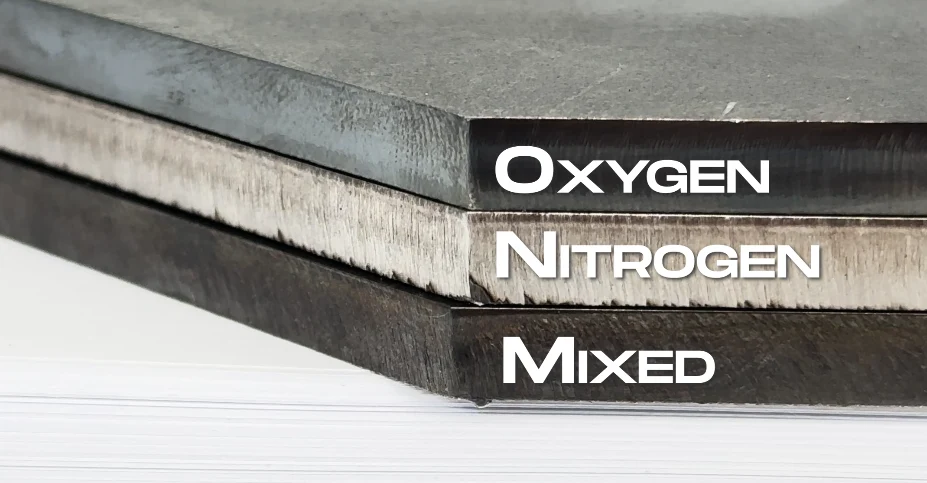
Carbon steel is cut with oxygen or compressed air. The oxygen reacts with the iron, generating an exothermic reaction that supplies the cutting energy. The cut is fast, but the edge is oxidized.
Compressed air is used on thinner carbon steel where the oxidation is acceptable. The air does not provide the exothermic reaction, so the cutting speed is lower, but the gas cost is near zero.
2. Stainless Steel: Nitrogen
Stainless steel is cut with nitrogen. The nitrogen is inert, and it does not react with the steel. The cut edge is oxide-free, which is required for welding and for corrosion resistance.
Oxygen cannot be used on stainless steel. The oxygen reacts with the chromium in the alloy, depleting the corrosion-resistant layer at the cut edge. The edge will rust.
3. Aluminum: Nitrogen
Aluminum is cut with nitrogen for the same reason as stainless steel. The inert gas prevents oxidation at the cut edge. Compressed air can be used on non-cosmetic aluminum parts where the edge oxidation is acceptable.
Table 2: Gas Selection by Material
| Matériau | Essence recommandée | Reason | Alternative |
|---|---|---|---|
| Carbon steel (thick) | Oxygène (O₂) | Exothermic reaction for speed | Air on thin sheet |
| Carbon steel (thin) | Compressed air | Cost saving, acceptable edge | Oxygène |
| Acier inoxydable | Azote (N₂) | Oxide-free edge | Aucun |
| Aluminium | Azote (N₂) | Oxide-free edge | Air on non-cosmetic parts |
Ⅲ. Boil-Off Loss: The Cost You Cannot See
1. The evaporation rate
A bulk liquid tank is not a sealed container. The insulation slows the heat transfer, but it does not stop it. The liquid gas absorbs heat from the ambient environment and boils off, and the resulting gas is vented to the atmosphere through the relief valve.
The evaporation rate for a standard bulk tank is 1.0% to 2.5% of the tank capacity per day. The rate depends on the tank size, the insulation quality, and the ambient temperature.
2. The weekend cost
On a 3,000-liter tank, a 1.5% daily evaporation rate equals 45 liters lost per day. Over a weekend, the shop loses 135 liters of gas without cutting a single part. At a liquid oxygen price of $0.20 per liter, that is $27 per weekend, or $1,400 per year.
The loss is not a defect. It is a physical reality of storing a cryogenic liquid. The shop pays for it whether it uses the gas or not.
3. The delivery surcharge
A bulk tank is refilled by a cryogenic delivery truck. The delivery carries a surcharge — for the truck, the driver, and the hazmat handling. The surcharge is $50 to $150 per delivery, and the delivery frequency is set by the consumption rate.
Table 3: Boil-Off Loss and Delivery Cost by Tank Size
| Tank Size | Daily Evaporation (1.5%) | Weekend Loss | Annual Boil-off Cost | Delivery Surcharge |
|---|---|---|---|---|
| 1,500 L | 22.5 L | 45 L | $1,642 | $50–$100 |
| 3,000 L | 45 L | 90 L | $3,285 | $50–$150 |
| 6,000 L | 90 L | 180 L | $6,570 | $100–$200 |
Assumes liquid oxygen price of $0.20 per liter and 52 weeks of operation.
Ⅳ. Operating Cost Ledger
1. The cost per cubic meter
When evaluating the shop-floor laser cutting gas cost: nitrogen vs air, the gas cost per cubic meter is only the baseline metric. The cost per cut meter is what matters, and it depends on the gas consumption rate, the cutting speed, and the edge quality that determines the secondary operations.
Liquid oxygen is cheaper per cubic meter than liquid nitrogen. But the oxygen cut on carbon steel produces an oxidized edge, which requires a secondary cleaning operation — grinding, pickling, or shot blasting. The nitrogen cut on stainless produces a clean edge, but the nitrogen is more expensive.
Compressed air is the lowest-cost gas per cubic meter, but it only works on thin carbon steel and non-cosmetic parts.
2. The comparison on 10mm carbon steel
On 10mm carbon steel, a high-power fiber laser cuts with oxygen at 3.0 to 4.0 m/min. The oxygen cost is approximately $0.50 to $1.00 per meter of cut. The edge is oxidized and requires a secondary cleaning operation.
The same cut with compressed air is slower, 1.5 to 2.0 m/min. The air cost is near zero, but the edge is oxidized and the cutting speed is lower.
3. The comparison on 10mm stainless steel
On 10mm stainless steel, the laser cuts with nitrogen at 2.0 to 3.0 m/min. The nitrogen cost is $1.50 to $3.00 per meter, depending on the purity and the local price. The edge is clean and weld-ready.
Table 4: Operating Cost Per Hour and Per Meter (12kW Laser)
| Gas | Material / Thickness | Consumption | Gas Cost / Hour | Cutting Speed | Cost / Meter |
|---|---|---|---|---|---|
| Liquid O₂ | 10mm Carbon Steel | 15–25 m³/h | $3.00–$7.50 | 3.0–4.0 m/min | $0.75–$2.50 |
| Compressed Air | 10mm Carbon Steel | 30–50 m³/h | $1.50–$2.50 | 1.5–2.0 m/min | $0.75–$1.65 |
| Liquid N₂ | 10mm Stainless | 40–60 m³/h | $16.00–$48.00 | 2.0–3.0 m/min | $5.30–$24.00 |
Gas prices reflect U.S. industrial supply benchmarks. Actual costs vary with local market rates, consumption, and tank size.
Ⅴ. Facility Safety and Compliance
1. Oxygen is an oxidizer, not a fuel
Liquid oxygen does not burn. It accelerates combustion. A material that would smolder in air will burn violently in an oxygen-enriched atmosphere. The fittings, the valves, and the piping must be oxygen-clean and free of any oil, grease, or solvent residue.
The tank pad must be separated from combustible materials and from the building by the distance specified in the local fire code. The area must be posted with no-smoking and no-oil signs.
2. Nitrogen is an asphyxiant
Liquid nitrogen is inert. It does not burn and it does not support combustion. But it displaces oxygen in a confined space. A nitrogen leak in a basement or a poorly ventilated room can reduce the oxygen concentration below the level required for human life.
The bulk nitrogen tank must be installed outdoors. The piping and the machine enclosure must be ventilated. An oxygen monitor is recommended in any enclosed area where nitrogen is piped.
3. Compressed air system maintenance
A compressed air system requires routine maintenance. The compressor oil must be changed, the filters must be replaced, and the dryer must be serviced. A neglected compressed air system delivers wet, oily air that contaminates the cutting lens and the assist gas line.
Ⅵ. Commercial Verdict: Match the Supply to the Volume
The gas supply decision is a function of the shop’s production profile. A shop cutting 20mm carbon steel with a single shift has a different cost structure than a shop cutting 3mm stainless on three shifts.
Liquid oxygen is the correct choice for a shop cutting thick carbon steel at high volume. The oxygen provides the cutting speed, and the bulk tank provides the lowest cost per cubic meter. The secondary cleaning operation is a known cost that can be planned.
Liquid nitrogen is the correct choice for a shop cutting stainless steel or aluminum. The nitrogen is the only gas that produces the oxide-free edge required for welding and corrosion resistance. The cost is higher, but the alternative — an oxidized edge — is not acceptable for the application.
Compressed air is the correct choice for a shop cutting thin carbon steel and non-cosmetic parts. The air is the lowest-cost gas, and the cutting speed is acceptable for the material. The edge is oxidized, but the application does not require a clean edge.
For a shop that cuts more than one material, a hybrid supply is the practical answer. A bulk oxygen tank for carbon steel, a nitrogen generator or bulk tank for stainless, and a compressed air system for thin sheet. The shop that installs all three has the lowest cost per part across the full production range.
Ⅶ. Frequently Asked Questions
When is liquid oxygen strictly necessary over compressed air?
Liquid oxygen becomes essential on carbon steel thicker than 6mm to 8mm. The exothermic iron-oxygen reaction provides the auxiliary thermal energy required to penetrate heavy plate cleanly at commercial speeds (3.0–4.0 m/min on 10mm plate), whereas compressed air suffers significant velocity loss and bottom dross on thick cross-sections.
What is the standard boil-off loss rate for bulk cryogenic tanks?
Industrial vacuum-insulated cryogenic tanks average a daily boil-off loss of 1.0% to 2.5% of total capacity. On a standard 3,000-liter bulk tank, this equates to 45 liters vented per day regardless of machine uptime, resulting in approximately $1,400 to $3,200 in annual venting loss during non-productive weekend and holiday intervals.
What are the minimum foundation requirements for a bulk oxygen tank?
A bulk liquid oxygen vessel requires an engineered outdoor concrete pad (typically 15–25 m²) capable of supporting 10 to 25 metric tons of static wet weight. Local fire codes mandate strict clearance separation distances from property lines, electrical transformers, and combustible materials, accompanied by a zero-hydrocarbon asphalt exclusion perimeter.
Can the same pipeline and vaporizer switch between oxygen and nitrogen?
No. Oxygen service requires strict cleaning protocols under CGA G-4.1 standards to prevent catastrophic ignition caused by hydrocarbon residues or trace lubricating oils. Nitrogen pipelines do not share these cleaning constraints. Cross-utilizing lines or vaporizers introduces contamination hazards and violates NFPA 55 industrial facility regulations.
Références
- CGA — Compressed Gas Association: Oxygen Pipeline Systems and Cryogenic Liquid Storage, Compressed Gas Association
- NFPA 55 — Compressed Gases and Cryogenic Fluids Code, National Fire Protection Association
- ISO 9013:2017 — Thermal cutting — Classification of thermal cuts, International Organization for Standardization
Pour en savoir plus
- Nitrogen Generator for Laser Cutting: Cost & Liquid N2 ROI — On-site PSA generation vs. bulk liquid nitrogen.
- Coût du gaz utilisé pour la découpe au laser : économies réalisées en comparant l'azote et l'air comprimé — The two-gas comparison for thin to medium sheet.
- Compresseur d'air pour la découpe laser : réduisez vos coûts de gaz de 75% — Compressed air system selection and operating cost.
- Coût horaire d'une découpeuse laser : le registre complet des coûts d'exploitation — The hourly cost model that incorporates gas, power, and consumables.