
Assist gas is the largest controllable line item in a fiber laser’s hourly operating cost. For a shop cutting thin-gauge stainless and galvanized sheet with bottled nitrogen, the gas bill can exceed the machine’s electricity cost, the chiller’s power draw, and the consumables combined.
High-pressure compressed air changes that equation. A 16-bar air compressors for laser cutting industrial applications system delivers the same dynamic pressure at the nozzle as liquid nitrogen for roughly one-tenth the per-cubic-meter cost, and the hardware pays for itself in months. This guide covers the financial case, the pressure and flow sizing that determines whether the system actually works, the air quality standard required to protect the machine, and the equipment selection between piston, rotary screw, and integrated skid configurations.
Ⅰ. Ⅰ. The Economics of Air Compressors for Laser Cutting Industrial Applications
1. Gas cost delta: Liquid nitrogen vs. generated compressed air
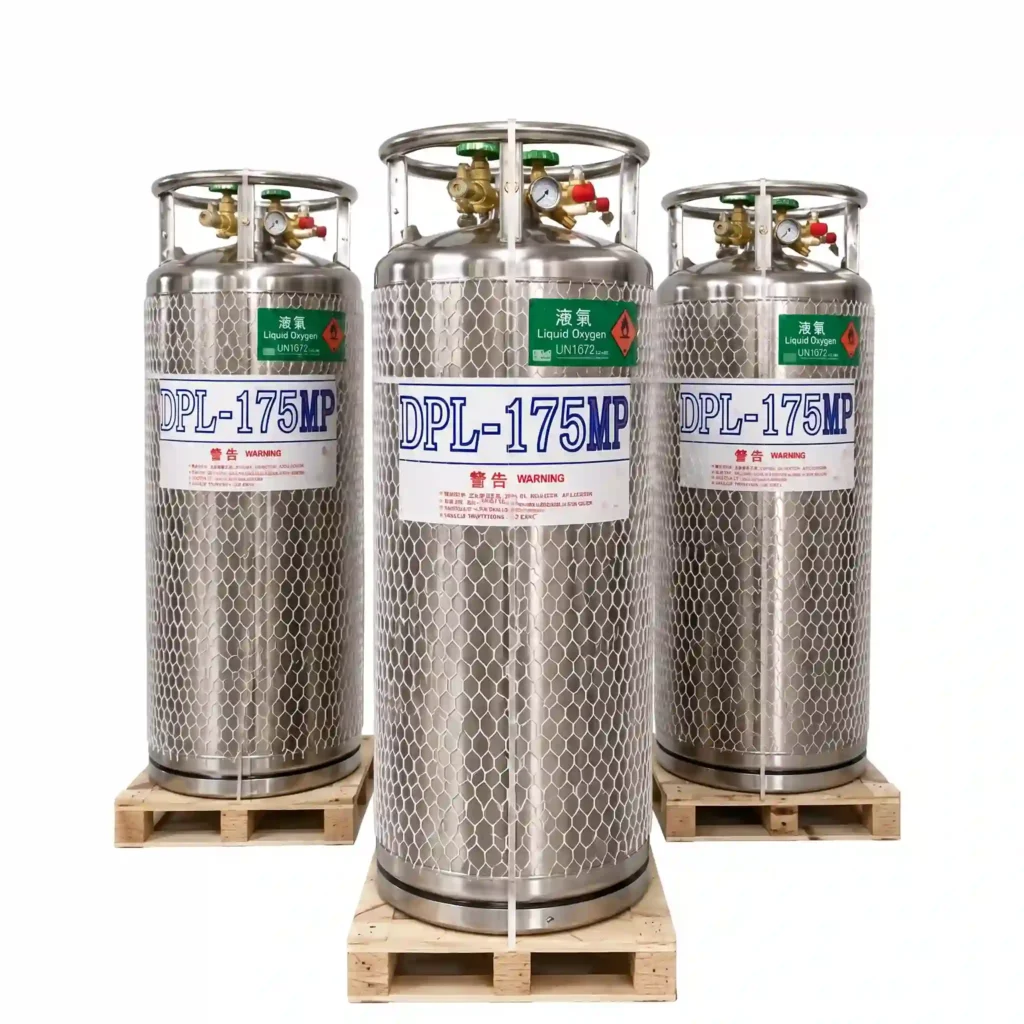
Liquid nitrogen delivered in dewars costs $0.35–$0.70 per cubic meter at the point of use, depending on delivery frequency and local supplier pricing. Compressed air generated on-site from a 16-bar screw compressor costs $0.04–$0.07 per cubic meter when the electricity, maintenance, and filter replacement are amortized over the compressor’s service life.
On a 6 kW laser cutting 2 mm stainless at typical production speed, the gas consumption runs roughly 15–25 m³ per hour. At liquid nitrogen pricing, that is $5.25–$17.50 per hour. At compressed air pricing, the same cut costs $0.60–$1.75 per hour.
2. Annual cash flow impact across production shifts
The savings are only meaningful if the machine is actually cutting the materials that can use air. For a shop running 1–3 mm carbon steel, stainless, and galvanized sheet as the dominant workload—the profile of most enclosure, HVAC, and appliance-panel fabricators—compressed air covers 80% of production hours.
Under those conditions, single-shift operation saves $25,000–$40,000 per year, and dual-shift operation saves $40,000–$60,000 per year. On a thicker-plate workload dominated by 6 mm+ carbon steel (which requires oxygen assist), the compressor sits idle and the savings do not materialize. Reviewing historical shop data via our air compressor for laser cutting benchmark shows that once thin-gauge volume crosses 1,500 hours annually, mechanical generation consistently beats cryogenic supply contracts.
3. Edge metallurgy and downstream process compatibility
Compressed air contains roughly 21% oxygen. On carbon steel, that oxygen participates in the cutting reaction as an exothermic assist, which accelerates the cut but leaves a light oxide layer on the edge. For enclosure panels that will be powder-coated or welded, this oxidation is typically acceptable—the coating system covers it and the weld process burns through it.
For aerospace, medical, or food-grade fabrication requiring oxide-free edges, nitrogen remains mandatory. The air compressor is the correct choice for general sheet metal, not for every application.
Table 1: Assist Gas Cost Comparison: Compressed Air vs. Liquid Nitrogen vs. Dewars
| Cost Category | Compressed Air (16 Bar) | Liquid Nitrogen (Dewar) | Bulk Liquid Nitrogen (Tank) |
|---|---|---|---|
| Gas cost per m³ | $0.04–$0.07 | $0.35–$0.70 | $0.15–$0.30 |
| Hourly consumption (2 mm SS) | 15–25 m³ | 15–25 m³ | 15–25 m³ |
| Hourly gas cost | $0.60–$1.75 | $5.25–$17.50 | $2.25–$7.50 |
| Annual savings vs. dewars (dual shift) | Baseline | $40,000–$60,000 | $20,000–$35,000 |
| Equipment capex | $18,000–$35,000 | $0 (rental) | $25,000 (tank) |
| Payback period | — | — | 6–10 months |
Assumes 2,000 cutting hours per year, 2 mm stainless at 18 m³/hour, and $0.12/kWh electricity.
Ⅱ. Pressure and Flow Sizing: Why Standard 8-Bar CNC Compressors Fail on Laser Tables
1. Dynamic pressure at the nozzle vs. static receiver pressure
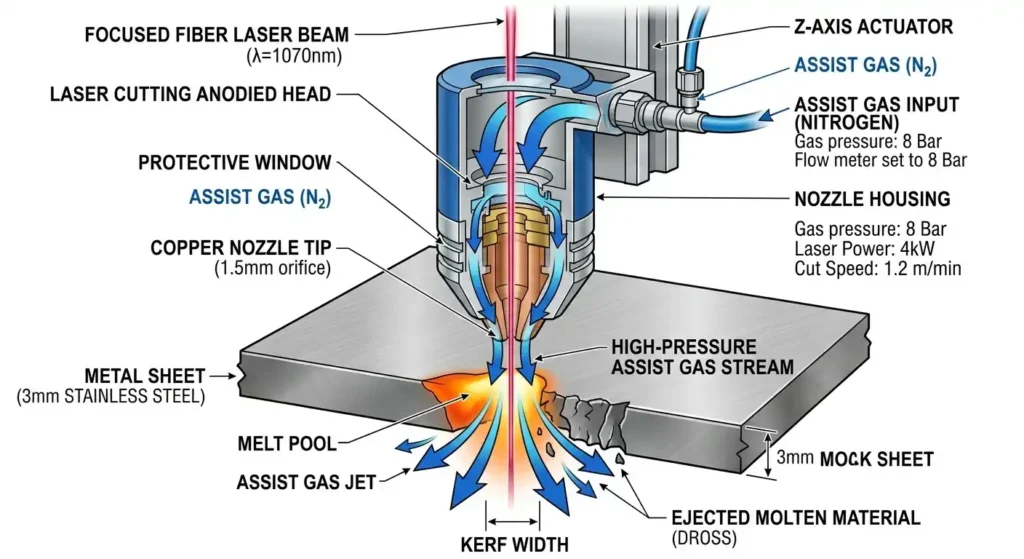
A standard CNC machining center operates on 6–8 bar shop air, which is sufficient for pneumatic clamping, tool-change cylinders, and blow-off nozzles. A fiber laser cutting head requires 14–18 bar at the nozzle inlet to generate the supersonic jet that ejects molten metal from the kerf.
An 8-bar compressor feeding a laser cutting head will produce incomplete ejection. The molten metal is not fully expelled from the bottom of the cut, so it adheres as dross. The operator increases feed rate or power to compensate, which increases heat input and worsens the dross. The root cause is the pressure, not the parameter.
2. Volumetric flow demands across laser power tiers
Flow demand scales with nozzle diameter and pressure, not with laser power directly. A 1.5 mm nozzle at 16 bar draws approximately 1.8–2.2 m³/min. A 3.0 mm nozzle at 18 bar draws 3.5–4.5 m³/min.
The critical selection detail: a compressor rated at 3.0 m³/min free air delivery (FAD) at 8 bar does not deliver 3.0 m³/min at 16 bar. Volumetric efficiency drops as discharge pressure rises, typically by 20–30% between 8 bar and 16 bar. A compressor sized on 8-bar FAD will be undersized at 16-bar operation.
The practical rule is to size the compressor’s rated FAD at 16 bar at least 20% above the peak nozzle demand, to absorb receiver pressure drop during pulsed piercing.
3. Piping geometry, pressure drops, and receiver buffer sizing
High-pressure air loses pressure through every fitting, elbow, and length of undersized pipe. For a 16-bar laser feed line, smooth aluminum or stainless tubing is required—rubber hose and small-bore fittings introduce 1–3 bar of pressure drop that the compressor must compensate for.
A 600–1000 L high-pressure receiver tank buffers the system against the pressure spike during pulsed piercing, so the compressor does not cycle on every pierce. Undersized receivers cause the compressor to short-cycle, which accelerates wear and reduces motor life.
Table 2: Pressure & Flow Sizing by Laser Power (3kW, 6kW, 12kW, 20kW)
| Laser Power | Typical Nozzle | Working Pressure | Peak Flow Demand | Compressor FAD at 16 Bar (min.) | Motor Power |
|---|---|---|---|---|---|
| 3 kW | 1.5–2.0 mm | 14–16 Bar | 1.5–2.0 m³/min | 2.5 m³/min | 15–22 kW |
| 6 kW | 2.0–2.5 mm | 16–18 Bar | 2.5–3.5 m³/min | 4.0 m³/min | 22–37 kW |
| 12 kW | 2.5–3.0 mm | 18–20 Bar | 3.5–5.0 m³/min | 6.0 m³/min | 37–55 kW |
| 20 kW | 3.0–3.5 mm | 20–22 Bar | 5.0–6.5 m³/min | 8.0 m³/min | 55–75 kW |
FAD at 16 bar accounts for volumetric efficiency loss relative to 8-bar rated output. Confirm final selection against specific nozzle and material combination.
Ⅲ. Air Quality Engineering: Achieving ISO 8573-1 Class 1.2.2 Purity
1. The equipment warranty threshold
Fiber laser manufacturers specify a minimum air quality for the assist gas supply, typically ISO 8573-1 Class 1.2.2. Below that threshold, the warranty on the cutting head optics may be voided, and the consumable life of protective windows and nozzles drops sharply.
Class 1.2.2 specifies particle content ≤ 0.1 μm, pressure dew point ≤ -40°C, and residual oil ≤ 0.1 mg/m³. The filter chain and dryer must be sized to meet all three simultaneously.
2. Four-stage coalescing filtration and active carbon adsorption
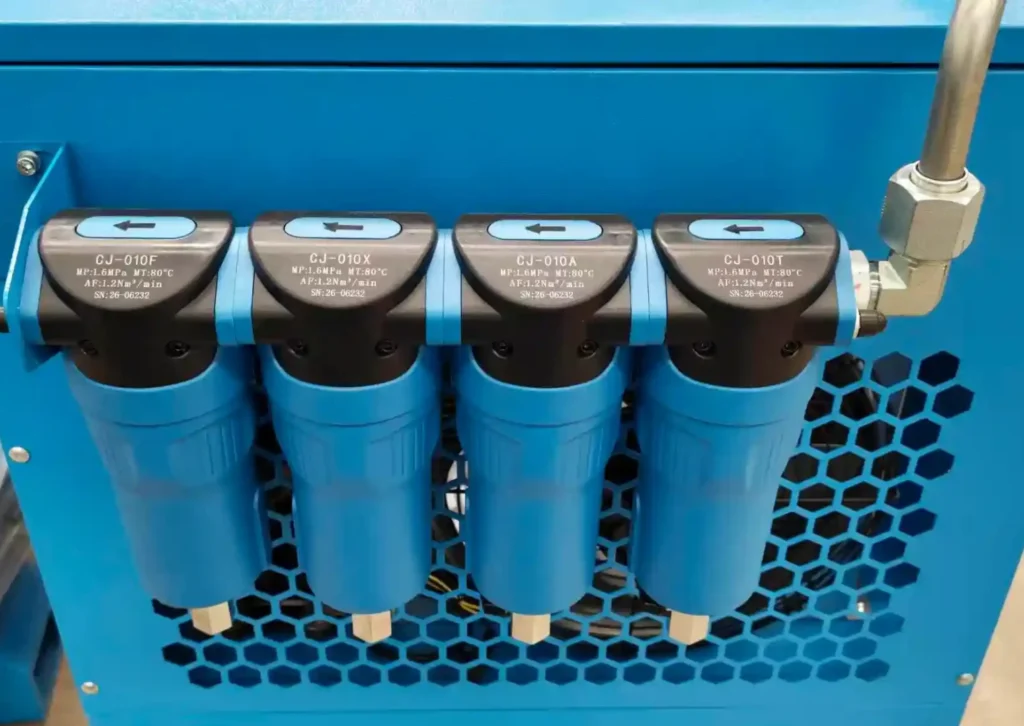
A single coalescing filter is not sufficient. The filtration chain for laser assist air uses four stages in series: a bulk separator (3 μm), a precision coalescer (0.1 μm), a high-efficiency coalescer (0.01 μm), and an activated carbon adsorber to remove oil vapor down to ≤ 0.003 mg/m³.
Each stage protects the next. Skipping the carbon adsorber allows oil vapor to pass through the coalescers and deposit on the optics downstream.
3. Refrigerated vs. desiccant air drying and dew point thresholds
A refrigerated dryer delivers pressure dew point of +3°C, which is adequate for most shops in temperate climates. For shops in cold climates or operating in winter conditions where the downstream piping runs through unheated spaces, a desiccant dryer is required to push the dew point to -40°C and prevent condensation in the line.
Table 3: ISO 8573-1 Air Purity Filtration Chain for Fiber Lasers
| Stage | Filter Type | Particle Removal | Residual Oil | Function |
|---|---|---|---|---|
| 1 | Bulk separator | 3 μm | Bulk liquid | Captures large particles and condensate |
| 2 | Precision coalescer | 0.1 μm | 0.5 mg/m³ | Removes fine aerosols |
| 3 | High-efficiency coalescer | 0.01 μm | 0.01 mg/m³ | Removes sub-micron oil mist |
| 4 | Activated carbon adsorber | — | ≤ 0.003 mg/m³ | Removes oil vapor and odor |
| Dryer | Refrigerated or desiccant | — | — | Pressure dew point +3°C or -40°C |
Ⅳ. Equipment Selection: Rotary Screw vs. Piston & Integrated Skid Packages
1. Piston compressors: Thermal duty cycle and oil blow-by limitations
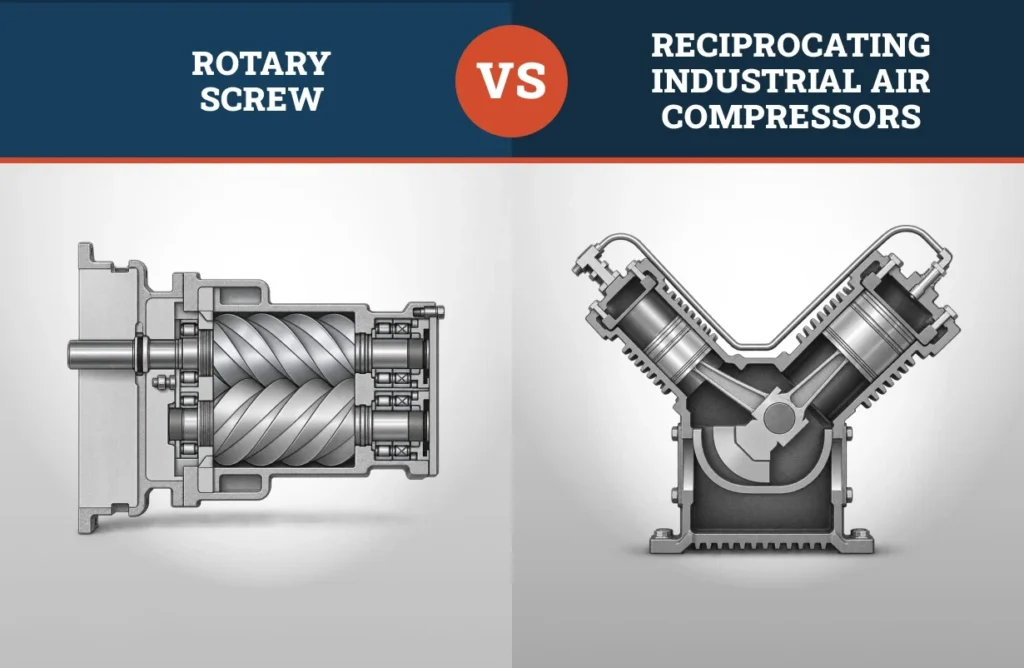
An industrial piston compressor is typically rated for 50% duty cycle—it must cool for as long as it runs. A laser cutting operation draws air continuously through an eight-hour shift, which exceeds the piston compressor’s design envelope and shortens motor and valve life.
Piston compressors also carry higher oil carryover than rotary screw designs, which accelerates filter loading and increases the risk of oil reaching the optics if a filter fails.
2. Rotary screw compression: 100% duty cycle and VFD energy efficiency
A rotary screw compressor runs continuously without a cooling cycle. The two intermeshing rotors compress air in a continuous flow, with oil injection providing both sealing and cooling. That architecture supports 100% duty cycle as the standard operating mode.
A variable frequency drive (VFD) matches compressor output to actual air demand. During loading and unloading cycles in a laser cell, the demand fluctuates, and the VFD saves 25–35% of compressor electricity compared to a fixed-speed unit running at full load and cycling on/off.
3. Turnkey all-in-one skid packages vs. modular field installations
An integrated skid package combines the screw compressor, refrigerated dryer, receiver tank, and four-stage filter chain on a single base frame occupying 1.8–2.2 m². For a shop without a dedicated utility room, the skid can be placed against a wall near the laser cell and connected with a single air line and power drop.
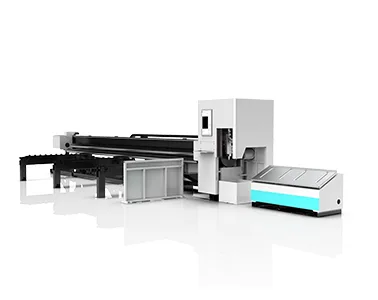
Auditing infrastructure specifications per laser cutter power requirements and installation guidelines ensures adequate transformer head-room before dropping in high-pressure pneumatic skids. Pairing this stable utility train with a heavy-duty wsl fiber laser cutting machine for precision sheet metal processing closes the loop between low-cost assist gas generation and high-yield factory blanking.
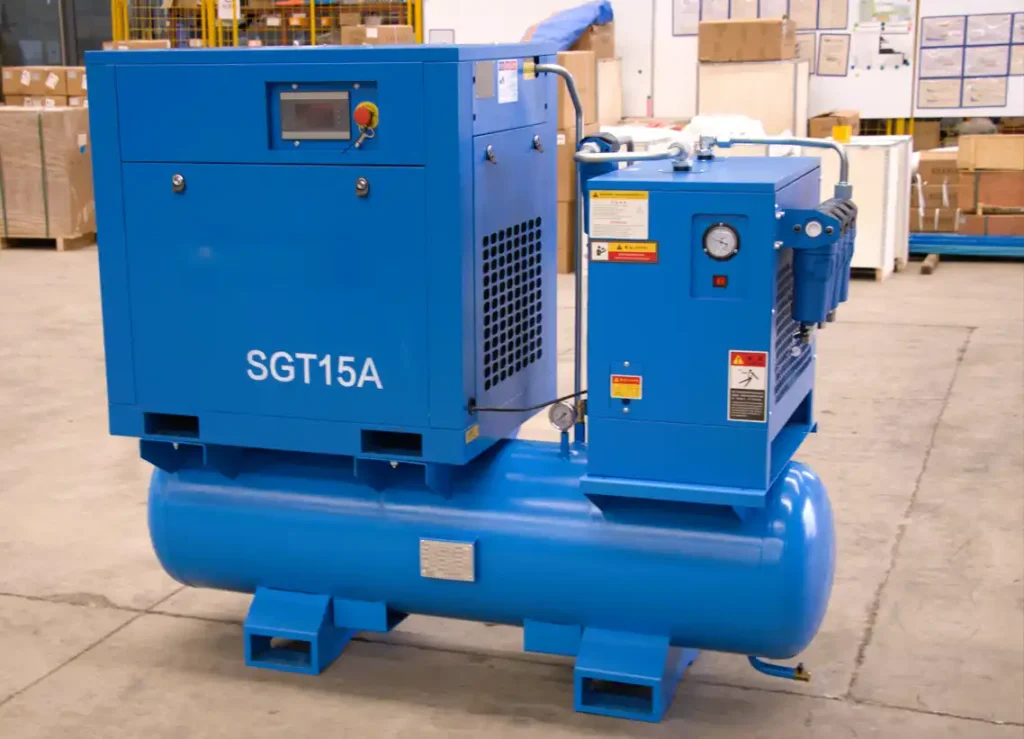
Table 4: Piston vs. Rotary Screw vs. Integrated Air Skid: Workshop Selection Matrix
| Parameter | Piston Compressor | Rotary Screw | Integrated Air Skid |
|---|---|---|---|
| Duty cycle | 50% max | 100% continuous | 100% continuous |
| Noise level | 85–95 dB(A) | 65–75 dB(A) | 65–75 dB(A) |
| Footprint (with dryer and filters) | 2–4 m² (modular) | 3–5 m² (modular) | 1.8–2.2 m² (integrated) |
| Oil carryover | High (5–10 mg/m³) | Low (1–3 mg/m³) | Low (1–3 mg/m³, with filtration) |
| Installation complexity | Medium | Medium | Low (single skid connection) |
| Typical capex (22 kW class) | $6,000–$10,000 | $18,000–$28,000 | $25,000–$35,000 |
| Suitability for laser cutting | Not recommended | Suitable | Preferred |
Ⅴ. Frequently Asked Questions
What pressure (bar/psi) is needed for air-assist fiber laser cutting?
Thin gauge (1–3 mm) requires 14–16 bar at the nozzle. Medium gauge (4–8 mm) requires 16–18 bar. Thick plate (10 mm+) requires 18–22 bar. The pressure must be measured at the nozzle inlet, not at the compressor outlet, because piping losses typically reduce supply pressure by 1–3 bar.
Can I use a standard shop compressor for laser cutting?
No. A standard 8-bar shop compressor does not deliver sufficient dynamic pressure at the nozzle, which causes incomplete ejection of molten metal and bottom dross. It also delivers insufficient volumetric flow at 16 bar due to reduced volumetric efficiency, and its filtration typically does not meet ISO 8573-1 Class 1.2.2.
Does air cutting cause edge oxidation on carbon steel?
Yes. Compressed air contains roughly 21% oxygen, which reacts with the molten steel during cutting and leaves a light oxide layer on the cut edge. For enclosure panels, HVAC components, and general fabrication, this oxidation is acceptable for powder coating and welding. For aerospace or food-grade work, nitrogen remains required.
References
- ISO 8573-1:2010 — Compressed air — Contaminants and purity classes, International Organization for Standardization
- ISO 9013:2017 — Thermal cutting — Classification of thermal cuts, International Organization for Standardization
Further Reading
- Laser Cutting Gas Cost: Compressed Air vs. Liquid Nitrogen — The full gas cost ledger behind the nitrogen-to-air switch.
- Laser Cutter Cost Per Hour: The Full Shop Floor Operating Ledger — Every operating cost line, from power to consumables, in one model.
- CNC Fiber Laser Cutting Table Selection Guide — Table dimensions, shuttle options, and power installation requirements.
- Laser Cutting Consumables: Annual Replacement Budget & Nozzle Care — Nozzle, window, and ceramic ring replacement costs across a production year.