
In precision sheet metal and heavy plate fabrication, the transition from oxygen-assisted cutting to high-pressure nitrogen cutting is essential for producing oxide-free, dross-free edges on stainless steel, aluminum, and structural carbon steel. However, shop floor directors and plant managers frequently encounter a severe operational bottleneck: the continuous, reliable supply of high-pressure assist nitrogen.
While bulk liquid nitrogen (LN2) tanks and portable dewars have long been considered the conventional default, external cryogenic supply introduces critical hidden liabilities that rarely appear on initial gas vendor quotes. When evaluating an on-site nitrogen generator against contracted liquid deliveries, manufacturing executives must analyze beyond the nominal price per cubic meter. The true operational cost is governed by winter vaporizer freezing, recurring cylinder-swap machine downtime, parasitic boil-off losses, and unpredictable delivery logistics.
This operational analysis details the real-world manufacturing vulnerabilities of bulk liquid supply, the engineering mechanics of Pressure Swing Adsorption (PSA), and the financial return realized by deploying an industrial on-site nitrogen generator directly within the laser cutting shop.
Ⅰ. Operational Vulnerabilities of Liquid Nitrogen: Why an On-Site Nitrogen Generator Prevents Shutdowns
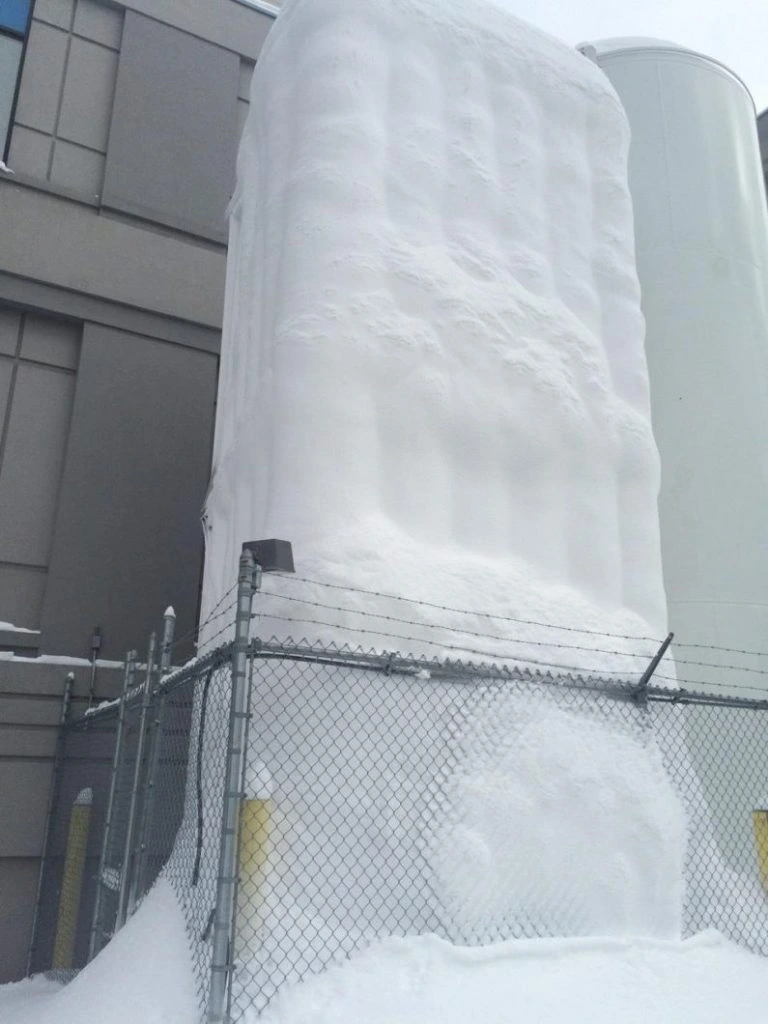
1. The winter ambient vaporizer freezing crisis
Bulk liquid nitrogen is stored in cryogenic tanks at -196°C (-320°F). To transition liquid nitrogen into a usable gas for fiber laser cutting nozzles, the fluid passes through an external ambient air vaporizer. This thermodynamic phase transition requires enormous quantities of ambient thermal energy.
During heavy multi-kilowatt cutting cycles—where high-power fiber lasers consume between 40 m³/h and 85 m³/h of assist gas per machine—the ambient heat transfer rate is easily overwhelmed. In cold winter conditions, humidity rapidly freezes onto the aluminum fin surfaces of the vaporizer.
As an insulating layer of ice thickens across the fins:
- Thermal conduction plummets, causing the gas discharge temperature to drop drastically.
- Output pressure suddenly collapses below the required 1.6 MPa to 2.0 MPa (16–20 bar) cutting threshold.
- The laser head loses the kinetic gas force required to evacuate molten metal from the kerf, resulting in severe dross formation, thermal blowouts, lens contamination, and scrapped workpieces.
Production must be halted entirely while maintenance personnel manually clear ice or pour hot water over the vaporizer coils. Conversely, an on-site nitrogen generator operates under controlled indoor ambient conditions, extracting nitrogen directly from dry compressed air and eliminating thermal vaporization freezing entirely.
2. Manual dewar swaps and labor-induced machine downtime
Fabricators utilizing portable cryogenic dewars (typically holding 160 to 240 liters) or high-pressure cylinder bundles face continuous micro-downtime. A single 12kW fiber laser cutting 6mm stainless steel will empty a standard dewar in approximately two to three hours of arc-on time.
Swapping an empty container requires:
- Depressurizing the gas supply manifold.
- Manually disconnecting cryogenic fittings with heavy wrenches.
- Utilizing a forklift or overhead crane to rig, transport, and seat a fresh 250kg cylinder.
- Purging the supply lines to prevent atmospheric contamination.
This manual exchange cycle consumes 15 to 30 minutes per swap. Across a two-shift manufacturing schedule, this accumulates between 25 and 45 hours of lost laser cutting production every month. Furthermore, moving high-pressure vessels containing -196°C liquid introduces severe cryogenic burn liabilities and crush injuries. An on-site nitrogen generator provides a continuous, automated utility line piped directly to the cutting head, eliminating manual handling.
3. Parasitic boil-off and weekend evaporation losses
Cryogenic storage vessels rely on vacuum insulation, yet heat ingress is inevitable. To prevent dangerous over-pressurization, liquid tanks are engineered with relief valves that continuously vent gas into the atmosphere once head pressure exceeds set limits.
Standard bulk tanks lose approximately 1.5% to 2.5% of their total volume every 24 hours to natural boil-off. When the manufacturing facility shuts down over weekends or holiday breaks, hundreds of dollars of purchased liquid nitrogen silently vent into the atmosphere. With an on-site nitrogen generator, gas is generated purely on-demand; zero consumable media is lost during factory idle periods.
Table 1: Operational Comparison: Bulk Liquid Nitrogen vs. On-Site Nitrogen Generator
| Operational Factor | External Liquid Nitrogen (Bulk / Dewar) | Industrial On-Site Nitrogen Generator | Manufacturing Impact |
| Winter Vaporizer Performance | High freeze-up risk; requires line shutoff | Zero risk; ambient pressure-swing cycle | Prevents winter pressure crashes and dross |
| Consumable Handling Downtime | 15–30 min per dewar/cylinder change | 0 minutes; continuous automated supply | Recovers up to 45 beam-on hours per month |
| Off-Shift Storage Losses | 1.5%–2.5% daily volume lost to boil-off | 0% storage loss (On-demand generation) | Eliminates paying for vented weekend gas |
| Supply Chain Dependency | Vulnerable to truck delays and weather | 100% self-sufficient inside the plant | Guarantees uninterrupted production |
| Occupational Safety Risks | Cryogenic frostbite and high-pressure drops | Standard plant compressed air (<10 bar feed) | Lowers insurance risks and injury rates |
Ⅱ. PSA Separation Mechanics: Engineering an On-Site Nitrogen Generator for Laser Purity
1. Carbon molecular sieve (CMS) dynamics and dual-tower cycling
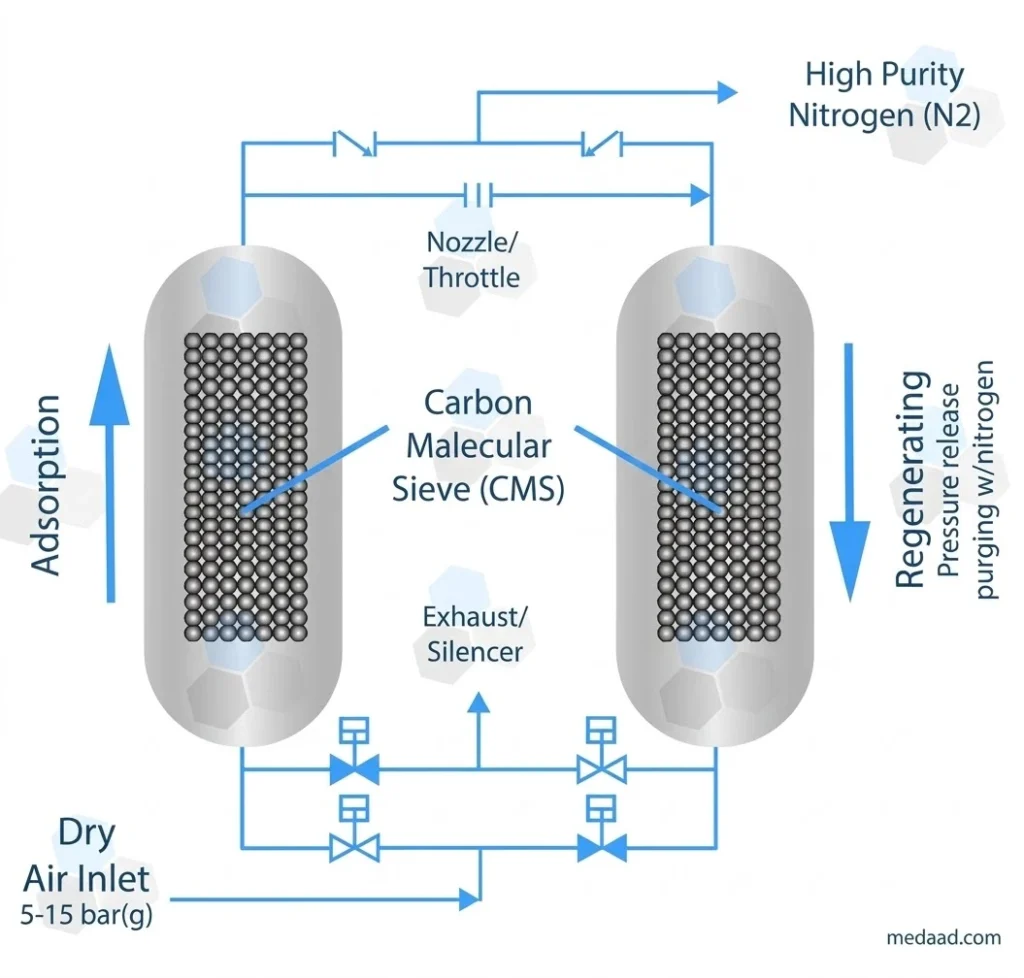
A Pressure Swing Adsorption on-site nitrogen generator relies on the selective physical adsorption properties of Carbon Molecular Sieves (CMS). Atmospheric air comprises approximately 78% nitrogen, 21% oxygen, and 1% trace argon and moisture.
Because oxygen molecules possess a smaller kinetic diameter (0.346 nm) compared to nitrogen molecules (0.364 nm), oxygen diffuses into the micropores of the CMS hundreds of times faster than nitrogen under elevated pressure:
- Pressurization and adsorption: Clean, compressed air enters Adsorption Tower A at 8 to 10 bar. Oxygen molecules are selectively trapped within the porous carbon matrix, allowing purified, non-adsorbed nitrogen gas to exit through the top outlet.
- Depressurization and regeneration: Simultaneously, Tower B is depressurized to atmospheric levels. As pressure drops, the captured oxygen molecules desorb from the CMS pores and are exhausted out through a silencer.
- Equalization and switch: Before saturation occurs, valve manifolds equalize pressure between the two columns, and Tower B begins adsorption while Tower A regenerates. This twin-column alternation guarantees an uninterrupted, steady stream of nitrogen.
2. Laser purity thresholds: 99.99% (4N) vs. 99.999% (5N)
The edge quality of laser-cut parts depends directly on nitrogen purity:
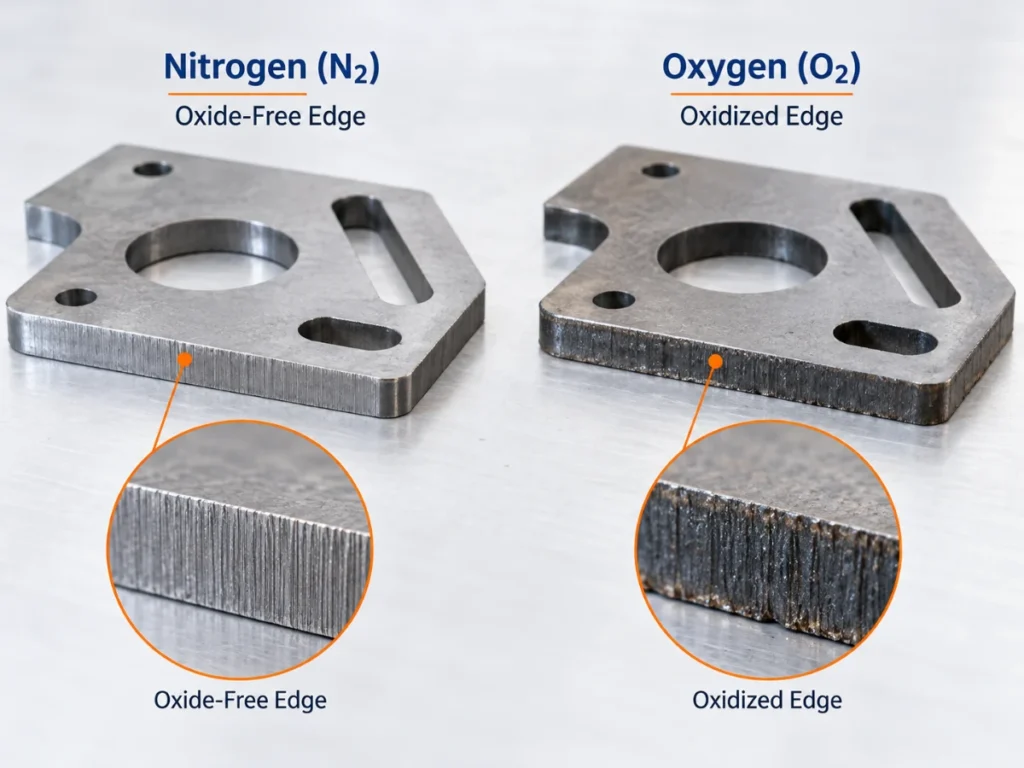
- 99.99% (4N Purity – ≤100 ppm O₂): Standard for carbon steel high-pressure cutting and medium-gauge stainless steel (up to 6mm). It yields clean cut faces suitable for industrial primers and structural assembly.
- 99.999% (5N Purity – ≤10 ppm O₂): Mandatory for food-grade, pharmaceutical, or architectural stainless steel, as well as aerospace components. Any trace oxygen contamination causes edge discoloration (yellowing, browning, or micro-oxidation), which compromises downstream TIG welding integrity.
A premium on-site nitrogen generator integrates zirconium-oxide or electrochemical oxygen analyzers. If gas purity drifts below the programmed threshold, the system automatically vents off-spec gas and signals the control loop, ensuring contaminated gas never reaches the laser cutting nozzle.
3. Air preparation train: Dew point and particulate control
The operating lifespan of the carbon molecular sieve exceeds 10 to 15 years, provided the incoming compressed air is pristine. Liquid water and aerosolized compressor oil will irreversibly coat the CMS pores, permanently degrading separation efficiency.
A robust on-site nitrogen generator installation mandates a multi-stage pre-treatment skid:
- Refrigerated / desiccant air drying: Maintains a pressure dew point of -40°C or lower, guaranteeing complete moisture removal.
- Coalescing and particulate filtration: A three-stage filtration sequence down to 0.01 microns removes liquid aerosols and solid particulates.
- Activated carbon adsorption bed: Strips residual hydrocarbon vapors to below 0.003 mg/m³, meeting ISO 8573-1 Class 1 oil purity standards.
Ⅲ. The True Cost per Cubic Meter: Evaluating an On-Site Nitrogen Generator Against Purchased Gas
1. The loaded cost structure of liquid nitrogen
Procurement departments often evaluate liquid nitrogen solely by the quoted liquid volume on the bulk supply contract. However, calculating the actual cost per normal cubic meter ($/Nm³) requires accounting for:
- Baseline gas purchase pricing ($0.35 to $0.65 per Nm³).
- Monthly cryogenic bulk tank rental and telemetry fees ($300 to $800/month).
- Hazardous material delivery surcharges and fuel index additions ($150 to $300 per drop).
- Parasitic boil-off loss (adding 10% to 15% to effective consumption).
When aggregated, heavy laser users routinely pay an effective rate between $0.40 and $0.70 per cubic meter of delivered gas.
2. The operational energy ledger of on-site production
An on-site nitrogen generator consumes zero chemical reagents; its operating cost is derived strictly from the electrical power needed to drive the rotary screw air compressor and the high-pressure gas booster.
Modern PSA generation trains require approximately 0.30 to 0.38 kWh of electrical power per cubic meter of 99.99% nitrogen produced (including compressor feed, PSA controls, and 30-bar booster compression).
Assuming a standard North American industrial power rate of $0.10 per kWh:
$$\text{Electrical Cost} = 0.34\ \text{kWh/m}^3 \times \$0.10/\text{kWh} = \$0.034/\text{m}^3$$
Factoring in scheduled preventive maintenance (annual coalescing filter replacements, desiccant changes, and routine compressor servicing at ~$0.015/m³), the fully loaded cost of an on-site nitrogen generator settles between $0.05 and $0.065 per cubic meter.
This provides an immediate 75% to 85% cost reduction compared to external liquid procurement.
Table 2: Assist Gas Cost Breakdown ($/m³ at 99.99% Purity)
| Cost Driver | Liquid Nitrogen Supply (Bulk Tank) | Dedicated On-Site Nitrogen Generator | Cost Delta / Savings |
| Base Media / Gas Charge | $0.380 / m³ | $0.000 / m³ (Atmospheric air) | Replaces purchased gas entirely |
| Electricity (Compressor + Booster) | $0.000 / m³ | $0.034 / m³ (0.34 kWh @ $0.10/kWh) | Primary operational expense |
| Consumable & Filter Maintenance | $0.000 / m³ | $0.015 / m³ (Annual element sets) | Routine PM allocation |
| Vessel Rental & Hazmat Delivery | $0.085 / m³ (Amortized monthly fees) | $0.000 / m³ | Zero recurring vendor surcharges |
| Parasitic Loss Adjustment | $0.045 / m³ (10% avg. boil-off) | $0.000 / m³ | Zero off-shift venting losses |
| Total Effective Cost per m³ | $0.510 / m³ | $0.049 / m³ | >88% direct operating savings |
Ⅳ. Financial Payback Ledger: Calculating On-Site Nitrogen Generator ROI
1. Capital expenditure (CapEx) baseline
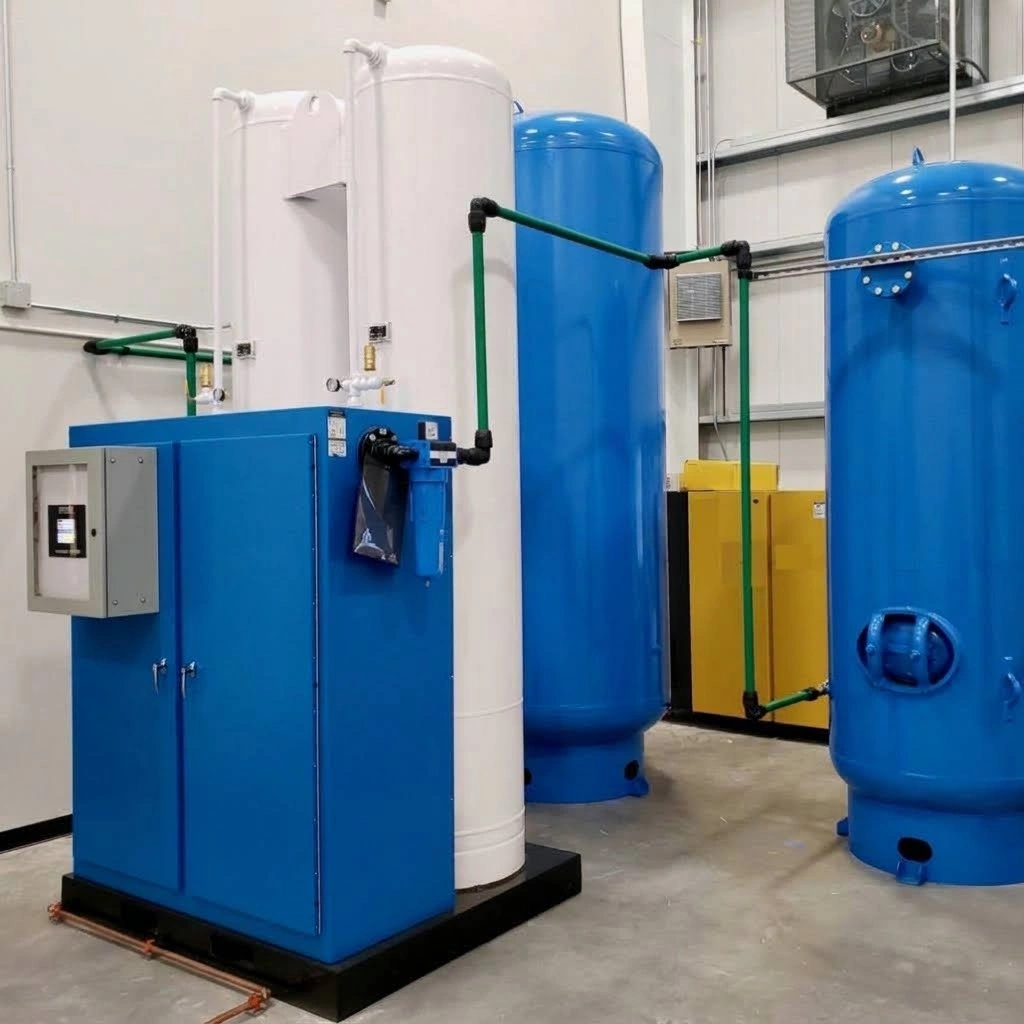
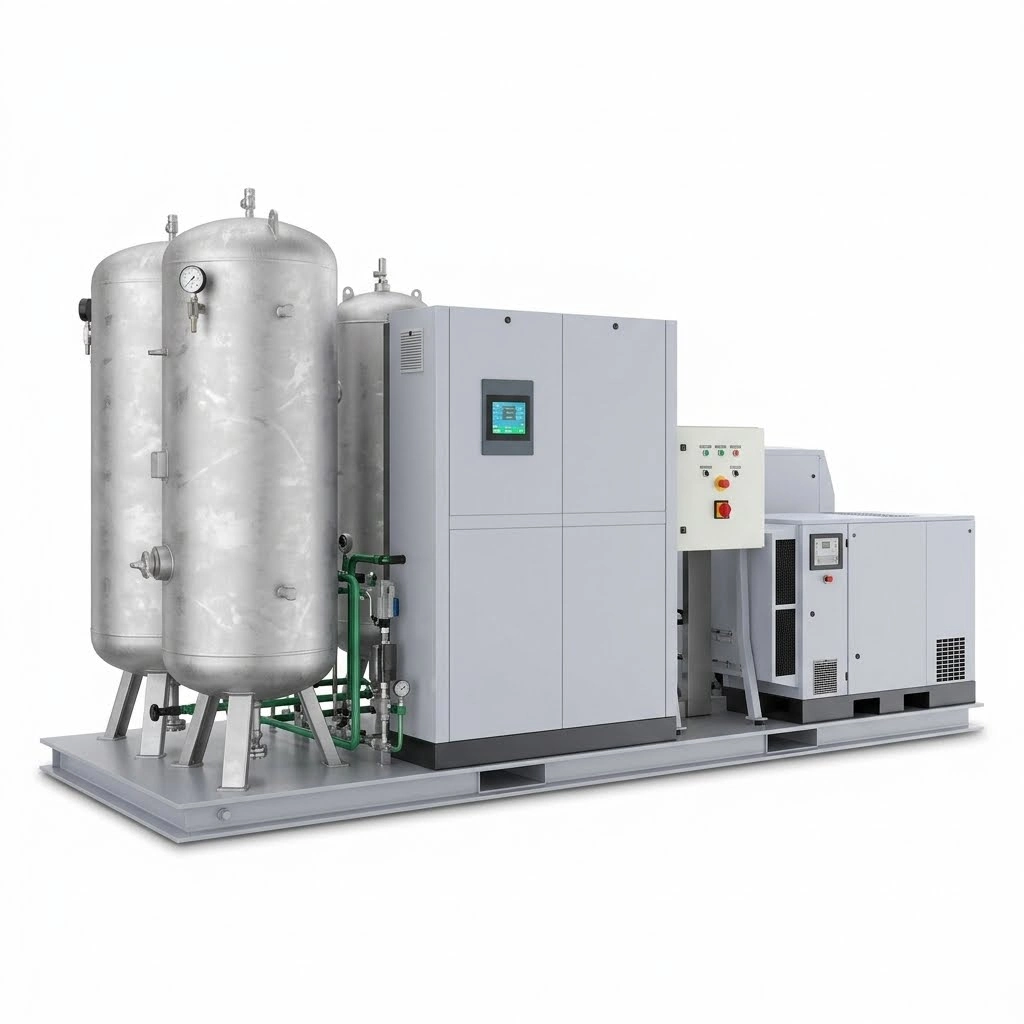
A turn-key industrial on-site nitrogen generator package consists of:
- High-efficiency rotary screw air compressor (15kW–37kW).
- Integrated air treatment package (cyclone separator, refrigerated dryer, multi-stage micro-filters, activated carbon tower).
- Twin-tower PSA generator unit with built-in zirconia oxygen sensor.
- Intermediate nitrogen buffer vessel.
- High-pressure piston booster (stepping pressure up to 25–35 bar for high-speed cutting).
- High-pressure storage cylinder pack (ensuring peak instantaneous flow capacity).
A complete skid delivering 40 to 60 Nm³/h ranges between $38,000 and $65,000, depending on automation, purity level, and compressor variable-frequency drive (VFD) options.
2. Comprehensive 3-year TCO payback model
The model below calculates cash flows for a mid-sized metal service center running two fiber lasers (one 6kW and one 12kW), operating two shifts (3,200 annual operating hours), with an average blended nitrogen consumption of 45 Nm³/h.
Table 3: 3-Year Total Cost of Ownership (TCO) Ledger: Liquid Supply vs. On-Site Nitrogen Generator
| Financial Parameter | Contracted Liquid Nitrogen | On-Site Nitrogen Generator System | 3-Year Cumulative Variance |
| Initial Capital Investment | $0 (Vendor-owned tank) | $52,000 (Turn-key turn-in skid) | -$52,000 (Capital equipment out) |
| Gas Procurement / Electricity | $220,320 (144,000 m³/yr @ $0.51) | $21,168 (144,000 m³/yr @ $0.049) | +$199,152 (Power vs. Gas delta) |
| Tank Leasing & Surcharges | $14,400 ($400/month over 36 mos) | $0 | +$14,400 (Fees eliminated) |
| Scheduled Maintenance & PM | $0 | $6,480 (Filters, oil, inspection) | -$6,480 (Maintenance expense) |
| Downtime & Scrap Recovery | Baseline | Recovered ($12,000 estimated gain) | +$12,000 (Labor & yield gain) |
| Total 3-Year Operational Cost | $234,720 | $79,648 | +$155,072 Net Cash Retained |
Under these baseline parameters, the total initial capital expenditure of $52,000 achieves a simple payback in 9.4 months.
Furthermore, under U.S. IRS Section 179 tax provisions, qualifying manufacturing machinery can be 100% expensed in the tax year of purchase, significantly reducing corporate tax liabilities and shortening the cash break-even horizon to under seven months.
Ⅴ. Frequently Asked Questions
Why does an on-site nitrogen generator eliminate winter vaporizer freeze-ups?
Liquid nitrogen must absorb ambient thermal heat to convert from -196°C fluid into cutting gas. In cold or humid conditions, this thermal transfer causes severe ice accumulation across the external vaporizer fins, dropping pressure below cutting limits. An on-site nitrogen generator separates gaseous nitrogen directly from ambient compressed air via molecular sieves, operating consistently indoors regardless of sub-zero outdoor weather.
Can an on-site nitrogen generator maintain the 99.999% purity required for stainless steel?
Yes. High-performance PSA systems feature precision cycle control and continuous optical/zirconia oxygen analyzers. By fine-tuning the cycle timing and air-to-nitrogen ratios, the system reliably outputs 99.999% (5N) purity with oxygen levels below 10 ppm. This eliminates yellowing, micro-cracking, and oxidation along stainless steel cut edges, delivering a clean weld-ready finish.
How much maintenance does a PSA on-site nitrogen generator require?
Routine maintenance is straightforward and centers on the compressed air preparation skid. Every 2,000 to 4,000 operating hours, maintenance personnel replace the coalescing pre-filter cartridges and change compressor oil. The core carbon molecular sieve (CMS) inside the separation towers is non-depleting and typically lasts 10 to 15 years, provided the incoming air stream is kept free of oil and liquid water.
References
- ISO 8573-1:2010 — Compressed air — Contaminants and purity classes, International Organization for Standardization
- ISO 9013:2017 — Thermal cutting — Classification of thermal cuts, International Organization for Standardization
- IRS Section 179 — Deduction Limit and Phase-out, Internal Revenue Service
Further Reading
- Nitrogen Generator for Laser Cutting: Cost & Liquid N2 ROI — Foundational analysis of on-site gas generation capital requirements.
- Laser Cutting Gas Cost: Nitrogen vs Compressed Air Savings — Operational threshold when air-assist replaces high-purity nitrogen.
- Air Compressor for Laser Cutting: Cut Gas Costs by 75% — Sizing screw compressors and high-pressure boosters for laser cutting.
- Laser Cutter Cost Per Hour: The Full Operating Ledger — Comprehensive operating expenditure model for multi-kilowatt fiber lasers.